 Zer dino zara? Galdetegia
 Dino borroka
 Dino lasterketa
 Dino minijokoak
 Pegatina-albuma
 Dino TOP zerrendak
 Harritu nazazu!
Arthropleura
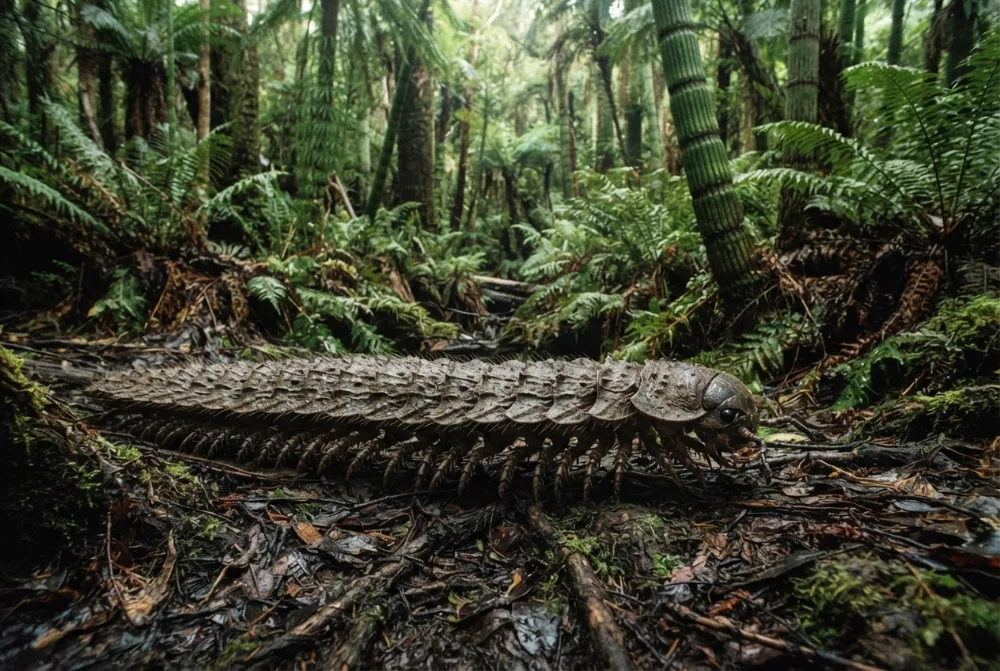
Arthropleura was a giant millipede that lived long before the dinosaurs. It could grow as long as a car, making it the biggest land bug ever! It crawled through ancient forests near water.1
Noiz bizi izan zen?
Zein handia zen?
Zein luzea zen?
Zein astuna zen?
 2,5 txakur bezain luze, sudurretik buztanera🍌bata bestearen atzean jarritako 14 banana bezain luze
 12 etxeko katu bezain astun🍉10 angurria bezain astun🧸haur-eskolako 2,5 haur bezain astun🎒1,5 eskolaume bezain astun🏃100 metro 90 segundotan egin zitzakeen korrika (gizakirik azkarrenak 9,6 behar ditu)
Zein handia zen Arthropleura ZUREKIN alderatuta?
Zure nabigatzaileko kalkulu hutsak. Ez da ezer gordetzen ez inora bidaltzen.
Zein azkarra zen?


Datu dibertigarriak
Arthropleura is the largest known land arthropod of all time, reaching at least 2 metres (6.5 feet) long.1
It left giant trackways up to 50 centimetres (20 inches) wide, which are fossilized footprints of its many legs.1
Its head had features of both millipedes and centipedes, showing it was a mix of both groups.2
Arthropleura lived in open, sparsely wooded areas near water and may have been able to go on land and in water.1
It was a slow mover, not a fast runner like centipedes, based on its short legs and trackways.2
Some Arthropleura fossils are so well preserved that scientists can see the details of its head and mouthparts using special scanners.2
Arthropleura: gehien egindako galderak
?How big was Arthropleura?
About 2 metres (6.5 feet) long, possibly up to 2.63 metres (8.6 feet). That makes it the largest known land arthropod of all time.12
?What did Arthropleura eat?
It probably ate dead plants and other detritus, like modern millipedes. It did not have venom fangs or legs for catching prey.5
?Was Arthropleura a dinosaur?
No, it was a giant millipede, not a dinosaur. It lived long before the dinosaurs, from about 344 to 292 million years ago.1
?Could Arthropleura swim?
It may have been amphibious, meaning it could live both on land and in water. It lived in open, sparsely wooded areas near water.1
?How fast could Arthropleura move?
Probably only about 4 km/h (2 mph), a slow walking pace. This is a guess: it was a giant millipede with short legs, and its trackways show it did not hurry.5
?Did Arthropleura have a head?
Yes, and scientists recently used special scanners to see its head in detail. It had antennae, mandibles, and two pairs of maxillae.2
?When did Arthropleura go extinct?
It died out around 292 million years ago, during the early Permian period.1
?Where did Arthropleura live?
It lived in what is now Europe and North America, in open, sparsely wooded forests near water.1
?Is Arthropleura related to centipedes?
It is a millipede, but its head has features of both millipedes and centipedes, showing it was a mix of both groups.5
?How much did Arthropleura weigh?
One large fossil suggests it weighed about 50 kilograms (110 pounds), as heavy as a small human.1
Mito-hauslea
Mitoa: Arthropleura was a giant centipede that hunted other animals.
Egia: Arthropleura was actually a millipede, and it was likely a slow plant-eater, not a predator.2
Dino adituentzat
- Izen zientifikoa
- Arthropleura
- Izendatzailea:
- (Jordan 1854)6
- Taldea
- Historiaurreko kondairak
- Familia / klada
- Arthropleuridae6
- Sailkapena
- Myriapoda > Arthropleurida > Arthropleuridae6
- Arroken adina
- 347 eta 290 milioi urte artean (Visean / Sakmarian)6
- Arroka-formazioak
- Saarbrucker layers, Farrington6
- Herrialdeak
- Alemania, Frantzia, Belgika, Erresuma Batua, Espainia, AEB6
- Fosil-erregistroak
- 61 The Paleobiology Database datu-basean6
- Aurkikuntza
- Arthropleura was first named by Jordan in 1854, based on fossils found in Europe.3
- Oraindik eztabaidagai
- Scientists still debate whether Arthropleura was a true millipede or a more primitive relative, and they are not sure exactly what it ate.2
Datuak nondik datozen
- Arthropleura (en.wikipedia.org)
- Head anatomy and phylogenomics show the Carboniferous giant Arthropleura belonged to a millipede-centipede group (science.org)
- PBDB Taxon (paleobiodb.org)
- Millipedes ‘as big as cars’ once roamed England | University of Cambridge (cam.ac.uk)
- Largest ever millipede’s head revealed by 300-million-year-old fossils | Natural History Museum (nhm.ac.uk)
- Arthropleura in The Paleobiology Database (CC BY 4.0): adina, tokiak, arroka-formazioak, sailkapena.
Orrialde honetako datu bakoitzak zenbaki bat du, bere iturrira eramaten zaituena. Zerbait gaizki badugu, barkatu, dino-zaleak gara, ez zientzia-aldizkari bat. Idatzi [email protected] helbidera eta konponduko dugu.
 Rex gose da! Dino Wiki aita baten proiektua da, dinosauroak maite dituen bere semearentzat, doakoa, iragarkirik eta jarraitzailerik gabe. Helduek mokadutxo bat eman diezaiokete Rexi, sarean jarraitzen laguntzeko.Eman jaten Rexi
 Megalodon
 Sabre-toothed cat
 Dimetrodon
 Woolly mammoth
 Helicoprion
 Deinosuchus