 Zer dino zara? Galdetegia
 Dino borroka
 Dino lasterketa
 Dino minijokoak
 Pegatina-albuma
 Dino TOP zerrendak
 Harritu nazazu!
Noiz bizi izan zen?

Zein handia zen?
Zein luzea zen?
Zein altua zen?
kalkulua
Zein astuna zen?
 2 etxeko katu bezain luze, sudurretik buztanera🍌bata bestearen atzean jarritako 6 banana bezain luzeetxeko katu bat bezain astun, gutxi gorabehera🍌42 banana bezain astun🏊igerileku handi baten luzera (50 m) 16 segundotan egin zezakeen igerian
Zein handia zen Baptornis ZUREKIN alderatuta?
Zure nabigatzaileko kalkulu hutsak. Ez da ezer gordetzen ez inora bidaltzen.
Zein azkarra zen?


Datu dibertigarriak
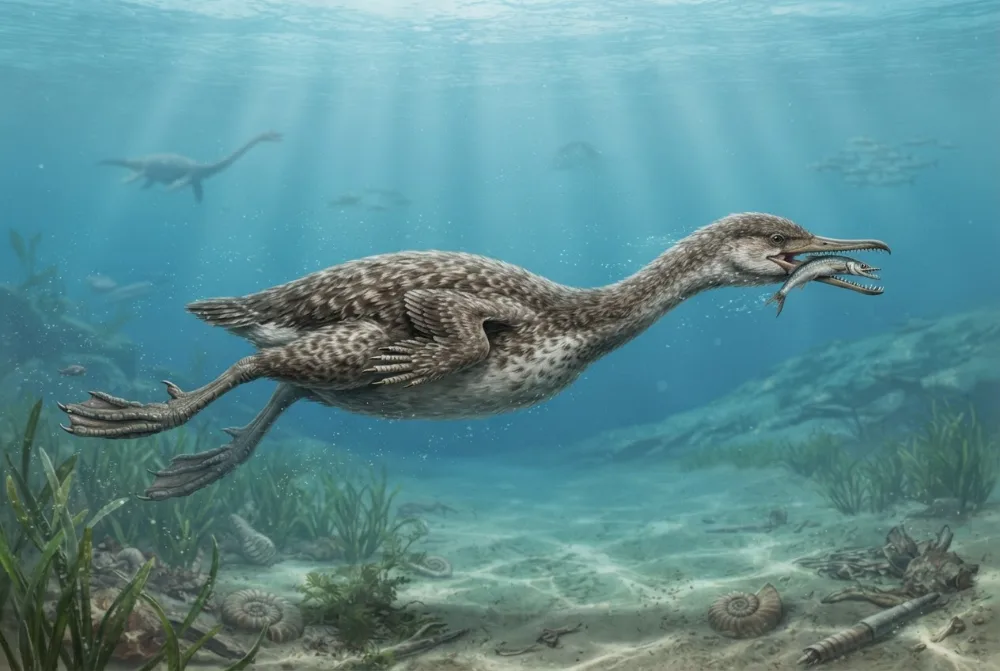
Baptornis had teeth in its beak, which is rare for birds. Most modern birds have no teeth.1
It was a strong swimmer and diver, but on land it was clumsy. It probably pushed itself along on its belly or did small hops.1
Fossils of young Baptornis have been found in Canada and Alaska, suggesting these birds migrated north to breed in summer, like some penguins do today.1
Baptornis lived about 87 to 80 million years ago, when a shallow sea covered much of central North America.1
One Baptornis fossil was found with tiny round coprolites (fossil poop) inside. The poop contained remains of a small sabre-toothed herring.1
Baptornis was one of the first Mesozoic birds discovered, along with Archaeopteryx. It was named by famous fossil hunter Othniel Charles Marsh in 1877.1
A second, much larger species of Baptornis was once named (Baptornis varneri), but later scientists moved it to a different genus called Brodavis.1
Baptornis: gehien egindako galderak
?How big was Baptornis?
About the size of a loon, which is roughly 0.7 to 1 metre long. It was a medium-sized bird among its relatives.12
?Could Baptornis fly?
No, Baptornis was flightless. It was a strong swimmer and diver instead.1
?What did Baptornis eat?
It ate fish, especially small sabre-toothed herring called Enchodus. It caught them with its beak and swallowed them whole or in pieces.1
?Did Baptornis have teeth?
Yes, Baptornis had teeth in its beak, which is unusual for birds. Most modern birds have no teeth.1
Dino adituentzat
- Izen zientifikoa
- Baptornis
- Izendatzailea:
- Marsh 18773
- Taldea
- Lehen hegaztiak
- Familia / klada
- Baptornithidae3
- Sailkapena
- Theropoda > Avialae3
- Arroken adina
- 90 eta 72 milioi urte artean (Coniacian / Campanian)3
- Arroka-formazioak
- Dinosaur Park, Niobrara, Judith River3
- Herrialdeak
- Kanada, AEB, Suedia3
- Fosil-erregistroak
- 10 The Paleobiology Database datu-basean3
- Honela ere ezaguna
- Parascaniornis (orain animalia bertzat hartzen diren izen zaharragoak)3
- Aurkikuntza
- Othniel Charles Marsh discovered the first fossils of Baptornis in Kansas in the 1870s. He named it in 1877.1
- Oraindik eztabaidagai
- Scientists are not sure if a fossil from Sweden called Parascaniornis stensioi is actually a second species of Baptornis or just the same species.1
Datuak nondik datozen
- Baptornis (en.wikipedia.org)
- The Skeleton of Baptornis advenus (Aves: Hesperornithiformes) (exa.ai)
- Baptornis in The Paleobiology Database (CC BY 4.0): adina, tokiak, arroka-formazioak, sailkapena.
Orrialde honetako datu bakoitzak zenbaki bat du, bere iturrira eramaten zaituena. Zerbait gaizki badugu, barkatu, dino-zaleak gara, ez zientzia-aldizkari bat. Idatzi [email protected] helbidera eta konponduko dugu.
 Rex gose da! Dino Wiki aita baten proiektua da, dinosauroak maite dituen bere semearentzat, doakoa, iragarkirik eta jarraitzailerik gabe. Helduek mokadutxo bat eman diezaiokete Rexi, sarean jarraitzen laguntzeko.Eman jaten Rexi
 Archaeopteryx
 Hesperornis
 Ichthyornis
 Jurapteryx
 Gobipteryx
 Martinavis
 Tyrannosaurus
 Triceratops
 Velociraptor
 Spinosaurus
 Ankylosaurus
 Parasaurolophus