 Zer dino zara? Galdetegia
 Dino borroka
 Dino lasterketa
 Dino minijokoak
 Pegatina-albuma
 Dino TOP zerrendak
 Harritu nazazu!
Edmontonia
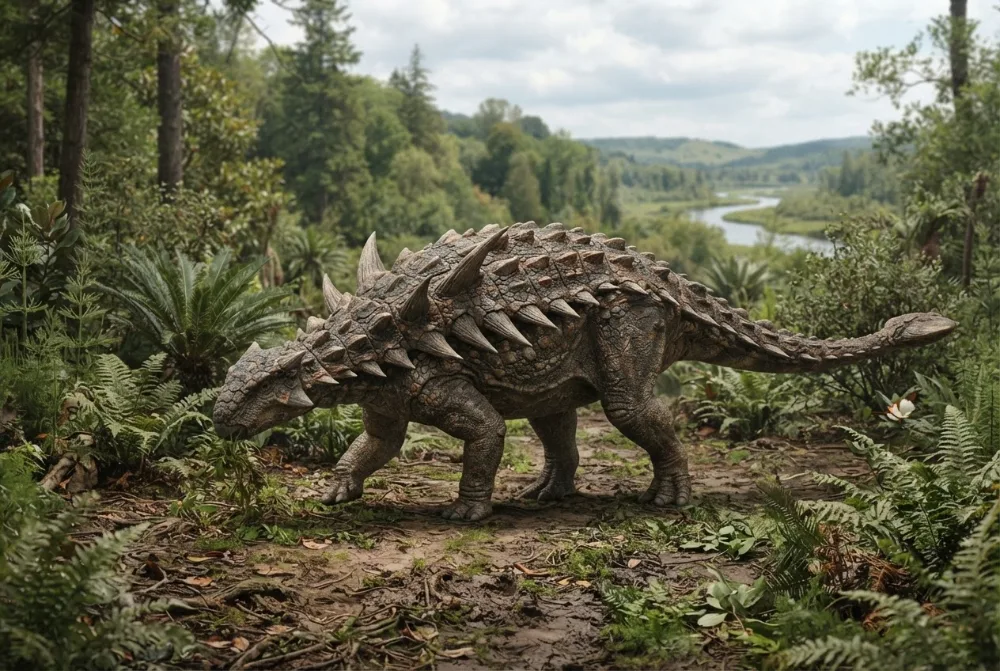
Edmontonia was a tank-like dinosaur covered in bony plates and sharp spikes. It walked on four legs and munched on low-growing plants. This nodosaurid dinosaur lived in western North America near the end of the Age of Dinosaurs.1
Noiz bizi izan zen?
Zein handia zen?
Zein luzea zen?
Zein altua zen?
Zein astuna zen?

 7 txakur bezain luze, sudurretik buztanera🍌bata bestearen atzean jarritako 37 banana bezain luze150 txakur bezain astun🍉600 angurria bezain astun🎒haurrez betetako 4 ikasgela oso bezain astun🐻❄️7 hartz zuri bezain astun🏃100 metro 28 segundotan egin zitzakeen korrika (gizakirik azkarrenak 9,6 behar ditu)
Zein handia zen Edmontonia ZUREKIN alderatuta?
Zure nabigatzaileko kalkulu hutsak. Ez da ezer gordetzen ez inora bidaltzen.
Zein azkarra zen?


Datu dibertigarriak
Edmontonia had four huge spikes sticking out from each shoulder, the largest of any nodosaurid. These spikes could have been used to fight other Edmontonia or to stab attacking predators.1
Its back and head were covered with small, oval bony plates that had a ridge down the middle. Its neck and shoulders were protected by three half-rings made of large keeled plates.1
Edmontonia lived alongside many other giant plant-eaters like the duck-billed dinosaurs Gryposaurus and Corythosaurus, and the horned dinosaurs Centrosaurus and Chasmosaurus.1
The only large predators that lived with Edmontonia were the tyrannosaurids Gorgosaurus and Daspletosaurus.1
Scientists think Edmontonia might have crouched down to protect its soft belly from predators, making it hard for a predator to flip it over.1
One species of Edmontonia, E. rugosidens, lived about 76.5 to 75 million years ago. The other species, E. longiceps, lived about 72 million years ago.1
Edmontonia: gehien egindako galderak
?How big was Edmontonia?
Edmontonia was about 6 to 6.6 metres (20 to 22 ft) long and weighed around 3 tonnes (about 6,600 lb).15
?What did Edmontonia eat?
Edmontonia was an herbivore that ate low-growing plants like ferns and cycads. Its small teeth and weak jaws suggest it processed food differently than modern mammals.156
?Did Edmontonia have armor?
Yes, Edmontonia was covered in small oval bony plates on its back and head, and had three half-rings of large keeled plates protecting its neck and shoulders. It also had four huge spikes on each shoulder.15
?How fast could Edmontonia run?
No source gives a speed for Edmontonia, but its heavy armor and short, thick legs suggest it was slow-moving, like a tank.15
?Was Edmontonia bigger than T. rex?
No, Edmontonia was much smaller. T. rex could be over 12 metres (40 ft) long, while Edmontonia was only about 6 to 6.6 metres (20 to 22 ft) long.1
?When did Edmontonia live?
Edmontonia lived during the Late Cretaceous Period, about 76.5 to 68 million years ago.16
?Where was Edmontonia found?
Edmontonia fossils have been found in western North America, especially in Alberta, Canada, and also in the Talkeetna Mountains near Denali National Park in Alaska.15
?Could Edmontonia swim?
No source says Edmontonia could swim. Its heavy armor and short legs probably kept it on land.1
Mito-hauslea
Mitoa: Edmontonia could swing its tail like a club to defend itself.
Egia: Edmontonia was a nodosaurid, not an ankylosaurid. Nodosaurids did not have a tail club. Instead, Edmontonia relied on its shoulder spikes and body armor for protection.1
Dino adituentzat
- Izen zientifikoa
- Edmontonia
- Izendatzailea:
- Sternberg 19287
- Taldea
- Dino kuirasdunak
- Familia / klada
- Nodosauridae7
- Sailkapena
- Ornithischia > Ankylosauria > Nodosauridae > Thyreophora7
- Arroken adina
- 84 eta 66 milioi urte artean (Campanian / Maastrichtian)7
- Arroka-formazioak
- Judith River, Aguja, Hell Creek7
- Herrialdeak
- AEB, Kanada7
- Fosil-erregistroak
- 16 The Paleobiology Database datu-basean7
- Honela ere ezaguna
- Chassternbergia, Denversaurus (orain animalia bertzat hartzen diren izen zaharragoak)7
- Aurkikuntza
- Edmontonia was named by Charles M. Sternberg in 1928. The first fossils, including a skull and much of the skeleton, were found near Morrin, Alberta, Canada in 1924 by George Paterson.1
- Oraindik eztabaidagai
- Scientists still debate whether the fossils called Denversaurus and Chassternbergia are really separate dinosaurs or just different species of Edmontonia.2
Datuak nondik datozen
- Edmontonia (en.wikipedia.org)
- PBDB Taxon (paleobiodb.org)
- EDMONTONIA - DinoChecker dinosaur archive (dinochecker.com)
- Edmontonia | Dino Tail - Dinosaur Encyclopedia (dino-tail.com)
- Edmontonia - Denali National Park & Preserve (U.S. National Park Service) (nps.gov)
- enchantedlearning.com (enchantedlearning.com)
- Edmontonia in The Paleobiology Database (CC BY 4.0): adina, tokiak, arroka-formazioak, sailkapena.
Orrialde honetako datu bakoitzak zenbaki bat du, bere iturrira eramaten zaituena. Zerbait gaizki badugu, barkatu, dino-zaleak gara, ez zientzia-aldizkari bat. Idatzi [email protected] helbidera eta konponduko dugu.
 Rex gose da! Dino Wiki aita baten proiektua da, dinosauroak maite dituen bere semearentzat, doakoa, iragarkirik eta jarraitzailerik gabe. Helduek mokadutxo bat eman diezaiokete Rexi, sarean jarraitzen laguntzeko.Eman jaten Rexi
 Ankylosaurus
 Sauropelta
 Pinacosaurus
 Scutellosaurus
 Struthiosaurus
 Euoplocephalus
 Tyrannosaurus
 Triceratops
 Velociraptor
 Spinosaurus
 Parasaurolophus
 Pteranodon