 Zer dino zara? Galdetegia
 Dino borroka
 Dino lasterketa
 Dino minijokoak
 Pegatina-albuma
 Dino TOP zerrendak
 Harritu nazazu!
Goyocephale
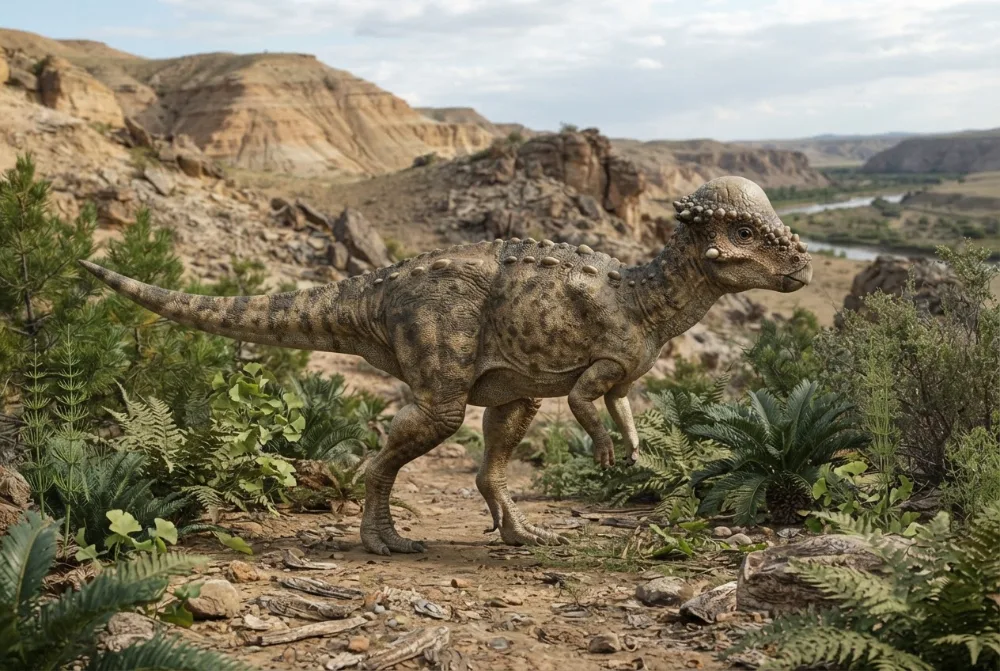
Goyocephale was a small, plant-eating dinosaur with a flat, bumpy skull. It lived in what is now Mongolia during the Late Cretaceous period, about 76 million years ago. This dinosaur was a primitive cousin of the dome-headed pachycephalosaurs.14
Noiz bizi izan zen?
Zein handia zen?
Zein luzea zen?
 4 etxeko katu bezain luze, sudurretik buztanera🍌bata bestearen atzean jarritako 11 banana bezain luze🏃100 metro 8,2 segundotan egin zitzakeen korrika (gizakirik azkarrenak 9,6 behar ditu)
Zein handia zen Goyocephale ZUREKIN alderatuta?
Zure nabigatzaileko kalkulu hutsak. Ez da ezer gordetzen ez inora bidaltzen.
Zein azkarra zen?


Datu dibertigarriak
Goyocephale had a flat skull roof, unlike the domed heads of later pachycephalosaurs like Pachycephalosaurus.1
Its name comes from the Mongolian word 'goyo' meaning 'decorated' and the Greek 'kephale' for 'head', referring to the bumpy ornamentation on its skull.1
Goyocephale had sharp, fang-like teeth at the front of its upper jaw, followed by a gap and then smaller cheek teeth.1
The back edge of its skull roof had many small bony bumps that would have been the base of little horns in life.1
Goyocephale is known from a single partial skeleton that includes most of the skull, parts of the forelimb and hindlimb, and some vertebrae.1
Scientists think Goyocephale was more primitive than its close relative Homalocephale because it had a shorter sacrum (hip bone) and larger skull openings.2
Goyocephale: gehien egindako galderak
?How big was Goyocephale?
Goyocephale was a small dinosaur, about 60 to 150 centimetres (2 to 5 feet) long from head to tail.2
?What did Goyocephale eat?
Goyocephale was a plant-eater (herbivore). It had sharp, fang-like teeth at the front of its mouth and smaller cheek teeth for chewing plants.13
Mito-hauslea
Mitoa: All pachycephalosaurs had thick, domed skulls for head-butting.
Egia: Goyocephale had a flat skull roof, not a dome. It belonged to a group of flat-headed pachycephalosaurs called Homalocephalidae.1
Dino adituentzat
- Izen zientifikoa
- Goyocephale
- Izendatzailea:
- Perle et al. 19824
- Taldea
- Kupula-buruak
- Familia / klada
- Pachycephalosauria4
- Sailkapena
- Ornithischia > Pachycephalosauria4
- Arroken adina
- 86 eta 66 milioi urte artean (Santonian / Maastrichtian)4
- Herrialdeak
- Mongolia4
- Fosil-erregistroak
- 1 The Paleobiology Database datu-basean4
- Aurkikuntza
- Goyocephale was named in 1982 by Altangerel Perle, Teresa Maryańska, and Halszka Osmólska based on a skeleton found at Boro Khovil in the Gobi Desert of Mongolia. The species name honors American scholar Owen Lattimore.12
- Oraindik eztabaidagai
- Scientists are not sure exactly how old the rocks at Boro Khovil are, so the precise age of Goyocephale is still debated.2
Datuak nondik datozen
- Goyocephale (en.wikipedia.org)
- GOYOCEPHALE LATTIMOREI GEN. ET SP. N., A NEW FLAT-HEADED PACHYCEPHALOSAUR (ORNITHISCHIA, DINOSAURIA) FROM THE UPPER CRETACEOUS OF MONGOLIA (app.pan.pl)
- Goyocephale | Natural History Museum (nhm.ac.uk)
- Goyocephale in The Paleobiology Database (CC BY 4.0): adina, tokiak, arroka-formazioak, sailkapena.
Orrialde honetako datu bakoitzak zenbaki bat du, bere iturrira eramaten zaituena. Zerbait gaizki badugu, barkatu, dino-zaleak gara, ez zientzia-aldizkari bat. Idatzi [email protected] helbidera eta konponduko dugu.
 Rex gose da! Dino Wiki aita baten proiektua da, dinosauroak maite dituen bere semearentzat, doakoa, iragarkirik eta jarraitzailerik gabe. Helduek mokadutxo bat eman diezaiokete Rexi, sarean jarraitzen laguntzeko.Eman jaten Rexi
 Pachycephalosaurus
 Stegoceras
 Prenocephale
 Sphaerotholus
 Foraminacephale
 Brontotholus
 Tyrannosaurus
 Triceratops
 Velociraptor
 Spinosaurus
 Ankylosaurus
 Parasaurolophus