 Zer dino zara? Galdetegia
 Dino borroka
 Dino lasterketa
 Dino minijokoak
 Pegatina-albuma
 Dino TOP zerrendak
 Harritu nazazu!
Henodus
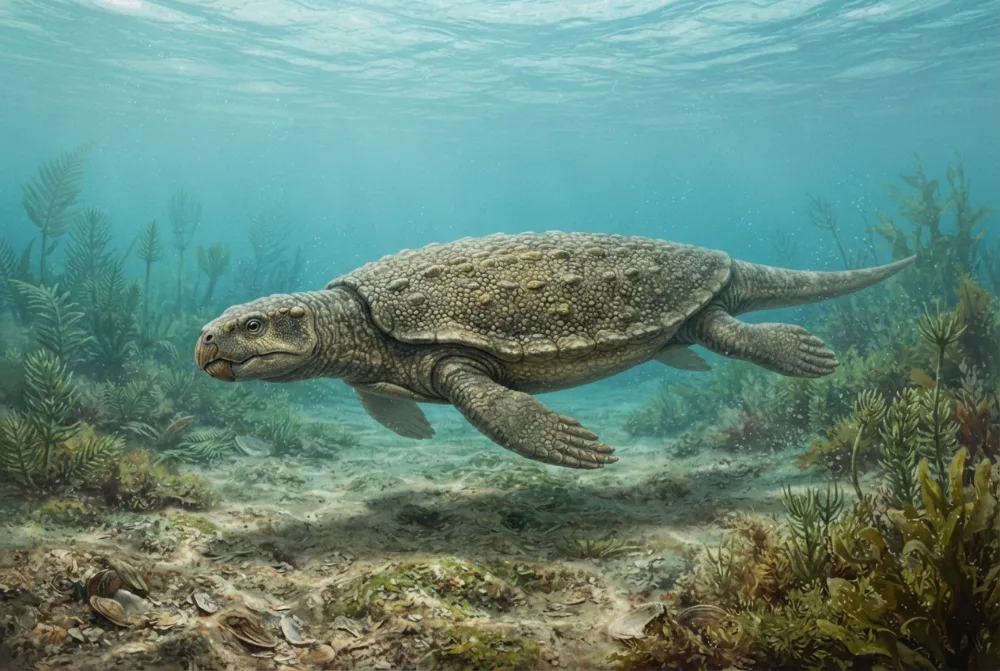
Henodus was a strange reptile that looked a bit like a turtle, but it wasn't one. It lived in shallow, salty lagoons during the Late Triassic, about 237 to 227 million years ago. It had a flat shell and a beak, and it probably used its special jaws to filter food from the water.13
Noiz bizi izan zen?
Zein handia zen?
Zein luzea zen?
 2 etxeko katu bezain luze, sudurretik buztanera🍌bata bestearen atzean jarritako 6 banana bezain luze🏊igerileku handi baten luzera (50 m) 30 segundotan egin zezakeen igerian
Zein handia zen Henodus ZUREKIN alderatuta?
Zure nabigatzaileko kalkulu hutsak. Ez da ezer gordetzen ez inora bidaltzen.
Zein azkarra zen?


Datu dibertigarriak
Henodus is the only placodont found in rocks that were not from the open sea, so it probably lived in brackish or freshwater lagoons.1
Its shell was made of many small bony plates that formed a mosaic pattern, unlike a turtle's shell.1
Henodus had only one tooth on each side of its mouth, and the rest of its jaws were a beak.1
It had baleen-like denticles along its jaws, similar to some whales, which helped it filter small food from the water.1
Its weak limbs suggest it spent little or no time on land.1
Scientists think Henodus could close its jaws very quickly, which helped it catch small prey.1
Small snail shells were found near the skulls of Henodus, so it might have eaten those tiny snails.2
Henodus: gehien egindako galderak
?How big was Henodus?
About 1 metre (3.3 feet) long.1
?What did Henodus eat?
It probably ate tiny snails, small crustaceans, and maybe plants. It had a beak and baleen-like denticles to filter food from the water.12
?Was Henodus a dinosaur?
No, it was a marine reptile called a placodont, not a dinosaur.1
?Could Henodus walk on land?
Probably not much. Its weak limbs suggest it spent little or no time on land.1
?When did Henodus live?
It lived during the Late Triassic period, about 237 to 227 million years ago.1
?Why did Henodus have a shell?
Its shell was made of many small bony plates that formed a mosaic pattern, and it probably protected Henodus from predators.1
Mito-hauslea
Mitoa: Henodus was a turtle.
Egia: Henodus looked like a turtle, but it was a different kind of reptile called a placodont. Its shell was made of many more bones, and its limbs were not inside its ribcage like a turtle's.1
Dino adituentzat
- Izen zientifikoa
- Henodus
- Izendatzailea:
- Huene 19363
- Taldea
- Itsas narrastiak
- Familia / klada
- Henodontidae3
- Sailkapena
- Placodontia > Sauropterygia3
- Arroken adina
- 237 eta 227 milioi urte artean (Carnian)3
- Arroka-formazioak
- Grabfeld3
- Herrialdeak
- Alemania3
- Fosil-erregistroak
- 1 The Paleobiology Database datu-basean3
- Aurkikuntza
- Henodus was named by Friedrich von Huene in 1936. The first fossils were found in the Grabfeld Formation near Tübingen, Germany.31
- Oraindik eztabaidagai
- Scientists are not sure exactly what Henodus ate. Some think it was a filter feeder, others think it ate plants, and some think it ate small animals. It might have done all of these.2
Datuak nondik datozen
- Henodus (en.wikipedia.org)
- Dentition and feeding in Placodontia: tooth replacement in Henodus chelyops | BMC Ecology and Evolution | Springer Nature Link (link.springer.com)
- Henodus in The Paleobiology Database (CC BY 4.0): adina, tokiak, arroka-formazioak, sailkapena.
Orrialde honetako datu bakoitzak zenbaki bat du, bere iturrira eramaten zaituena. Zerbait gaizki badugu, barkatu, dino-zaleak gara, ez zientzia-aldizkari bat. Idatzi [email protected] helbidera eta konponduko dugu.
 Rex gose da! Dino Wiki aita baten proiektua da, dinosauroak maite dituen bere semearentzat, doakoa, iragarkirik eta jarraitzailerik gabe. Helduek mokadutxo bat eman diezaiokete Rexi, sarean jarraitzen laguntzeko.Eman jaten Rexi
 Nothosaurus
 Placodus
 Lariosaurus
 Cyamodus
 Cymatosaurus
 Proneusticosaurus
 Massospondylus
 Plateosaurus
 Coelophysis
 Podokesaurus
 Thecodontosaurus
 Eudimorphodon