 Zer dino zara? Galdetegia
 Dino borroka
 Dino lasterketa
 Dino minijokoak
 Pegatina-albuma
 Dino TOP zerrendak
 Harritu nazazu!
Megacephalosaurus
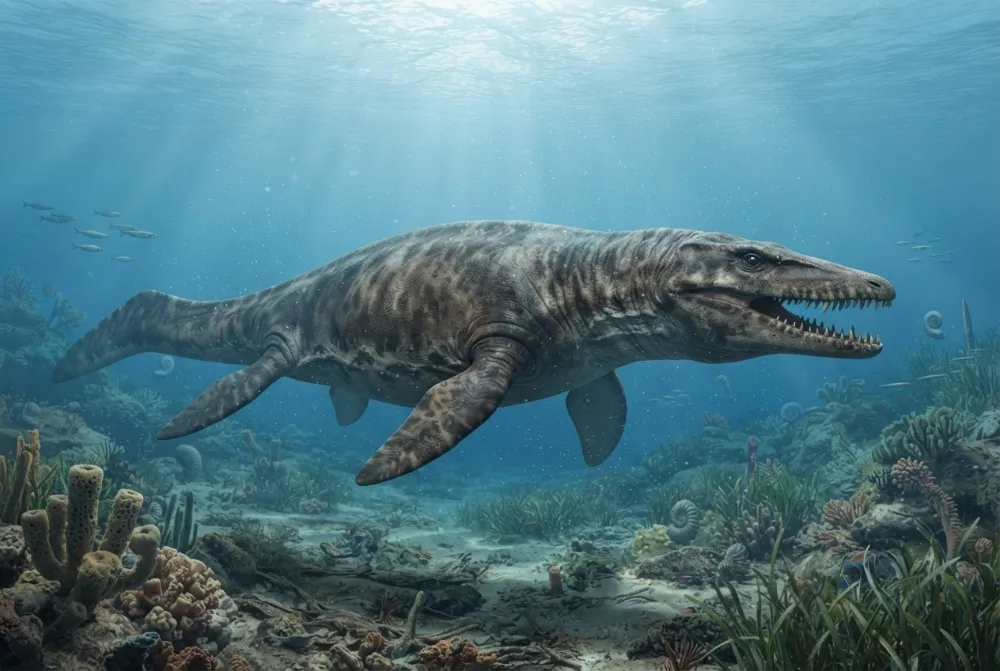
Megacephalosaurus was a huge, short-necked plesiosaur that swam in the ancient sea that split North America in two. It had a massive head, the biggest of any plesiosaur found on the continent, and used its long snout to catch smaller prey.1
Noiz bizi izan zen?
Zein handia zen?
Zein luzea zen?
 ilaran aparkatutako 2 auto bezain luze🍌bata bestearen atzean jarritako 50 banana bezain luze🏊igerileku handi baten luzera (50 m) 7,8 segundotan egin zezakeen igerian
Zein handia zen Megacephalosaurus ZUREKIN alderatuta?
Zure nabigatzaileko kalkulu hutsak. Ez da ezer gordetzen ez inora bidaltzen.
Zein azkarra zen?


Datu dibertigarriak
Megacephalosaurus was one of the last pliosaurs, living about 94 to 93 million years ago during the Turonian stage of the Late Cretaceous.1
Its skull was up to 1.75 meters (5.7 feet) long, making it the largest skull of any plesiosaur known from North America.1
The teeth had long, thin ridges called apicobasal ridges that helped grip and puncture slippery prey.1
It shared its ocean home with sharks like Cretoxyrhina and Squalicorax, as well as other marine reptiles like mosasaurs and sea turtles.1
The first fossils were found in 1950 and were originally thought to belong to a different pliosaur called Brachauchenius lucasi.1
It was not until 2013 that scientists realized the fossils were from a new, distinct animal and named it Megacephalosaurus.1
Megacephalosaurus: gehien egindako galderak
?How big was Megacephalosaurus?
It was one of the largest marine reptiles of its time, estimated to be 6 to 9 meters (20 to 30 ft) long. Its skull alone could reach 1.75 meters (5.7 ft) in length.1
?What did Megacephalosaurus eat?
It likely ate smaller prey, because it had a long snout and teeth that were all about the same size. Its teeth had ridges that helped grip and puncture slippery animals.12
?When did Megacephalosaurus live?
It lived about 94 to 93 million years ago, during the Turonian stage of the Late Cretaceous. It was among the last of the pliosaurs.1
?Is Megacephalosaurus a dinosaur?
No, it is not a dinosaur. It is a plesiosaur, a type of marine reptile that lived in the ocean at the same time as dinosaurs.1
Dino adituentzat
- Izen zientifikoa
- Megacephalosaurus
- Izendatzailea:
- Schumacher et al. 20133
- Taldea
- Plesiosauroak
- Familia / klada
- Pliosauridae3
- Sailkapena
- Plesiosauria > Pliosauridae > Sauropterygia3
- Arroken adina
- 94 eta 90 milioi urte artean (Turonian)3
- Arroka-formazioak
- Carlile Shale, Greenhorn Limestone3
- Herrialdeak
- AEB3
- Fosil-erregistroak
- 2 The Paleobiology Database datu-basean3
- Aurkikuntza
- The first fossils were discovered in 1950 by George F. Sternberg in Kansas. They were later studied by Bruce Schumacher, Kenneth Carpenter, and Mike Everhart, who named the new species Megacephalosaurus eulerti in 2013.1
- Oraindik eztabaidagai
- Scientists are still debating how the last brachauchenine pliosaurs, including Megacephalosaurus, are related to each other and what their teeth tell us about their evolution.2
Datuak nondik datozen
- Megacephalosaurus (en.wikipedia.org)
- Morphological and phylogenetic aspects of the dentition of Megacephalosaurus eulerti , a pliosaurid from the Turonian of Kansas, USA, with remarks on the cranial anatomy of the taxon (cambridge.org)
- Megacephalosaurus in The Paleobiology Database (CC BY 4.0): adina, tokiak, arroka-formazioak, sailkapena.
Orrialde honetako datu bakoitzak zenbaki bat du, bere iturrira eramaten zaituena. Zerbait gaizki badugu, barkatu, dino-zaleak gara, ez zientzia-aldizkari bat. Idatzi [email protected] helbidera eta konponduko dugu.
 Rex gose da! Dino Wiki aita baten proiektua da, dinosauroak maite dituen bere semearentzat, doakoa, iragarkirik eta jarraitzailerik gabe. Helduek mokadutxo bat eman diezaiokete Rexi, sarean jarraitzen laguntzeko.Eman jaten Rexi
 Elasmosaurus
 Pliosaurus
 Plesiosaurus
 Cimoliasaurus
 Colymbosaurus
 Trinacromerum
 Tyrannosaurus
 Triceratops
 Velociraptor
 Spinosaurus
 Ankylosaurus
 Parasaurolophus