 Que dino es ti? O test
 Batalla de dinos
 Carreira de dinos
 Minixogos de dinos
 Álbum de cromos
 Listas TOP de dinos
 Sorpréndeme!
Acamptonectes
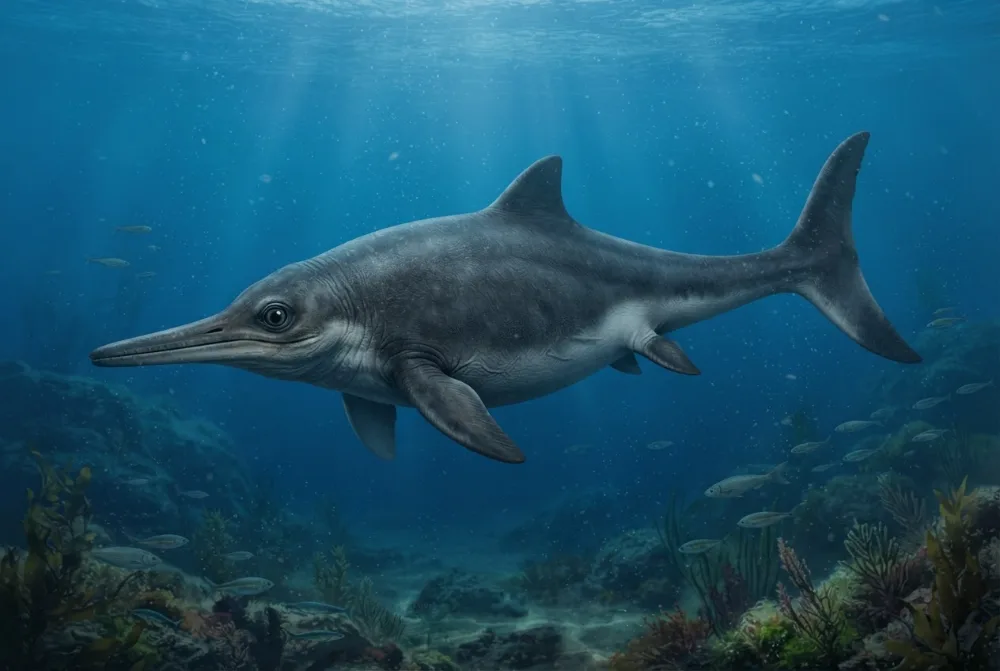
Acamptonectes was a fast-swimming marine reptile that lived in the Early Cretaceous seas. It had a stiff body and large eyes, perfect for hunting fish and squid in the deep ocean.12
Cando viviu?
Como era de grande?
Canto medía de longo?
 tan longo coma 3 cans do fociño á cola🍌tan longo coma 17 plátanos postos un tras outro🏊podería nadar o longo dunha piscina grande (50 m) en 3,8 segundos
Como era de grande Acamptonectes comparado CONTIGO?
Só son contas no teu navegador. Non se garda nin se envía nada.
Que velocidade alcanzaba?


Datos curiosos
Acamptonectes belongs to a group called ophthalmosaurids, which had very large eyes for seeing in dark, deep water.12
Its name means 'stiff swimmer' because its body was unusually rigid, helping it move fast through the water.1
Acamptonectes lived about 133 to 129 million years ago, during the Hauterivian stage of the Early Cretaceous.1
Scientists once thought most ichthyosaurs died out at the end of the Jurassic, but Acamptonectes shows they survived and thrived into the Cretaceous.21
The first Acamptonectes fossil was found in 1958 by geology students near Speeton, England, but it was not named until 2012.21
Its teeth had tiny ridges along the length, which helped it grip slippery prey like fish and squid.1
As preguntas máis frecuentes sobre Acamptonectes
?Was Acamptonectes a dinosaur?
No, it was a marine reptile called an ichthyosaur, not a dinosaur.1
?How big was Acamptonectes?
It was about 3 metres (9.8 feet) long.1
?What did Acamptonectes eat?
It likely ate soft, fleshy prey like fish and squid, using its slender ridged teeth to impale them.1
?Why did Acamptonectes have a stiff body?
Its stiff body helped it swim fast like a tuna by making it more streamlined in the water.1
Para expertos en dinos
- Nome científico
- Acamptonectes
- Bautizado por
- Fischer et al. 20123
- Grupo
- Ictiosauros
- Familia / clado
- Ophthalmosauridae3
- Clasificación
- Ichthyosauria > Ichthyosauromorpha3
- Idade das rochas
- de 133 a 126 millóns de anos (Hauterivian)3
- Formacións rochosas
- Speeton Clay3
- Países
- Reino Unido, Alemaña3
- Rexistros fósiles
- 3 na Paleobiology Database3
- Descubrimento
- Acamptonectes was named in 2012 by a team of scientists including V. Fischer, M. W. Maisch, and D. Naish. The first specimen was collected in 1958 by geology students in Speeton, England, but it took decades to study and describe.23
- Aínda en debate
- Scientists are still debating whether Acamptonectes had a different diet or lifestyle from other Cretaceous ichthyosaurs because of its unusual shallow snout and tooth shape.1
De onde veñen os datos
- Acamptonectes (en.wikipedia.org)
- New Ophthalmosaurid Ichthyosaurs from the European Lower Cretaceous Demonstrate Extensive Ichthyosaur Survival across the Jurassic, Cretaceous Boundary (pmc.ncbi.nlm.nih.gov)
- Acamptonectes in The Paleobiology Database (CC BY 4.0): idade, lugares, formacións rochosas, clasificación.
Cada dato desta páxina ten un número que leva á súa fonte. Se nos equivocamos nalgo, sentímolo, somos fans dos dinos, non unha revista científica. Escríbenos a [email protected] e arranxámolo.
 Rex ten fame! Dino Wiki é o proxecto dun pai para o seu fillo, que adora os dinosauros, gratis, sen anuncios e sen rastrexadores. Os adultos poden darlle un petisco a Rex para mantelo en liña.Dálle de comer a Rex
 Ichthyosaurus
 Platypterygius
 Stenopterygius
 Khudiakovia
 Ophthalmosaurus
 Chonespondylus
 Stegosaurus
 Iguanodon
 Archaeopteryx
 Giganotosaurus
 Microraptor
 Deinonychus