 Que dino es ti? O test
 Batalla de dinos
 Carreira de dinos
 Minixogos de dinos
 Álbum de cromos
 Listas TOP de dinos
 Sorpréndeme!
Aegirosaurus
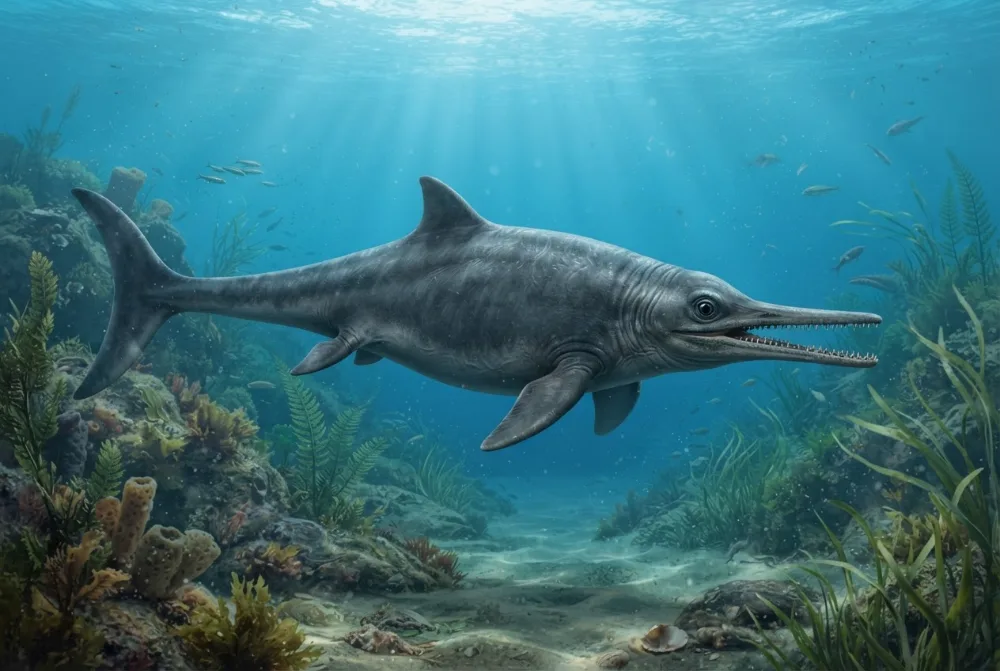
Aegirosaurus was a sleek, dolphin-like marine reptile that swam in the warm seas of Europe during the time of the dinosaurs. It had a long, slender snout packed with tiny, sharp teeth for catching fish and squid.1
Cando viviu?
Como era de grande?
Canto medía de longo?
 tan longo coma 4 gatos domésticos do fociño á cola🍌tan longo coma 11 plátanos postos un tras outro🏊podería nadar o longo dunha piscina grande (50 m) en 4,4 segundos
Como era de grande Aegirosaurus comparado CONTIGO?
Só son contas no teu navegador. Non se garda nin se envía nada.
Que velocidade alcanzaba?


Datos curiosos
Aegirosaurus had a very long snout that made up 62 to 73 percent of its lower jaw length.1
Its front flippers were narrow and elongated, but its hind flippers were wide because of extra soft tissue.1
Aegirosaurus had a crescent-shaped tail fin, like a fish, to help it swim fast.1
Fossils of Aegirosaurus show skin impressions, including what might be tiny scales on the upper part of its tail fin.1
This ichthyosaur lived from the Late Jurassic to the Early Cretaceous, about 149 to 133 million years ago.3
Aegirosaurus is one of the few ichthyosaurs known from the Valanginian stage of the Early Cretaceous.1
As preguntas máis frecuentes sobre Aegirosaurus
?How big was Aegirosaurus?
Aegirosaurus was a medium sized ichthyosaur. The largest known specimen was about 2 metres (6.6 ft) long, and a complete skeleton is 1.77 metres (5.8 ft) long.1
?What did Aegirosaurus eat?
Aegirosaurus ate small fish and squid. Its long, slender snout was packed with tiny, sharp teeth, and its tooth wear suggests it was a generalist feeder.1
?When did Aegirosaurus live?
Aegirosaurus lived from the Late Jurassic to the Early Cretaceous, about 149 to 133 million years ago.1
?Where was Aegirosaurus found?
Fossils of Aegirosaurus have been found in Germany and France. Its remains were discovered in the Solnhofen limestone of Bavaria, Germany, and in southeastern France.1
Cazamitos
Mito: Aegirosaurus was a dinosaur.
Verdade: Aegirosaurus was an ichthyosaur, a marine reptile that lived in the sea, not a dinosaur. Dinosaurs lived on land.1
Para expertos en dinos
- Nome científico
- Aegirosaurus
- Bautizado por
- Bardet and Fernandez 20003
- Grupo
- Ictiosauros
- Familia / clado
- Ophthalmosauridae3
- Clasificación
- Ichthyosauria > Ichthyosauromorpha3
- Idade das rochas
- de 149 a 133 millóns de anos (Tithonian / Valanginian)3
- Formacións rochosas
- Solnhofen3
- Países
- Alemaña, Francia3
- Rexistros fósiles
- 3 na Paleobiology Database3
- Descubrimento
- The first fossil was named Ichthyosaurus leptospondylus by Wagner in 1853. In 2000, scientists Bardet and Fernández gave it the new genus name Aegirosaurus after studying a nearly complete skeleton with soft tissue impressions.12
- Aínda en debate
- Scientists are not sure whether Aegirosaurus had scales on its tail fin, because only one fossil shows possible scale impressions.1
De onde veñen os datos
- Aegirosaurus (en.wikipedia.org)
- A new ichthyosaur from the Upper Jurassic lithographic limestones of Bavaria | Journal of Paleontology | Cambridge Core (cambridge.org)
- Aegirosaurus in The Paleobiology Database (CC BY 4.0): idade, lugares, formacións rochosas, clasificación.
Cada dato desta páxina ten un número que leva á súa fonte. Se nos equivocamos nalgo, sentímolo, somos fans dos dinos, non unha revista científica. Escríbenos a [email protected] e arranxámolo.
 Rex ten fame! Dino Wiki é o proxecto dun pai para o seu fillo, que adora os dinosauros, gratis, sen anuncios e sen rastrexadores. Os adultos poden darlle un petisco a Rex para mantelo en liña.Dálle de comer a Rex
 Ichthyosaurus
 Platypterygius
 Stenopterygius
 Khudiakovia
 Ophthalmosaurus
 Chonespondylus
 Stegosaurus
 Iguanodon
 Archaeopteryx
 Giganotosaurus
 Microraptor
 Deinonychus