 Que dino es ti? O test
 Batalla de dinos
 Carreira de dinos
 Minixogos de dinos
 Álbum de cromos
 Listas TOP de dinos
 Sorpréndeme!
Albertonectes
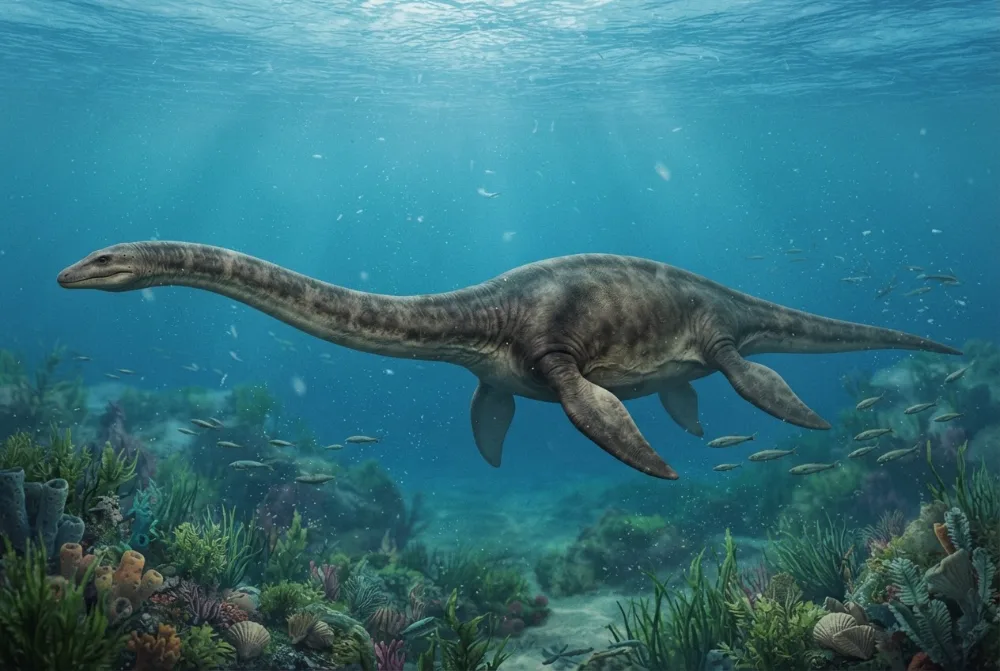
Albertonectes was a huge marine reptile that lived in the sea, not a dinosaur. It had an incredibly long neck, longer than a school bus, and swam with four flippers like paddles.12
Cando viviu?
Como era de grande?
Canto medía de longo?
Canto pesaba?
 tan longo coma 2,5 coches aparcados en fila🍌tan longo coma 67 plátanos postos un tras outro
 máis ou menos tan pesado coma un elefante🍉tan pesado coma 960 sandías🎒tan pesado coma 6 clases enteiras de nenos🐻❄️tan pesado coma 11 osos polares🏊podería nadar o longo dunha piscina grande (50 m) en 8,2 segundos
Como era de grande Albertonectes comparado CONTIGO?
Só son contas no teu navegador. Non se garda nin se envía nada.
Que velocidade alcanzaba?


Datos curiosos
Albertonectes had 76 neck bones, more than any other known animal. Its neck was about 7 metres (23 feet) long.12
Its fossils were discovered by accident in 2007 during ammolite mining. An excavator broke part of the skeleton, and some stomach stones were lost.12
Albertonectes lived in the Western Interior Seaway, a huge inland sea that stretched from the Gulf of Mexico to the Arctic Ocean.2
No skull of Albertonectes has ever been found, so scientists can only guess what its head looked like based on other elasmosaurs.12
Over 97 stomach stones were found with the skeleton, but they are too small to help with buoyancy or digestion. Scientists are still not sure why plesiosaurs swallowed stones.12
Albertonectes was a plesiosaur, not a dinosaur. Dinosaurs lived on land, while plesiosaurs were air-breathing reptiles that lived in the sea.2
As preguntas máis frecuentes sobre Albertonectes
?How big was Albertonectes?
Albertonectes was about 12.1 metres (40 feet) long and weighed around 4.8 metric tons (5.3 short tons). Its neck alone was about 7 metres (23 feet) long.12
?Was Albertonectes a dinosaur?
No, Albertonectes was a plesiosaur, a marine reptile that lived in the sea. Dinosaurs lived on land.2
?What did Albertonectes eat?
Scientists think Albertonectes ate small fish and crustaceans. Its small, slender teeth were not for attacking large prey.2
?How many neck bones did Albertonectes have?
Albertonectes had 76 neck bones, more than any other known animal. That is why its neck was so long.12
?When did Albertonectes live?
Albertonectes lived about 73.5 million years ago, during the Late Cretaceous period.1
Cazamitos
Mito: Albertonectes was a dinosaur.
Verdade: Albertonectes was a plesiosaur, a marine reptile that lived in the ocean, not a dinosaur. Dinosaurs were land animals.2
Para expertos en dinos
- Nome científico
- Albertonectes
- Bautizado por
- Kubo et al. 20124
- Grupo
- Plesiosauros
- Familia / clado
- Elasmosauridae4
- Clasificación
- Plesiosauria > Elasmosauridae > Sauropterygia4
- Idade das rochas
- de 84 a 72 millóns de anos (Campanian)4
- Formacións rochosas
- Bearpaw Shale4
- Países
- Canadá4
- Rexistros fósiles
- 1 na Paleobiology Database4
- Descubrimento
- The only known skeleton was found in 2007 by an ammolite mining company near Lethbridge, Alberta, Canada. It was named Albertonectes vanderveldei in 2012 by paleontologist Tai Kubo and his team.12
- Aínda en debate
- Scientists are not sure why Albertonectes swallowed so many stomach stones, since they are too small to help with buoyancy or digestion.2
De onde veñen os datos
- Albertonectes (en.wikipedia.org)
- Albertonectes | The Canadian Encyclopedia (thecanadianencyclopedia.ca)
- PBDB Taxon (paleobiodb.org)
- Albertonectes in The Paleobiology Database (CC BY 4.0): idade, lugares, formacións rochosas, clasificación.
Cada dato desta páxina ten un número que leva á súa fonte. Se nos equivocamos nalgo, sentímolo, somos fans dos dinos, non unha revista científica. Escríbenos a [email protected] e arranxámolo.
 Rex ten fame! Dino Wiki é o proxecto dun pai para o seu fillo, que adora os dinosauros, gratis, sen anuncios e sen rastrexadores. Os adultos poden darlle un petisco a Rex para mantelo en liña.Dálle de comer a Rex
 Elasmosaurus
 Pliosaurus
 Plesiosaurus
 Cimoliasaurus
 Colymbosaurus
 Trinacromerum
 Tyrannosaurus
 Triceratops
 Velociraptor
 Spinosaurus
 Ankylosaurus
 Parasaurolophus