 Que dino es ti? O test
 Batalla de dinos
 Carreira de dinos
 Minixogos de dinos
 Álbum de cromos
 Listas TOP de dinos
 Sorpréndeme!
Amargasaurus
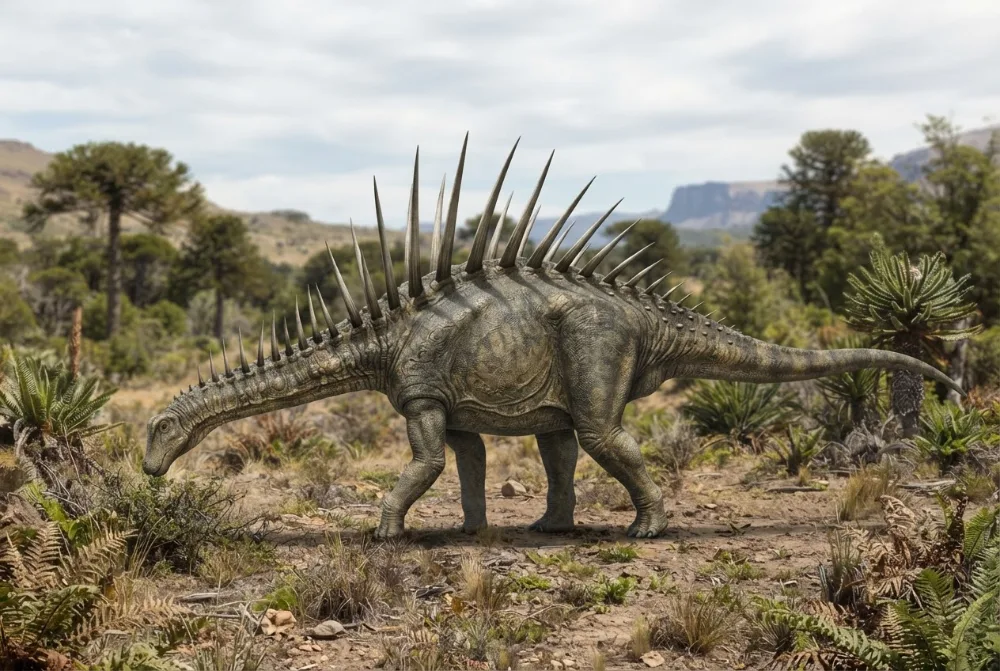
Amargasaurus was a sauropod with a very unusual back. It had long, sharp spines sticking up from its neck and back, like a row of spikes. Scientists think these spikes might have been used for defense or to impress other Amargasaurus.1
Cando viviu?
Como era de grande?
Canto medía de longo?
Canto medía de alto?
Canto pesaba?
 tan longo coma 3 coches aparcados en fila🍌tan longo coma 72 plátanos postos un tras outro
 tan pesado coma 200 cans🍉tan pesado coma 800 sandías🎒tan pesado coma 5 clases enteiras de nenos🐻❄️tan pesado coma 9 osos polares🏃podería correr 100 metros en 17 segundos (o humano máis rápido necesita 9,6)
Como era de grande Amargasaurus comparado CONTIGO?
Só son contas no teu navegador. Non se garda nin se envía nada.
Que velocidade alcanzaba?


Datos curiosos
Amargasaurus had very long, sharp spines on its neck and back vertebrae. These spines were much longer than those of its relative Dicraeosaurus.1
The spines on its neck were so long that they probably stuck out like a sail or a row of spikes. Scientists think they could have been used for defense or to show off to other Amargasaurus.1
Amargasaurus was a dicraeosaurid, a family of sauropods with shorter necks than other long-necked dinosaurs. Its closest relatives include Dicraeosaurus and Bajadasaurus.6
The only known skeleton of Amargasaurus is mostly complete. It includes the back of the skull, most of the backbone, and parts of the legs and hips.1
Amargasaurus lived about 125 to 121 million years ago, during the Early Cretaceous period. That is about 15 to 20 million years after its African relative Dicraeosaurus.61
Scientists think Amargasaurus could not rear up on its hind legs like some other sauropods. Its legs were built for slow, steady walking, not speed.1
As preguntas máis frecuentes sobre Amargasaurus
?How big was Amargasaurus?
Amargasaurus was about 9 to 13 metres long and weighed around 2.5 to 4 metric tons. That is small for a sauropod.25
?What did Amargasaurus eat?
Amargasaurus was a herbivore that ate tough plants. It had pencil-like teeth for grinding and chewing.52
?When did Amargasaurus live?
Amargasaurus lived during the Early Cretaceous period, about 130 to 120 million years ago.25
?Where was Amargasaurus found?
Amargasaurus was found in Argentina, in the La Amarga Formation of Neuquén Province. The only known skeleton was discovered in 1984.25
?Why did Amargasaurus have spines?
Scientists think the spines might have been used for display, combat, or defense. They could have supported a sail or been covered in horn.23
?Was Amargasaurus a dinosaur?
Yes, Amargasaurus was a dinosaur. It was a sauropod, a type of long-necked plant-eating dinosaur.25
?How fast could Amargasaurus run?
Scientists think Amargasaurus could not run fast. Its legs were built for slow, steady walking, not speed.2
?Is Amargasaurus bigger than T. rex?
Amargasaurus was longer than T. rex, reaching 9 to 13 metres, but it was much lighter, weighing only 2.5 to 4 metric tons.2
Para expertos en dinos
- Nome científico
- Amargasaurus
- Bautizado por
- Bonaparte 19846
- Grupo
- Pescozos longos
- Familia / clado
- Dicraeosauridae6
- Clasificación
- Sauropodomorpha > Sauropoda > Diplodocoidea6
- Idade das rochas
- de 126 a 121 millóns de anos (Barremian)6
- Formacións rochosas
- La Amarga6
- Países
- Arxentina6
- Rexistros fósiles
- 2 na Paleobiology Database6
- Descubrimento
- Amargasaurus was named by Argentine paleontologist José Bonaparte in 1984. The skeleton was found in the La Amarga Formation in Neuquén Province, Argentina.61
- Aínda en debate
- Scientists are not sure exactly what the long spines on Amargasaurus's neck were used for. They might have been for defense, to attract mates, or to help control body temperature.1
De onde veñen os datos
- p (naturalhistory.si.edu)
- Amargasaurus (en.wikipedia.org)
- Amargasaurus | Western Australian Museum (museum.wa.gov.au)
- Giants and Bizarres: Body Size of Some Southern South American Cretaceous Dinosaurs (miketaylor.org.uk)
- Amargasaurus | Natural History Museum (nhm.ac.uk)
- Amargasaurus in The Paleobiology Database (CC BY 4.0): idade, lugares, formacións rochosas, clasificación.
Cada dato desta páxina ten un número que leva á súa fonte. Se nos equivocamos nalgo, sentímolo, somos fans dos dinos, non unha revista científica. Escríbenos a [email protected] e arranxámolo.
 Rex ten fame! Dino Wiki é o proxecto dun pai para o seu fillo, que adora os dinosauros, gratis, sen anuncios e sen rastrexadores. Os adultos poden darlle un petisco a Rex para mantelo en liña.Dálle de comer a Rex
 Brachiosaurus
 Diplodocus
 Brontosaurus
 Argentinosaurus
 Camarasaurus
 Morosaurus
 Stegosaurus
 Iguanodon
 Archaeopteryx
 Giganotosaurus
 Microraptor
 Deinonychus