 Que dino es ti? O test
 Batalla de dinos
 Carreira de dinos
 Minixogos de dinos
 Álbum de cromos
 Listas TOP de dinos
 Sorpréndeme!
Amargatitanis
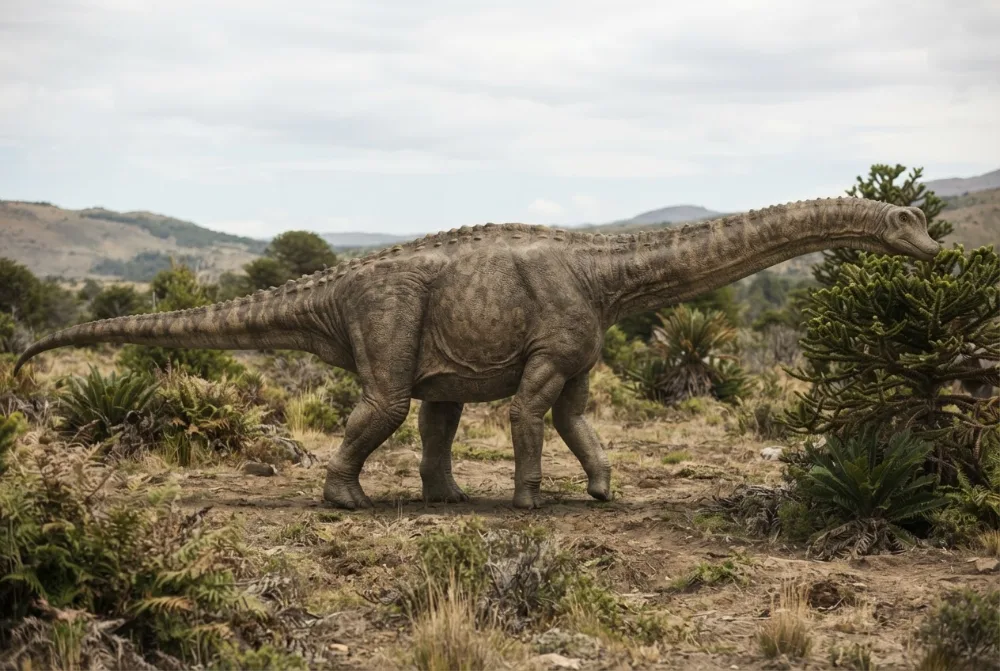
Amargatitanis was a long-necked plant-eater that lived in what is now Argentina. It was a sauropod, but not one of the biggest, it was about as long as a school bus. Its fossils were found near a place called La Amarga, which means 'the bitter one' in Spanish.1
Cando viviu?
Como era de grande?
Canto medía de longo?
Canto medía de alto?
estimación
Canto pesaba?
 tan longo coma 2,5 coches aparcados en fila🍌tan longo coma 67 plátanos postos un tras outro
 tan pesado coma 180 cans🍉tan pesado coma 700 sandías🎒tan pesado coma 4 clases enteiras de nenos🐻❄️tan pesado coma 8 osos polares🏃podería correr 100 metros en 17 segundos (o humano máis rápido necesita 9,6)
Como era de grande Amargatitanis comparado CONTIGO?
Só son contas no teu navegador. Non se garda nin se envía nada.
Que velocidade alcanzaba?


Datos curiosos
Amargatitanis was first thought to be a titanosaur, but later scientists realized it was a dicraeosaurid, a group of sauropods with short necks and tall spines on their vertebrae.1
The only known skeleton of Amargatitanis is incomplete: just a partial hind leg, a hip bone, and two vertebrae. That makes it hard for scientists to know exactly what it looked like.1
Amargatitanis lived about 129 to 123 million years ago, during the Early Cretaceous period.1
The fossils were collected by famous paleontologist José Bonaparte in 1983, but the dinosaur wasn't named until 2007 by Sebastián Apesteguía.1
Amargatitanis shared its home with other sauropods like Amargasaurus and Zapalasaurus. They probably ate different plants to avoid competing for food.1
Like other dicraeosaurids, Amargatitanis had a long tail and strong legs. Its neck was shorter than many other sauropods, so it probably fed at heights up to about 2.7 metres (8.9 feet).1
As preguntas máis frecuentes sobre Amargatitanis
?How big was Amargatitanis?
About 12 metres (39.7 feet) long and weighed around 3.5 metric tons (3.9 short tons), according to one estimate. Another study gave a higher weight of about 11.4 metric tons (12.6 short tons).1
?What did Amargatitanis eat?
It was a plant-eater, or herbivore. It probably ate low-growing plants because its neck was shorter than many other sauropods.13
?When did Amargatitanis live?
It lived about 129 to 123 million years ago, during the Early Cretaceous period.1
Para expertos en dinos
- Nome científico
- Amargatitanis
- Bautizado por
- Apesteguía 20073
- Grupo
- Pescozos longos
- Familia / clado
- Dicraeosauridae3
- Clasificación
- Sauropodomorpha > Sauropoda > Diplodocoidea3
- Idade das rochas
- de 126 a 121 millóns de anos (Barremian)3
- Formacións rochosas
- La Amarga3
- Países
- Arxentina3
- Rexistros fósiles
- 1 na Paleobiology Database3
- Descubrimento
- Amargatitanis was named by Argentine paleontologist Sebastián Apesteguía in 2007. The fossils were found in 1983 by a team led by José Bonaparte in the La Amarga Formation of Argentina.1
- Aínda en debate
- Scientists are not sure whether Amargatitanis is a valid genus or a nomen dubium (doubtful name), because the fossils are so few and fragmentary.2
De onde veñen os datos
- Amargatitanis (en.wikipedia.org)
- PBDB Taxon (paleobiodb.org)
- Amargatitanis in The Paleobiology Database (CC BY 4.0): idade, lugares, formacións rochosas, clasificación.
Cada dato desta páxina ten un número que leva á súa fonte. Se nos equivocamos nalgo, sentímolo, somos fans dos dinos, non unha revista científica. Escríbenos a [email protected] e arranxámolo.
 Rex ten fame! Dino Wiki é o proxecto dun pai para o seu fillo, que adora os dinosauros, gratis, sen anuncios e sen rastrexadores. Os adultos poden darlle un petisco a Rex para mantelo en liña.Dálle de comer a Rex
 Brachiosaurus
 Diplodocus
 Brontosaurus
 Argentinosaurus
 Camarasaurus
 Morosaurus
 Stegosaurus
 Iguanodon
 Archaeopteryx
 Giganotosaurus
 Microraptor
 Deinonychus