 Que dino es ti? O test
 Batalla de dinos
 Carreira de dinos
 Minixogos de dinos
 Álbum de cromos
 Listas TOP de dinos
 Sorpréndeme!
Antarctopelta
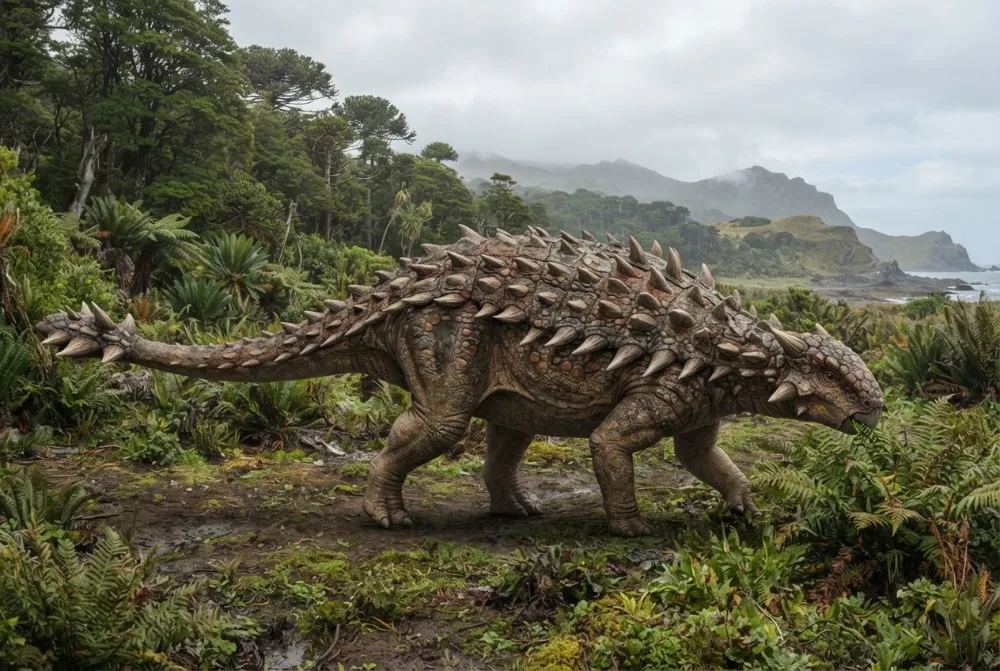
Antarctopelta was an armoured dinosaur that lived in Antarctica during the Late Cretaceous. It was covered in bony plates and spikes, and its tail ended in a weapon made of fused spikes that looked like an Aztec club. It was a slow-moving plant-eater that used its armour for protection.1
Cando viviu?
Como era de grande?
Canto medía de longo?
Canto medía de alto?
estimación
Canto pesaba?
 tan longo coma 6 cans do fociño á cola🍌tan longo coma 33 plátanos postos un tras outro🍉tan pesado coma 70 sandías🧸tan pesado coma 18 nenos de infantil🎒tan pesado coma 11 nenos de primaria🏃podería correr 100 metros en 16 segundos (o humano máis rápido necesita 9,6)
Como era de grande Antarctopelta comparado CONTIGO?
Só son contas no teu navegador. Non se garda nin se envía nada.
Que velocidade alcanzaba?


Datos curiosos
Antarctopelta was the first dinosaur fossil ever named from Antarctica, even though it was discovered before another Antarctic dinosaur called Cryolophosaurus.1
Its tail had a special weapon called a macuahuitl, made of flat, spiky bones fused together. It looked like an Aztec club and was used for defence.1
Scientists found six different types of armour plates on Antarctopelta, including large flat ones and tall keeled spikes.1
Antarctopelta lived in a warm, ice-free Antarctica with dense forests of conifers, cycads, and ginkgos. It still had to survive long dark winters.1
The only known skeleton was discovered in 1986 by Argentine geologists Eduardo Olivero and Robert Scasso, but it took ten years to dig out because of frozen ground and bad weather.1
Antarctopelta shared its home with the small plant-eater Trinisaura, as well as marine reptiles like mosasaurs and plesiosaurs.1
As preguntas máis frecuentes sobre Antarctopelta
?How big was Antarctopelta?
About 4 meters (13 feet) long from snout to tail tip. One scientist estimated it could have been up to 6 meters (20 feet) long and weighed 350 kilograms (770 pounds).1
?What did Antarctopelta eat?
It was a plant-eater. Its jaws had small, leaf-shaped teeth for chewing plants.1
?Did Antarctopelta have feathers?
No. It was an armoured dinosaur covered in bony plates and spikes, not feathers.1
?When did Antarctopelta live?
It lived during the late Campanian stage of the Late Cretaceous period, about 73.4 million years ago.1
?Was Antarctopelta a dinosaur?
Yes, it was a type of armoured dinosaur called an ankylosaur.1
?Could Antarctopelta swim?
Scientists are not sure, but its body was stocky and built for walking on land, not swimming. Its fossils were found with a shark tooth, suggesting it may have floated out to sea after death.1
Cazamitos
Mito: Some people think Antarctopelta had a tail club like a typical ankylosaur.
Verdade: Antarctopelta actually had a macuahuitl, a flat fan of spikes at the end of its tail, not a round club.1
Para expertos en dinos
- Nome científico
- Antarctopelta
- Bautizado por
- Salgado and Gasparini 20062
- Grupo
- Dinos acoirazados
- Familia / clado
- Parankylosauria2
- Clasificación
- Ornithischia > Ankylosauria > Thyreophora2
- Idade das rochas
- de 84 a 72 millóns de anos (Campanian)2
- Formacións rochosas
- Snow Hill Island2
- Países
- Antártida2
- Rexistros fósiles
- 1 na Paleobiology Database2
- Descubrimento
- Antarctopelta was discovered in January 1986 by Argentine geologists Eduardo Olivero and Robert Scasso on James Ross Island, Antarctica. It was named in 2006 by paleontologists Leonardo Salgado and Zulma Gasparini, who called it Antarctopelta oliveroi after Olivero.1
- Aínda en debate
- Scientists are still debating whether Antarctopelta was more closely related to nodosaurids or ankylosaurids, because it has features of both groups.1
De onde veñen os datos
- Antarctopelta (en.wikipedia.org)
- Antarctopelta in The Paleobiology Database (CC BY 4.0): idade, lugares, formacións rochosas, clasificación.
Cada dato desta páxina ten un número que leva á súa fonte. Se nos equivocamos nalgo, sentímolo, somos fans dos dinos, non unha revista científica. Escríbenos a [email protected] e arranxámolo.
 Rex ten fame! Dino Wiki é o proxecto dun pai para o seu fillo, que adora os dinosauros, gratis, sen anuncios e sen rastrexadores. Os adultos poden darlle un petisco a Rex para mantelo en liña.Dálle de comer a Rex
 Ankylosaurus
 Sauropelta
 Pinacosaurus
 Scutellosaurus
 Struthiosaurus
 Euoplocephalus
 Tyrannosaurus
 Triceratops
 Velociraptor
 Spinosaurus
 Parasaurolophus
 Pteranodon