 Que dino es ti? O test
 Batalla de dinos
 Carreira de dinos
 Minixogos de dinos
 Álbum de cromos
 Listas TOP de dinos
 Sorpréndeme!
Bravoceratops
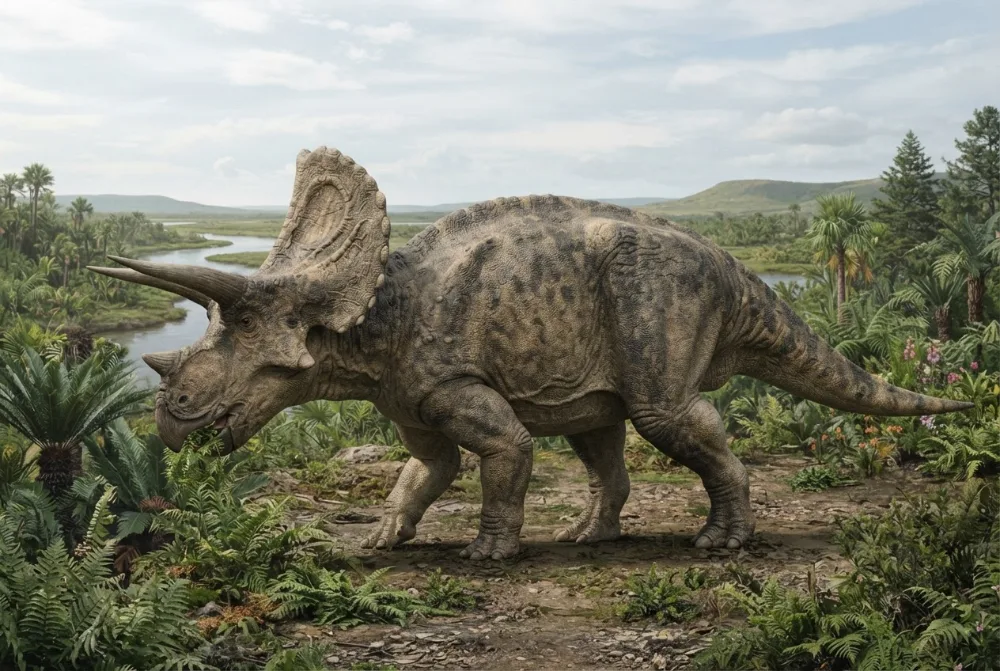
Bravoceratops was a big, plant-eating dinosaur with a huge frill on its head and a beak like a parrot. It lived in what is now Texas, USA, about 70 million years ago. This dinosaur is known from just one skull, but it helps scientists understand how horned dinosaurs changed over time.1
Cando viviu?
Como era de grande?
Canto medía de longo?
Canto medía de alto?
estimación
 tan longo coma 2 coches aparcados en fila🍌tan longo coma 56 plátanos postos un tras outro🏃podería correr 100 metros en 19 segundos (o humano máis rápido necesita 9,6)
Como era de grande Bravoceratops comparado CONTIGO?
Só son contas no teu navegador. Non se garda nin se envía nada.
Que velocidade alcanzaba?


Datos curiosos
Bravoceratops had a fan-shaped bone in the middle of its frill with a hollow spot that looked like a single eye, which is why it was named after the cyclops Polyphemus.1
Its name comes from the Rio Bravo del Norte, the Mexican name for the Rio Grande river.1
The only known fossil of Bravoceratops was found in Big Bend National Park in Texas.1
Bravoceratops lived during the Maastrichtian age, about 70 million years ago, near the end of the dinosaur era.1
Some scientists think Bravoceratops might be the same as another dinosaur, but others say it is a valid genus with unique features.1
Bravoceratops had two brow horns that were taller than they were wide, not round like in some other horned dinosaurs.1
As preguntas máis frecuentes sobre Bravoceratops
?How big was Bravoceratops?
Bravoceratops was one of the largest chasmosaurine horned dinosaurs. Its skull was about 2.1 metres long, and its brow horns were each over 0.9 metres long. It was similar in size to Triceratops, which weighed up to about 6,800 kilograms.3
?What did Bravoceratops eat?
Bravoceratops was a plant-eater. It had a beak like a parrot for snipping plants.1
?When did Bravoceratops live?
Bravoceratops lived about 70 million years ago, during the Late Cretaceous period.1
Cazamitos
Mito: Bravoceratops had a single horn on its frill like a cyclops eye.
Verdade: The hollow spot on its frill was probably the base for a small horn, but the horn itself is not preserved in the fossil.1
Para expertos en dinos
- Nome científico
- Bravoceratops
- Bautizado por
- Wick and Lehman 20134
- Grupo
- Dinos con cornos
- Familia / clado
- Ceratopsidae4
- Clasificación
- Ornithischia > Ceratopsia > Ceratopsidae4
- Idade das rochas
- de 72 a 66 millóns de anos (Maastrichtian)4
- Formacións rochosas
- Javelina4
- Países
- EUA4
- Rexistros fósiles
- 1 na Paleobiology Database4
- Descubrimento
- Bravoceratops was named by Steven L. Wick and Thomas M. Lehman in 2013 based on a skull found in the Javelina Formation of Texas.1
- Aínda en debate
- Scientists are not sure if Bravoceratops is a valid genus or if its fossil was reconstructed upside down, making it a nomen dubium.1
De onde veñen os datos
- Bravoceratops (en.wikipedia.org)
- PBDB Taxon (paleobiodb.org)
- Horned Dinosaur Discovery - Big Bend National Park (U.S. National Park Service) (nps.gov)
- Bravoceratops in The Paleobiology Database (CC BY 4.0): idade, lugares, formacións rochosas, clasificación.
Cada dato desta páxina ten un número que leva á súa fonte. Se nos equivocamos nalgo, sentímolo, somos fans dos dinos, non unha revista científica. Escríbenos a [email protected] e arranxámolo.
 Rex ten fame! Dino Wiki é o proxecto dun pai para o seu fillo, que adora os dinosauros, gratis, sen anuncios e sen rastrexadores. Os adultos poden darlle un petisco a Rex para mantelo en liña.Dálle de comer a Rex
 Triceratops
 Protoceratops
 Ojoceratops
 Tatankaceratops
 Psittacosaurus
 Centrosaurus
 Tyrannosaurus
 Velociraptor
 Spinosaurus
 Ankylosaurus
 Parasaurolophus
 Pteranodon