 Que dino es ti? O test
 Batalla de dinos
 Carreira de dinos
 Minixogos de dinos
 Álbum de cromos
 Listas TOP de dinos
 Sorpréndeme!
Cando viviu?

Como era de grande?
Canto medía de longo?
Canto medía de alto?
estimación
Canto pesaba?
 tan longo coma 4 cans do fociño á cola🍌tan longo coma 21 plátanos postos un tras outro🍉tan pesado coma 54 sandías🧸tan pesado coma 14 nenos de infantil🎒tan pesado coma 8 nenos de primaria🏃podería correr 100 metros en 8,6 segundos (o humano máis rápido necesita 9,6)
Como era de grande Canardia comparado CONTIGO?
Só son contas no teu navegador. Non se garda nin se envía nada.
Que velocidade alcanzaba?


Datos curiosos
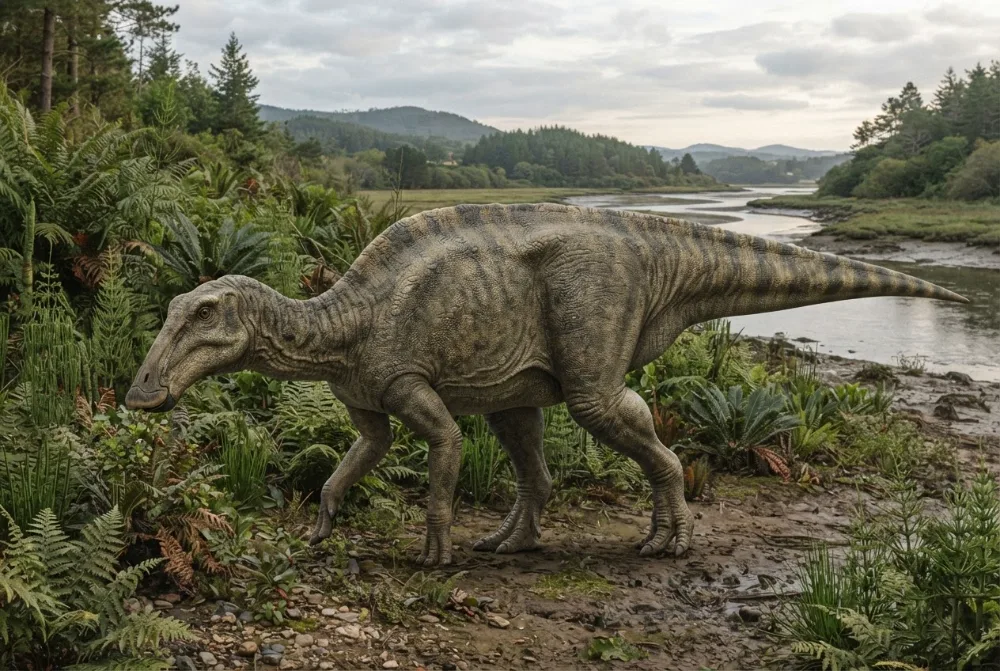
Canardia is known only from juvenile specimens, so scientists think the fossils found so far are from young animals.1
Its name comes from the French word 'canard', which means 'duck', because it belongs to the duck-billed dinosaur group.1
Canardia lived between 67.5 and 66 million years ago, right up to the end of the Cretaceous Period.1
The first fossils of Canardia were discovered in 1999 near the village of Marignac-Laspeyres in France.1
Some scientists think Canardia is closely related to Aralosaurus from Central Asia, while others place it in a group with other European and North African duck-billed dinosaurs.1
One Canardia fossil was found just one metre below the layer that marks the dinosaur extinction event, showing it was one of the very last non-bird dinosaurs in Europe.1
As preguntas máis frecuentes sobre Canardia
?How big was Canardia?
Scientists are not sure of its full adult size because all known fossils are from juveniles. The biggest bones found are a maxilla 16.9 cm long, a scapula 21.8 cm long, and a humerus 19.4 cm long.1
?Did Canardia have a crest?
Nobody knows for sure. No complete skull has been found, so scientists cannot tell if it had a hollow bony crest like many other lambeosaurines.1
?What did Canardia eat?
Like other duck-billed dinosaurs, Canardia was a plant-eater. It had teeth with ridges for grinding plants, and its duck-like beak helped it bite off leaves.1
?When did Canardia live?
Canardia lived between 67.5 and 66 million years ago, during the very end of the Cretaceous Period. It was one of the last non-bird dinosaurs before the big extinction.1
?Where was Canardia found?
All Canardia fossils have been found in southwestern France, in the Haute-Garonne department. The first ones were discovered in 1999 near the village of Marignac-Laspeyres.1
?Is Canardia a dinosaur?
Yes, Canardia is a dinosaur. It is a type of duck-billed dinosaur called a lambeosaurine hadrosaurid.1
Para expertos en dinos
- Nome científico
- Canardia
- Bautizado por
- Prieto-Marquez et al. 20133
- Grupo
- Bicos de pato
- Familia / clado
- Hadrosauridae3
- Clasificación
- Ornithischia > Ornithopoda > Iguanodontia > Hadrosauridae3
- Idade das rochas
- de 72 a 66 millóns de anos (Maastrichtian)3
- Formacións rochosas
- Marno-calcaires jaunes de Gensac, Marnes d'Auzas3
- Países
- Francia3
- Rexistros fósiles
- 2 na Paleobiology Database3
- Descubrimento
- Canardia was named in 2013 by Albert Prieto-Márquez and colleagues. The first fossils were found in 1999 by a team from the Musée des Dinosaures d'Espéraza in southwestern France.1
- Aínda en debate
- Scientists are not sure exactly where Canardia fits in the duck-billed dinosaur family tree. Some think it belongs to a group called Aralosaurini, while others place it in Arenysaurini.1
De onde veñen os datos
- Canardia (en.wikipedia.org)
- Canardia garonnensis | Dinosaur Database by DinoAnimals.com (dinoanimals.com)
- Canardia in The Paleobiology Database (CC BY 4.0): idade, lugares, formacións rochosas, clasificación.
Cada dato desta páxina ten un número que leva á súa fonte. Se nos equivocamos nalgo, sentímolo, somos fans dos dinos, non unha revista científica. Escríbenos a [email protected] e arranxámolo.
 Rex ten fame! Dino Wiki é o proxecto dun pai para o seu fillo, que adora os dinosauros, gratis, sen anuncios e sen rastrexadores. Os adultos poden darlle un petisco a Rex para mantelo en liña.Dálle de comer a Rex
 Parasaurolophus
 Edmontosaurus
 Saurolophus
 Hypacrosaurus
 Corythosaurus
 Kritosaurus
 Tyrannosaurus
 Triceratops
 Velociraptor
 Spinosaurus
 Ankylosaurus
 Pteranodon