 Que dino es ti? O test
 Batalla de dinos
 Carreira de dinos
 Minixogos de dinos
 Álbum de cromos
 Listas TOP de dinos
 Sorpréndeme!
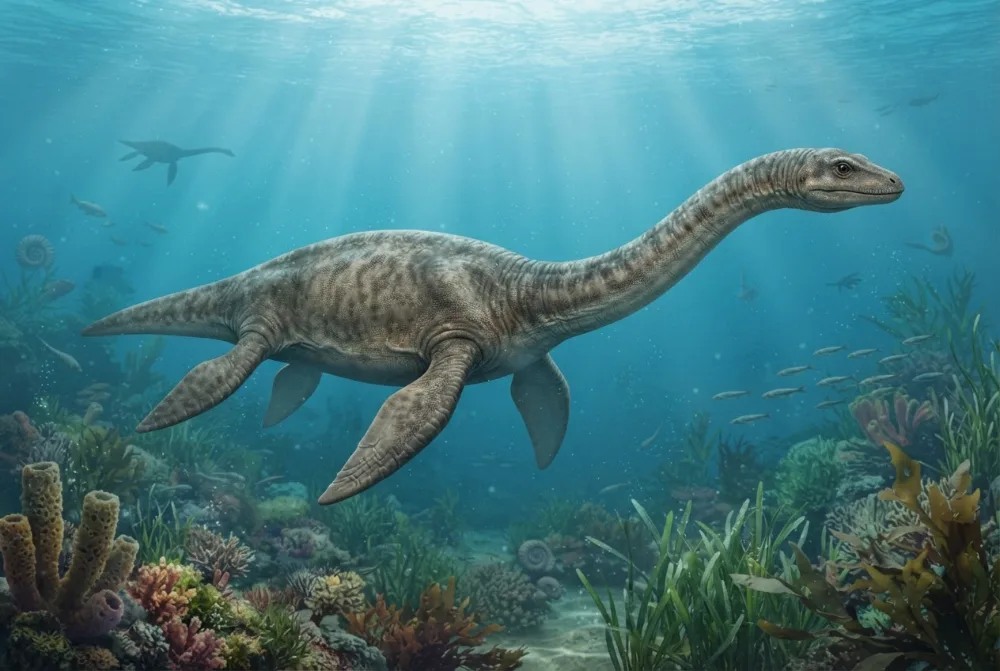
Cryptoclidus
Cryptoclidus was a medium-sized plesiosaur that swam in warm seas during the Middle and Late Jurassic. It had a small head, a long neck, and four flippers. It probably ate soft animals like squid and small fish.1
Cando viviu?
Como era de grande?
Canto medía de longo?
Canto pesaba?
 tan longo coma 4 cans do fociño á cola🍌tan longo coma 22 plátanos postos un tras outro🍉tan pesado coma 150 sandías🧸tan pesado coma 40 nenos de infantil🎒tan pesado coma 24 nenos de primaria🏊podería nadar o longo dunha piscina grande (50 m) en 6,4 segundos
Como era de grande Cryptoclidus comparado CONTIGO?
Só son contas no teu navegador. Non se garda nin se envía nada.
Que velocidade alcanzaba?


Datos curiosos
The name Cryptoclidus means 'hidden collarbone' because its collarbones are tiny and hidden in the shoulder area.1
Fossils of Cryptoclidus have been found in the Oxford Clay of Cambridgeshire, England, and in the Kimmeridge Clay of France.1
The type species was first called Plesiosaurus eurymerus, which means 'wide thigh bone', because scientists mistook a front flipper bone for a back leg bone.1
Cryptoclidus had a small, fragile skull and teeth that could not handle tough prey, so it ate only soft animals.1
Scientists think Cryptoclidus used its long, intermeshing teeth to strain small animals from the water or sift through mud.1
The size and shape of its nostrils suggest Cryptoclidus could smell chemicals in seawater, helping it find food.1
Complete skeletons of Cryptoclidus have been found, including some that are nearly entirely preserved, showing both adults and juveniles.1
As preguntas máis frecuentes sobre Cryptoclidus
?How big was Cryptoclidus?
About 4 metres long and weighed around 737 to 756 kilograms. That is about as long as a small car.1
?What did Cryptoclidus eat?
It ate small, soft animals like squid and small fish. Its fragile teeth could not handle tough prey.1
?Was Cryptoclidus a dinosaur?
No, it was a plesiosaur, which is a marine reptile that lived in the sea. It is not a dinosaur.1
?When did Cryptoclidus live?
It lived during the Middle and Late Jurassic Period, about 166 to 160 million years ago.1
?Where were Cryptoclidus fossils found?
Fossils have been found in England, France, Cuba, and Russia. Many come from the Oxford Clay in Cambridgeshire, England.12
?Could Cryptoclidus swim?
Yes, it was a good swimmer. It used its four flippers to move through warm Jurassic seas.1
Cazamitos
Mito: Some people think Cryptoclidus was a dinosaur.
Verdade: Cryptoclidus was a plesiosaur, a marine reptile that lived in the sea, not a dinosaur.1
Para expertos en dinos
- Nome científico
- Cryptoclidus
- Bautizado por
- (Seeley 1892)2
- Grupo
- Plesiosauros
- Familia / clado
- Cryptoclididae2
- Clasificación
- Plesiosauria > Sauropterygia2
- Idade das rochas
- de 165 a 143 millóns de anos (Callovian / Tithonian)2
- Formacións rochosas
- Oxford Clay, Jagua, Kimmeridge Clay2
- Países
- Reino Unido, Cuba, Arxentina, Francia2
- Rexistros fósiles
- 17 na Paleobiology Database2
- Tamén coñecido como
- Apractocleidus (nomes antigos que agora contan como o mesmo animal)2
- Descubrimento
- The first fossils were described in 1871 by John Phillips as Plesiosaurus eurymerus. Harry Govier Seeley renamed it Cryptoclidus in 1892.12
- Aínda en debate
- Scientists are not sure whether Cryptoclidus caught prey by swimming fast or by ambushing it, because its skeleton was not built for speed.1
De onde veñen os datos
- Cryptoclidus (en.wikipedia.org)
- Cryptoclidus in The Paleobiology Database (CC BY 4.0): idade, lugares, formacións rochosas, clasificación.
Cada dato desta páxina ten un número que leva á súa fonte. Se nos equivocamos nalgo, sentímolo, somos fans dos dinos, non unha revista científica. Escríbenos a [email protected] e arranxámolo.
 Rex ten fame! Dino Wiki é o proxecto dun pai para o seu fillo, que adora os dinosauros, gratis, sen anuncios e sen rastrexadores. Os adultos poden darlle un petisco a Rex para mantelo en liña.Dálle de comer a Rex
 Elasmosaurus
 Pliosaurus
 Plesiosaurus
 Cimoliasaurus
 Colymbosaurus
 Trinacromerum
 Brachiosaurus
 Diplodocus
 Allosaurus
 Brontosaurus
 Compsognathus
 Camarasaurus