 Que dino es ti? O test
 Batalla de dinos
 Carreira de dinos
 Minixogos de dinos
 Álbum de cromos
 Listas TOP de dinos
 Sorpréndeme!
Dorygnathus
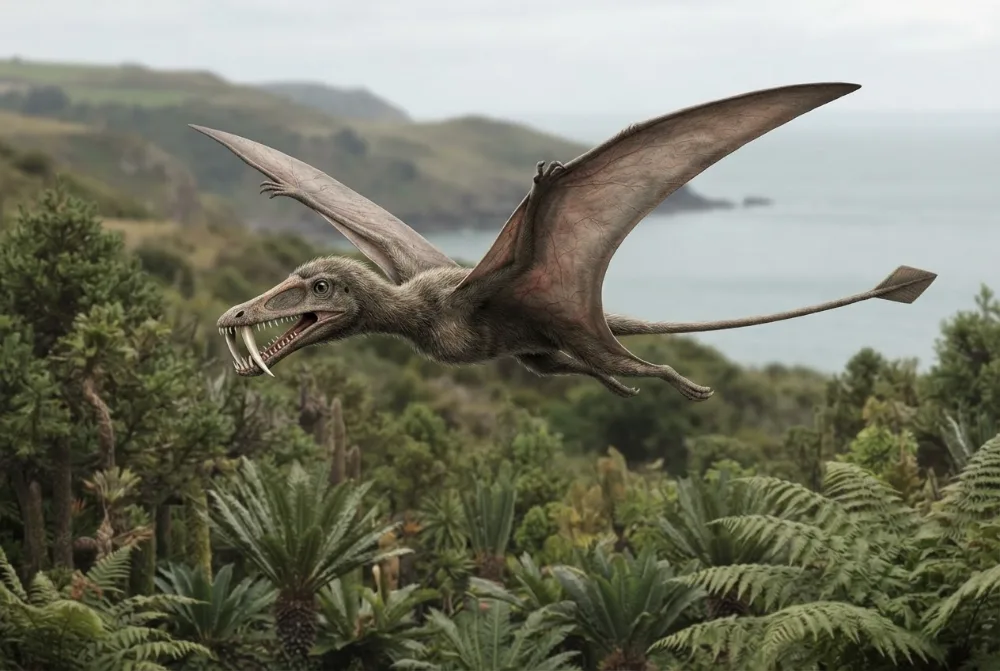
Dorygnathus was a flying reptile that lived during the Early Jurassic, about 180 million years ago. It had a short wingspan of around 1.5 metres (4.9 feet) and a long tail. Its most striking feature was its mouth full of large, curved fangs at the front and smaller teeth at the back.1
Cando viviu?
Como era de grande?
Que anchura tiñan as súas ás?
 tan longo coma 3 gatos domésticos do fociño á cola⚽podería voar sobre un campo de fútbol enteiro en 8,4 segundos
Como era de grande Dorygnathus comparado CONTIGO?
Só son contas no teu navegador. Non se garda nin se envía nada.
Que velocidade alcanzaba?


Datos curiosos
Dorygnathus had different kinds of teeth: four large fangs in the upper jaw and three or four in the lower jaw at the front, with smaller, straighter teeth behind. This is called heterodonty and is rare in modern reptiles.1
The fifth toe on its hind feet was unusually long and pointed sideways. Scientists think it may have supported a membrane, like the one on its wings.1
Dorygnathus was a close relative of the later pterosaur Rhamphorhynchus, and lived at the same time as another pterosaur called Campylognathoides in Germany.1
Over 50 specimens of Dorygnathus have been found, many in slate quarries. The best fossils are kept at the State Museum of Natural History Stuttgart in Germany.1
Some Dorygnathus teeth show wear from eating hard food like crustaceans or mollusks, not just fish.1
The smallest known Dorygnathus had a wingspan of 60 centimetres (2 feet). Scientists think very young juveniles could not fly far over the open sea.1
As preguntas máis frecuentes sobre Dorygnathus
?How big was Dorygnathus?
Dorygnathus had a wingspan of about 1.5 metres (4.9 feet), though some large individuals reached 1.7 metres (5.6 feet).12
?What did Dorygnathus eat?
Dorygnathus ate small fish, as shown by fossilised stomach contents. Some teeth also show wear from eating hard food like crustaceans or mollusks.13
?Could Dorygnathus fly?
Yes, Dorygnathus was a flying reptile. It had wings made of skin and other membranes, and its flight muscles attached to a small triangular breastbone.1
?Is Dorygnathus a dinosaur?
No, Dorygnathus was a pterosaur, a flying reptile that lived during the age of dinosaurs, but it was not a dinosaur.1
Para expertos en dinos
- Nome científico
- Dorygnathus
- Bautizado por
- Wagner 18604
- Grupo
- Réptiles voadores
- Familia / clado
- Rhamphorhynchidae4
- Clasificación
- Pterosauria > Rhamphorhynchidae4
- Idade das rochas
- de 184 a 183 millóns de anos (Toarcian)4
- Formacións rochosas
- Posidonia Shale, Posidonienschiefer, Marne de Flize4
- Países
- Alemaña, Francia4
- Rexistros fósiles
- 37 na Paleobiology Database4
- Descubrimento
- The first fossils of Dorygnathus were found near Banz, Bavaria, Germany, and were described in 1830 by Carl Theodori as Ornithocephalus banthensis. In 1860, Johann Andreas Wagner gave it the name Dorygnathus, meaning 'spear jaw'.1
- Aínda en debate
- Scientists still debate whether Dorygnathus walked on two legs or four. Some think it could walk on two legs because of its long tail, but most now believe all pterosaurs walked on all fours.1
De onde veñen os datos
- Dorygnathus (en.wikipedia.org)
- The Early Jurassic Pterosaur Dorygnathus Banthensis (Theodori, 1830) | The Palaeontological Association (palass.org)
- Press | State Museum of Natural History Stuttgart (naturkundemuseum-bw.de)
- Dorygnathus in The Paleobiology Database (CC BY 4.0): idade, lugares, formacións rochosas, clasificación.
Cada dato desta páxina ten un número que leva á súa fonte. Se nos equivocamos nalgo, sentímolo, somos fans dos dinos, non unha revista científica. Escríbenos a [email protected] e arranxámolo.
 Rex ten fame! Dino Wiki é o proxecto dun pai para o seu fillo, que adora os dinosauros, gratis, sen anuncios e sen rastrexadores. Os adultos poden darlle un petisco a Rex para mantelo en liña.Dálle de comer a Rex
 Pteranodon
 Quetzalcoatlus
 Rhamphorhynchus
 Anhanguera
 Pterodactylus
 Eudimorphodon
 Dilophosaurus
 Stenopterygius
 Lufengosaurus
 Scutellosaurus
 Yunnanosaurus
 Sinosaurus