 Que dino es ti? O test
 Batalla de dinos
 Carreira de dinos
 Minixogos de dinos
 Álbum de cromos
 Listas TOP de dinos
 Sorpréndeme!
Ekrixinatosaurus
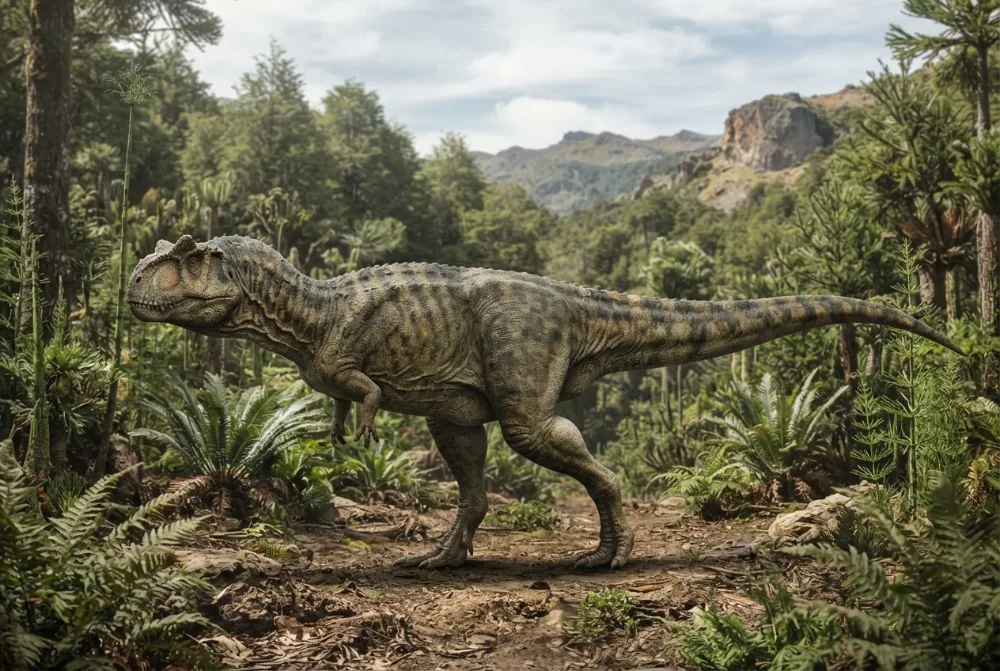
Ekrixinatosaurus was a big, meat-eating dinosaur with a boxy head and strong legs. It lived in what is now Argentina during the Early Cretaceous period. Its fossils were found when workers were building a gas pipeline and used dynamite, which is how it got its name!1
Cando viviu?
Como era de grande?
Canto medía de longo?
Canto medía de alto?
estimación
Canto pesaba?
 tan longo coma 8 cans do fociño á cola🍌tan longo coma 44 plátanos postos un tras outro🍉tan pesado coma 160 sandías🧸tan pesado coma 42 nenos de infantil🎒tan pesado coma 25 nenos de primaria🏃podería correr 100 metros en 9,5 segundos (o humano máis rápido necesita 9,6)
Como era de grande Ekrixinatosaurus comparado CONTIGO?
Só son contas no teu navegador. Non se garda nin se envía nada.
Que velocidade alcanzaba?


Datos curiosos
Ekrixinatosaurus was an abelisaurid, a family of theropod dinosaurs with short, deep skulls and tiny arms. Its skull was about 83 centimetres long.1
The only known skeleton of Ekrixinatosaurus was found scattered over an area of 15 square metres. It included parts of the skull, backbone, hips, legs and feet.1
Ekrixinatosaurus lived alongside the giant meat-eater Giganotosaurus and the long-necked sauropods Andesaurus and Limaysaurus. Scientists think they may have competed for food.1
The bones of Ekrixinatosaurus were discovered because of a gas pipeline project. Workers used dynamite to blast through the rock, which is why the dinosaur was named 'explosion-born reptile'.1
Ekrixinatosaurus had a boxy skull with a bump above its eye and a jaw that curved upward. Its face bones were covered in small holes and spikes, which may have supported a tough, wrinkly skin.1
Some scientists once thought Ekrixinatosaurus was the largest abelisaurid, bigger than Carnotaurus. But later studies showed that Carnotaurus was actually larger, just with a smaller head.1
As preguntas máis frecuentes sobre Ekrixinatosaurus
?How big was Ekrixinatosaurus?
It was about 6.5 to 8 metres long (21 to 26 feet) and weighed around 800 kilograms (1,800 pounds). Some scientists once thought it was bigger, but later studies showed it was smaller than Carnotaurus.1
?What did Ekrixinatosaurus eat?
It was a meat-eater that probably hunted smaller dinosaurs and animals. It lived alongside giant plant-eaters like Andesaurus and may have competed with the huge predator Giganotosaurus for food.1
?When did Ekrixinatosaurus live?
It lived during the Early Cretaceous period, about 111 to 106 million years ago.1
?Where was Ekrixinatosaurus found?
Its fossils were found in Argentina, in a place called the Candeleros Formation. Workers building a gas pipeline blasted the rock with dynamite, which is how the dinosaur got its name 'explosion-born reptile'.1
?Was Ekrixinatosaurus bigger than Carnotaurus?
No, Carnotaurus was actually larger. Some scientists once thought Ekrixinatosaurus was bigger because of its large skull, but comparing the leg bones shows Carnotaurus was the bigger dinosaur.1
?Did Ekrixinatosaurus have feathers?
The sources do not say whether it had feathers. Its face bones had small holes and spikes that may have supported tough, wrinkly skin, but no information about feathers is given.1
Para expertos en dinos
- Nome científico
- Ekrixinatosaurus
- Bautizado por
- Calvo et al. 20042
- Grupo
- Dinos carnívoros
- Familia / clado
- Abelisauridae2
- Clasificación
- Theropoda > Ceratosauria > Abelisauridae2
- Idade das rochas
- de 113 a 110 millóns de anos (Albian)2
- Formacións rochosas
- Candeleros2
- Países
- Arxentina2
- Rexistros fósiles
- 1 na Paleobiology Database2
- Descubrimento
- Ekrixinatosaurus was named in 2004 by paleontologists Jorge Calvo, David Rubilar-Rogers and Karen Moreno. The fossils were found in the Candeleros Formation of Argentina during construction of a gas pipeline.12
- Aínda en debate
- Scientists are not sure exactly how big Ekrixinatosaurus was. Some think it was 6.5 to 8 metres long, while others estimate it could have been 10 to 11 metres based on its skull size.1
De onde veñen os datos
- Ekrixinatosaurus (en.wikipedia.org)
- Ekrixinatosaurus in The Paleobiology Database (CC BY 4.0): idade, lugares, formacións rochosas, clasificación.
Cada dato desta páxina ten un número que leva á súa fonte. Se nos equivocamos nalgo, sentímolo, somos fans dos dinos, non unha revista científica. Escríbenos a [email protected] e arranxámolo.
 Rex ten fame! Dino Wiki é o proxecto dun pai para o seu fillo, que adora os dinosauros, gratis, sen anuncios e sen rastrexadores. Os adultos poden darlle un petisco a Rex para mantelo en liña.Dálle de comer a Rex
 Allosaurus
 Carnotaurus
 Dilophosaurus
 Giganotosaurus
 Compsognathus
 Paronychodon
 Stegosaurus
 Iguanodon
 Archaeopteryx
 Microraptor
 Deinonychus
 Baryonyx