 Que dino es ti? O test
 Batalla de dinos
 Carreira de dinos
 Minixogos de dinos
 Álbum de cromos
 Listas TOP de dinos
 Sorpréndeme!
Cando viviu?

Como era de grande?
Canto medía de longo?
Canto medía de alto?
Como era de grande Ichthyornis comparado CONTIGO?
Só son contas no teu navegador. Non se garda nin se envía nada.
Que velocidade alcanzaba?


Datos curiosos
Ichthyornis was one of the first prehistoric birds discovered with teeth, and Charles Darwin said it was important for understanding evolution.1
Its backbone bones were shaped like a fish's, which is why it got the name 'fish bird'.1
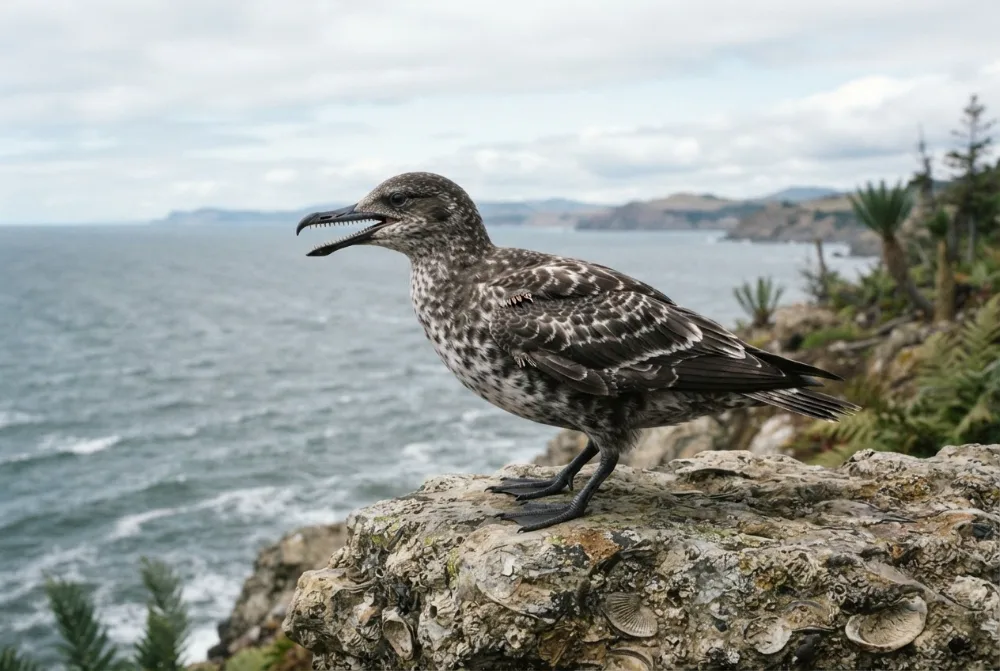
The beak of Ichthyornis was made of several separate plates, like an albatross's beak, not a single piece like most modern birds.1
Ichthyornis lived between about 93 and 83.5 million years ago, during the Late Cretaceous Period.1
Over time, Ichthyornis grew larger: older fossils have a wing bone about 58 mm long, while younger ones have a wing bone about 71.5 mm long.1
Its teeth were curved backward and set in a groove, similar to those of marine reptiles like mosasaurs.1
Ichthyornis is one of the closest extinct relatives of modern birds, helping scientists learn how today's birds evolved.1
As preguntas máis frecuentes sobre Ichthyornis
?How big was Ichthyornis?
About 24 centimetres (9.4 inches) long, with a skeletal wingspan of around 43 centimetres (17 inches). That is about the size of a pigeon.1
?Did Ichthyornis have teeth?
Yes, it had sharp, backward-curved teeth in the middle part of its jaws. The tips of its jaws had no teeth and were covered by a beak.1
?Could Ichthyornis fly?
Yes, it was a strong flier. Its wings and breastbone looked very modern, similar to birds that fly well today.1
?What did Ichthyornis eat?
It probably ate fish and other small sea animals, like modern gulls and terns. Its teeth helped it grab slippery prey.2
?When did Ichthyornis live?
It lived during the Late Cretaceous Period, from about 93 million to 83.5 million years ago.1
?Where did Ichthyornis live?
It lived along the coasts of the huge inland sea that covered the middle of North America. Its fossils have been found in Kansas, Texas, Alberta, and other places.1
?Is Ichthyornis a dinosaur?
Yes, birds evolved from dinosaurs, so Ichthyornis is a type of dinosaur called an avialan. But it is not a non-avian dinosaur like T. rex.1
Cazamitos
Mito: Ichthyornis is sometimes thought to be a dinosaur like T. rex.
Verdade: Ichthyornis is a bird, not a non-avian dinosaur. It belongs to the group Avialae, which includes modern birds and their extinct relatives.1
Para expertos en dinos
- Nome científico
- Ichthyornis
- Bautizado por
- Marsh 18724
- Grupo
- Aves primitivas
- Familia / clado
- Ichthyornithes4
- Clasificación
- Theropoda > Avialae4
- Idade das rochas
- de 100 a 72 millóns de anos (Cenomanian / Campanian)4
- Formacións rochosas
- Niobrara, Mooreville Chalk, Belle Fourche4
- Países
- EUA, Canadá, Usbequistán, México4
- Rexistros fósiles
- 33 na Paleobiology Database4
- Tamén coñecido como
- Angelinornis, Colonosaurus, Plegadornis (nomes antigos que agora contan como o mesmo animal)4
- Descubrimento
- Ichthyornis was named by American paleontologist Othniel Charles Marsh in 1872. At first, Marsh thought the toothed jaws belonged to a marine reptile, but later in 1873 he realized they were part of the bird.12
- Aínda en debate
- Scientists still debate whether the species should be called Ichthyornis dispar or Ichthyornis anceps, because of naming rules.1
De onde veñen os datos
- Ichthyornis (en.wikipedia.org)
- Ichthyornis | Cretaceous period, seabird, toothed beak (britannica.com)
- A New Specimen of the Late Cretaceous Bird, cf.Ichthyornissp., from the Cenomanian of Central Kansas, with Comments on the Size Distribution ofIchthyornisin North America (exa.ai)
- Ichthyornis in The Paleobiology Database (CC BY 4.0): idade, lugares, formacións rochosas, clasificación.
Cada dato desta páxina ten un número que leva á súa fonte. Se nos equivocamos nalgo, sentímolo, somos fans dos dinos, non unha revista científica. Escríbenos a [email protected] e arranxámolo.
 Rex ten fame! Dino Wiki é o proxecto dun pai para o seu fillo, que adora os dinosauros, gratis, sen anuncios e sen rastrexadores. Os adultos poden darlle un petisco a Rex para mantelo en liña.Dálle de comer a Rex
 Archaeopteryx
 Hesperornis
 Baptornis
 Jurapteryx
 Gobipteryx
 Martinavis
 Tyrannosaurus
 Triceratops
 Velociraptor
 Spinosaurus
 Ankylosaurus
 Parasaurolophus