 Que dino es ti? O test
 Batalla de dinos
 Carreira de dinos
 Minixogos de dinos
 Álbum de cromos
 Listas TOP de dinos
 Sorpréndeme!
Ichthyovenator
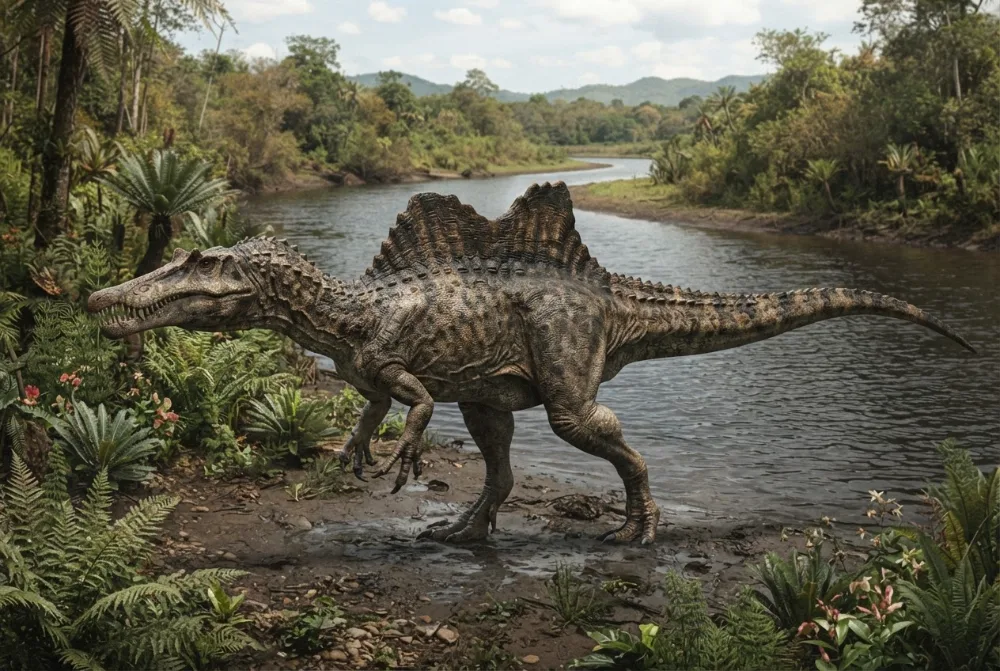
Ichthyovenator was a fish-eating dinosaur with a wavy sail on its back. It lived in what is now Laos during the Early Cretaceous period, about 120 to 113 million years ago. Its sail was shaped like two waves, which made it different from other sail-backed dinosaurs.1
Cando viviu?
Como era de grande?
Canto medía de longo?
Canto medía de alto?
Canto pesaba?
 tan longo coma 2,5 coches aparcados en fila🍌tan longo coma 58 plátanos postos un tras outro
 tan pesado coma 120 cans🍉tan pesado coma 480 sandías🎒tan pesado coma 3 clases enteiras de nenos🐻❄️tan pesado coma 5 osos polares🏃podería correr 100 metros en 16 segundos (o humano máis rápido necesita 9,6)
Como era de grande Ichthyovenator comparado CONTIGO?
Só son contas no teu navegador. Non se garda nin se envía nada.
Que velocidade alcanzaba?


Datos curiosos
Ichthyovenator had a sail on its back that was shaped like two waves, curving down over its hips. No other spinosaurid dinosaur had a sail like that.1
Its tail had unusually tall spines, which may have helped it swim like modern crocodiles.1
Ichthyovenator lived alongside sauropods, iguanodonts, turtles, and fish in a river or lake environment.1
The first fossils were found in 2010 in a red sandstone layer, all within an area smaller than 2 square metres.1
Ichthyovenator was the first definite spinosaurid dinosaur discovered in Asia.1
Its teeth were straight and without serrations, perfect for grabbing slippery fish.1
As preguntas máis frecuentes sobre Ichthyovenator
?How big was Ichthyovenator?
Ichthyovenator was about 8.5 to 10.5 metres (28 to 34 feet) long and weighed around 2 to 2.4 tonnes (2.2 to 2.6 short tons).1
?What did Ichthyovenator eat?
Ichthyovenator mainly ate fish, as its name means 'fish hunter'. It may also have eaten small dinosaurs and pterosaurs.1
?Why did Ichthyovenator have a wavy sail?
Scientists think the wavy sail was used for display, like attracting mates or recognizing its own species, not for controlling body temperature.12
?Could Ichthyovenator swim?
Yes, it likely could swim. Its tail had unusually tall spines, similar to modern crocodiles, which may have helped it paddle through water.1
?Where was Ichthyovenator found?
Ichthyovenator was found in Laos, in the Savannakhet Basin, from a red sandstone layer in the Grès supérieurs Formation.1
?Is Ichthyovenator a dinosaur?
Yes, Ichthyovenator is a dinosaur. It is a type of spinosaurid theropod that lived during the Early Cretaceous period.1
Cazamitos
Mito: Ichthyovenator was a slow, clumsy dinosaur that only ate fish.
Verdade: Ichthyovenator was likely a good swimmer and may have also hunted small dinosaurs and pterosaurs, not just fish.1
Para expertos en dinos
- Nome científico
- Ichthyovenator
- Bautizado por
- Allain et al. 20123
- Grupo
- Espinosauros
- Familia / clado
- Spinosauridae3
- Clasificación
- Theropoda > Spinosauridae3
- Idade das rochas
- de 121 a 113 millóns de anos (Aptian)3
- Formacións rochosas
- Grès supérieurs3
- Países
- Laos3
- Rexistros fósiles
- 1 na Paleobiology Database3
- Descubrimento
- Ichthyovenator was named in 2012 by paleontologist Ronan Allain and his team. The fossils were found in 2010 at Ban Kalum in Laos, and more bones were dug up in 2012.1
- Aínda en debate
- Scientists are not sure whether Ichthyovenator belonged to the spinosaurine or baryonychine group. Recent studies place it as a primitive spinosaurine.1
De onde veñen os datos
- Ichthyovenator (en.wikipedia.org)
- Ichthyovenator: The Sail-Backed Fish Hunter of Laos (smithsonianmag.com)
- Ichthyovenator in The Paleobiology Database (CC BY 4.0): idade, lugares, formacións rochosas, clasificación.
Cada dato desta páxina ten un número que leva á súa fonte. Se nos equivocamos nalgo, sentímolo, somos fans dos dinos, non unha revista científica. Escríbenos a [email protected] e arranxámolo.
 Rex ten fame! Dino Wiki é o proxecto dun pai para o seu fillo, que adora os dinosauros, gratis, sen anuncios e sen rastrexadores. Os adultos poden darlle un petisco a Rex para mantelo en liña.Dálle de comer a Rex
 Spinosaurus
 Baryonyx
 Suchomimus
 Angaturama
 Camarillasaurus
 Ceratosuchops
 Stegosaurus
 Iguanodon
 Archaeopteryx
 Giganotosaurus
 Microraptor
 Deinonychus