 Que dino es ti? O test
 Batalla de dinos
 Carreira de dinos
 Minixogos de dinos
 Álbum de cromos
 Listas TOP de dinos
 Sorpréndeme!
Ikqaumishan
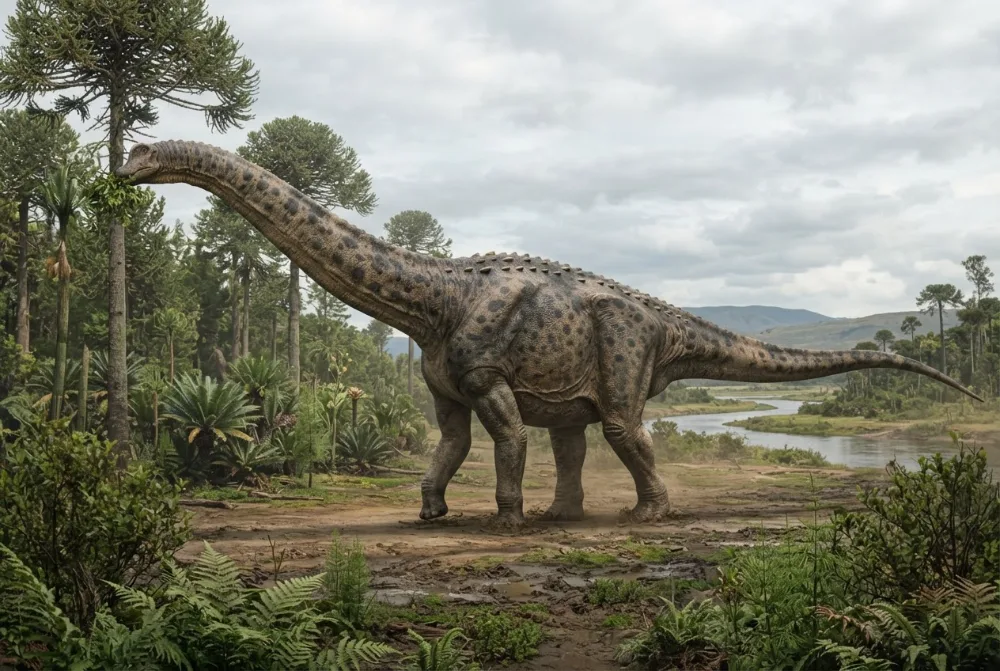
Ikqaumishan was a huge, long-necked plant-eater that stomped around what is now Pakistan and India near the very end of the dinosaur age. It belonged to a group called titanosaurs, which included some of the biggest land animals ever. It probably used its long neck to munch leaves high in trees.21
Cando viviu?
Como era de grande?
Canto medía de longo?
 tan longo coma 22 coches aparcados en fila🍌tan longo coma 560 plátanos postos un tras outro🏃podería correr 100 metros en 24 segundos (o humano máis rápido necesita 9,6)
Como era de grande Ikqaumishan comparado CONTIGO?
Só son contas no teu navegador. Non se garda nin se envía nada.
Que velocidade alcanzaba?


Datos curiosos
Ikqaumishan is known from a partial upper arm bone called a humerus, which was found in Pakistan.2
It lived about 72 to 66 million years ago, during the Maastrichtian age, which is the very last part of the dinosaur era.2
Its upper arm bone had a special ridge that was straight and set inward, which is different from many other titanosaurs.1
The place where it was found was near the equator about 9 degrees south, so it lived in a warm, tropical area.1
Ikqaumishan is one of several new titanosaurs described from Pakistan in 2023, showing that this region had many giant plant-eaters.1
Its fossils were found in rocks that formed in a river environment, so it probably walked along ancient floodplains.2
As preguntas máis frecuentes sobre Ikqaumishan
?What is Ikqaumishan?
Ikqaumishan is a genus of titanosaurian sauropod dinosaur from the Late Cretaceous. It was a huge, long-necked plant-eater.41
?How big was Ikqaumishan?
The exact size is not known, but it was a large titanosaur. The only known fossil is a partial upper arm bone, so scientists can only estimate its size.43
?When did Ikqaumishan live?
Ikqaumishan lived during the Maastrichtian age, about 72 to 66 million years ago, near the very end of the dinosaur age.41
?What did Ikqaumishan eat?
Ikqaumishan was a herbivore, meaning it ate plants. It probably used its long neck to munch leaves high in trees.41
?Where was Ikqaumishan found?
Ikqaumishan fossils were found in Pakistan and India. The main bone, a partial humerus, came from the Vitakri Formation in Balochistan, Pakistan.31
?Is Ikqaumishan a dinosaur?
Yes, Ikqaumishan is a dinosaur. It belongs to the group called titanosaurs, which were long-necked sauropod dinosaurs.41
?Why is it called Ikqaumishan?
The name honors former Prime Minister Imran Khan and journalist Imran Khan, and comes from Urdu/Saraiki words meaning 'nation' and 'respect'.3
Cazamitos
Mito: Some people think all dinosaurs lived in North America or Africa, but Ikqaumishan shows that giant sauropods also lived in South Asia.
Verdade: Ikqaumishan is a real dinosaur from Pakistan and India, proving that titanosaurs thrived in many parts of the ancient world.2
Para expertos en dinos
- Nome científico
- Ikqaumishan
- Bautizado por
- Malkani 20234
- Grupo
- Pescozos longos
- Familia / clado
- Gspsauridae4
- Clasificación
- Sauropodomorpha > Sauropoda > Titanosauria > Macronaria4
- Idade das rochas
- de 72 a 66 millóns de anos (Maastrichtian)4
- Formacións rochosas
- Vitakri, Lameta4
- Países
- Paquistán, India4
- Rexistros fósiles
- 3 na Paleobiology Database4
- Descubrimento
- Ikqaumishan was named by paleontologist M. S. Malkani in 2023. The first fossil, a partial humerus, was found in the Sangiali locality in the Vitakri Formation, Pakistan.21
- Aínda en debate
- Scientists are still debating exactly how many different titanosaur species lived in Pakistan, because many are known from only a few bones.1
De onde veñen os datos
- A Glance on the Mineral Deposits and Stratigraphic Sequential Variations and Structures in Different Sections of Indus Basin (Pakistan): New Titanosaurian Sauropod Dinosaurs from the Latest Maastrichtian Vitakri Formation of Pakistan (scirp.org)
- PBDB Taxon (paleobiodb.org)
- Untitled Document (paleofile.com)
- Ikqaumishan in The Paleobiology Database (CC BY 4.0): idade, lugares, formacións rochosas, clasificación.
Cada dato desta páxina ten un número que leva á súa fonte. Se nos equivocamos nalgo, sentímolo, somos fans dos dinos, non unha revista científica. Escríbenos a [email protected] e arranxámolo.
 Rex ten fame! Dino Wiki é o proxecto dun pai para o seu fillo, que adora os dinosauros, gratis, sen anuncios e sen rastrexadores. Os adultos poden darlle un petisco a Rex para mantelo en liña.Dálle de comer a Rex
 Brachiosaurus
 Diplodocus
 Brontosaurus
 Argentinosaurus
 Camarasaurus
 Morosaurus
 Tyrannosaurus
 Triceratops
 Velociraptor
 Spinosaurus
 Ankylosaurus
 Parasaurolophus