 Que dino es ti? O test
 Batalla de dinos
 Carreira de dinos
 Minixogos de dinos
 Álbum de cromos
 Listas TOP de dinos
 Sorpréndeme!
Kank
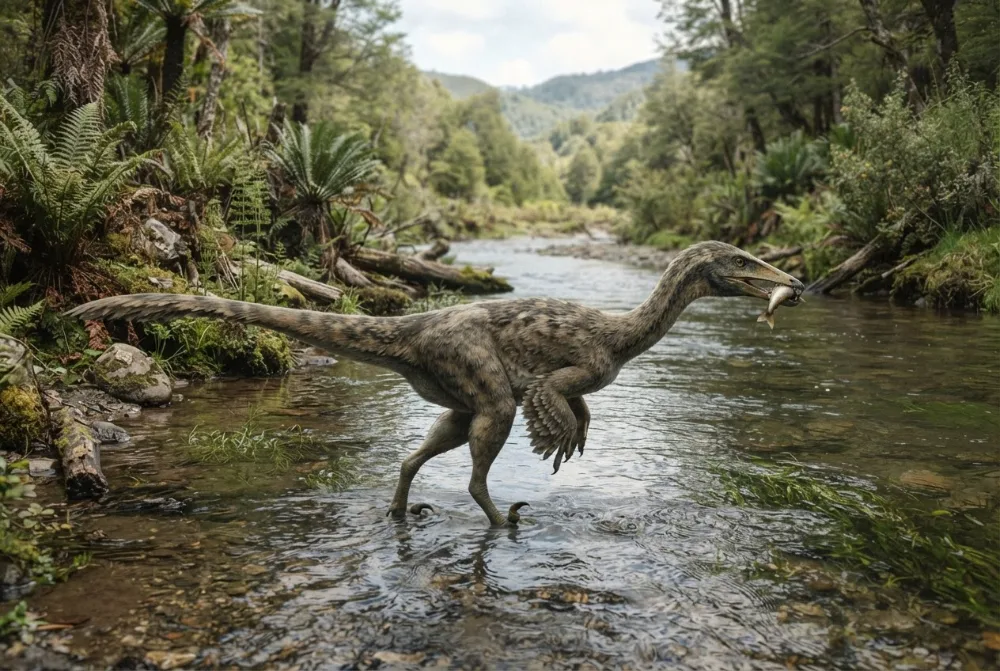
Kank was a fish-eating dinosaur that lived like a modern heron. It waded in rivers and streams in southern Patagonia, using its long neck to snatch fish. This raptor-like dinosaur was about the size of a small car.1
Cando viviu?
Como era de grande?
Canto medía de longo?
Canto medía de alto?
estimación
 tan longo coma 3 cans do fociño á cola🍌tan longo coma 17 plátanos postos un tras outro🏃podería correr 100 metros en 7,2 segundos (o humano máis rápido necesita 9,6)
Como era de grande Kank comparado CONTIGO?
Só son contas no teu navegador. Non se garda nin se envía nada.
Que velocidade alcanzaba?


Datos curiosos
Kank lived about 70 million years ago in a warm, wet place with rivers and ponds.1
Its neck bones had air chambers inside, making them light and strong.1
Kank had a big claw on its second toe, like other raptors, but it probably used it for fishing, not hunting on land.1
The first Kank fossils were found in 2018, but scientists needed more bones to know it was a new species.1
Kank shared its home with giant predators like Maip macrothorax, a megaraptorid over 10 metres long.1
Kank is part of a group called unenlagiids, which are found in South America, Antarctica, Australia and Madagascar.1
As preguntas máis frecuentes sobre Kank
?What did Kank eat?
Kank mostly ate fish, like a modern heron. It may have also eaten frogs, lizards, turtles and small mammals that lived in its wetland home.12
?Did Kank have feathers?
Scientists think Kank probably had feathers, because it belongs to a group of dinosaurs called unenlagiids that are closely related to birds. No direct feather fossils of Kank have been found yet.2
?When did Kank live?
Kank lived about 70 million years ago, during the Late Cretaceous period. That was near the very end of the age of dinosaurs.12
?Where was Kank found?
Kank was discovered at La Anita farm near El Calafate in Santa Cruz, Argentina. The fossils come from the Chorrillo Formation in southern Patagonia.12
?Was Kank bigger than Velociraptor?
Yes, Kank was a bit bigger. Velociraptor was about 2 metres long, while Kank grew up to 3 metres long.1
Cazamitos
Mito: All raptor-like dinosaurs were fast land hunters like Velociraptor.
Verdade: Kank was a fish-eater that behaved like a heron, not a speedy land predator.1
Para expertos en dinos
- Nome científico
- Kank
- Bautizado por
- Motta et al. 20263
- Grupo
- Dinos carnívoros
- Familia / clado
- Unenlagiidae3
- Clasificación
- Theropoda3
- Idade das rochas
- de 72 a 66 millóns de anos (Maastrichtian)3
- Formacións rochosas
- Chorrillo3
- Países
- Arxentina3
- Rexistros fósiles
- 2 na Paleobiology Database3
- Descubrimento
- Kank was named by Matías Motta and his team in 2026, based on fossils found at La Anita farm in Argentina from 2018 to 2024.1
- Aínda en debate
- Scientists are not sure if Kank also ate other animals like frogs or mammals, or only fish.1
De onde veñen os datos
- Heron-like, fish-eating dinosaur from 70 million years ago discovered in Argentina | EurekAlert! (eurekalert.org)
- Kank (Wikipedia) (Wikipedia)
- Kank in The Paleobiology Database (CC BY 4.0): idade, lugares, formacións rochosas, clasificación.
Cada dato desta páxina ten un número que leva á súa fonte. Se nos equivocamos nalgo, sentímolo, somos fans dos dinos, non unha revista científica. Escríbenos a [email protected] e arranxámolo.
 Rex ten fame! Dino Wiki é o proxecto dun pai para o seu fillo, que adora os dinosauros, gratis, sen anuncios e sen rastrexadores. Os adultos poden darlle un petisco a Rex para mantelo en liña.Dálle de comer a Rex
 Allosaurus
 Carnotaurus
 Dilophosaurus
 Giganotosaurus
 Compsognathus
 Paronychodon
 Tyrannosaurus
 Triceratops
 Velociraptor
 Spinosaurus
 Ankylosaurus
 Parasaurolophus