 Que dino es ti? O test
 Batalla de dinos
 Carreira de dinos
 Minixogos de dinos
 Álbum de cromos
 Listas TOP de dinos
 Sorpréndeme!
Leptoceratops
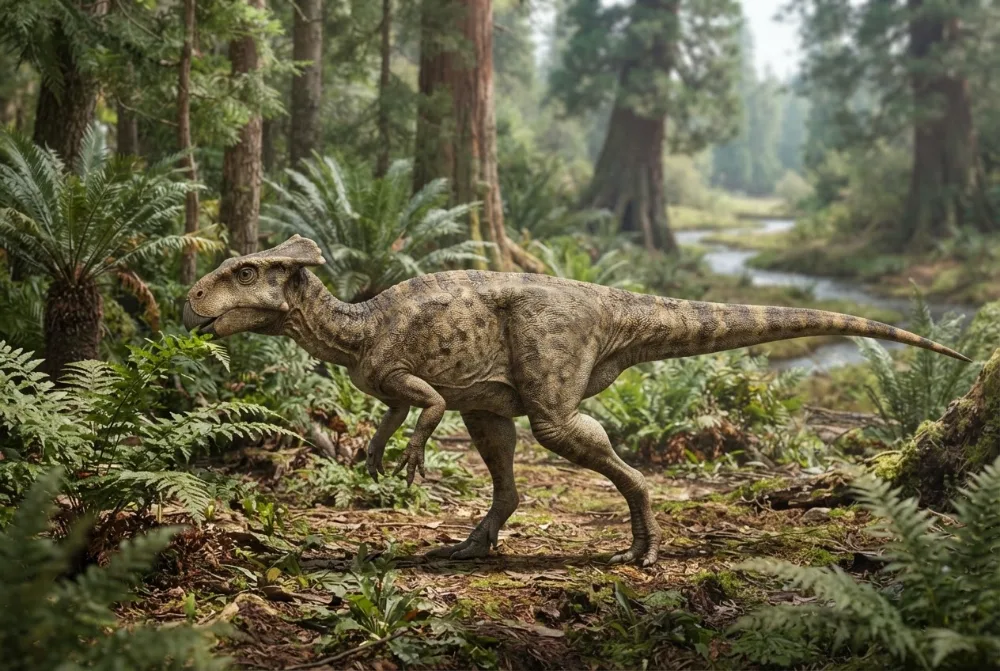
Leptoceratops was a tiny horned dinosaur that lived at the very end of the Age of Dinosaurs. It had a small frill on its head and no horns, and it walked on two legs. Even though it was small, it was a tough plant-eater that lived alongside giants like Triceratops and Tyrannosaurus.1
Cando viviu?
Como era de grande?
Canto medía de longo?
Canto medía de alto?
Canto pesaba?
 tan longo coma 3 cans do fociño á cola🍌tan longo coma 17 plátanos postos un tras outro🍉tan pesado coma 40 sandías🧸tan pesado coma 11 nenos de infantil🎒tan pesado coma 6 nenos de primaria🏃podería correr 100 metros en 9,7 segundos (o humano máis rápido necesita 9,6)
Como era de grande Leptoceratops comparado CONTIGO?
Só son contas no teu navegador. Non se garda nin se envía nada.
Que velocidade alcanzaba?


Datos curiosos
Leptoceratops is one of the smallest horned dinosaurs ever found, only about the size of a large dog.1
Unlike its big cousin Triceratops, Leptoceratops had no horns and only a tiny frill at the back of its skull.1
The first Leptoceratops fossils were discovered in 1910 by Barnum Brown along the Red Deer River in Alberta, Canada.13
Scientists have found at least eight Leptoceratops specimens, including several nearly complete skeletons.2
Leptoceratops lived right at the end of the Cretaceous Period, about 66 to 72 million years ago.6
Some bonebeds in Montana suggest that Leptoceratops may have dug burrows and lived in groups.3
Leptoceratops had a deep, pointed beak and teeth with simple roots, perfect for chewing tough plants.2
As preguntas máis frecuentes sobre Leptoceratops
?How big was Leptoceratops?
About 2 metres (6.6 feet) long and 0.6 to 0.9 metres (2 to 3 feet) tall at the hips, roughly the size of a large dog.14
?Did Leptoceratops have horns?
No, Leptoceratops had no horns, only a small frill on its head, unlike its big cousin Triceratops.14
?What did Leptoceratops eat?
It was a plant-eater that ate tough plants like angiosperms, conifers, and cycads, using its beak and special teeth to chew.1
?Could Leptoceratops walk on two legs?
Yes, it likely walked on two legs when moving fast and on all fours when moving slowly.14
Cazamitos
Mito: Leptoceratops is often thought to be a baby Triceratops because of its small size and simple frill.
Verdade: Leptoceratops is a separate, smaller species of horned dinosaur that lived at the same time as Triceratops. It had its own unique features like a tiny frill and no horns.1
Para expertos en dinos
- Nome científico
- Leptoceratops
- Bautizado por
- Brown 19146
- Grupo
- Dinos con cornos
- Familia / clado
- Leptoceratopsidae6
- Clasificación
- Ornithischia > Ceratopsia6
- Idade das rochas
- de 72 a 66 millóns de anos (Maastrichtian)6
- Formacións rochosas
- Scollard, Hell Creek, "Lance"6
- Países
- EUA, Canadá6
- Rexistros fósiles
- 8 na Paleobiology Database6
- Descubrimento
- Leptoceratops was named by American paleontologist Barnum Brown in 1914, based on a partial skull and skeleton found in 1910 in Alberta, Canada.13
- Aínda en debate
- Scientists still debate whether some fossils from Montana belong to Leptoceratops or to its close relatives Montanoceratops and Cerasinops.1
De onde veñen os datos
- Leptoceratops - Wikipedia (en.wikipedia.org)
- A NEW PARTIAL SKELETON OF LEPTOCERATOPS GRACILIS FROM (experiment-uploads.s3.amazonaws.com)
- LEPTOCERATOPS - DinoChecker dinosaur archive (dinochecker.com)
- Leptoceratops Gracilis, Dinosaur Pictures, Dinosaur Facts - National Geographic | National Geographic (nationalgeographic.com)
- Leptoceratops | Natural History Museum (nhm.ac.uk)
- Leptoceratops in The Paleobiology Database (CC BY 4.0): idade, lugares, formacións rochosas, clasificación.
Cada dato desta páxina ten un número que leva á súa fonte. Se nos equivocamos nalgo, sentímolo, somos fans dos dinos, non unha revista científica. Escríbenos a [email protected] e arranxámolo.
 Rex ten fame! Dino Wiki é o proxecto dun pai para o seu fillo, que adora os dinosauros, gratis, sen anuncios e sen rastrexadores. Os adultos poden darlle un petisco a Rex para mantelo en liña.Dálle de comer a Rex
 Triceratops
 Protoceratops
 Ojoceratops
 Tatankaceratops
 Psittacosaurus
 Centrosaurus
 Tyrannosaurus
 Velociraptor
 Spinosaurus
 Ankylosaurus
 Parasaurolophus
 Pteranodon