 Que dino es ti? O test
 Batalla de dinos
 Carreira de dinos
 Minixogos de dinos
 Álbum de cromos
 Listas TOP de dinos
 Sorpréndeme!
Leptocleidus
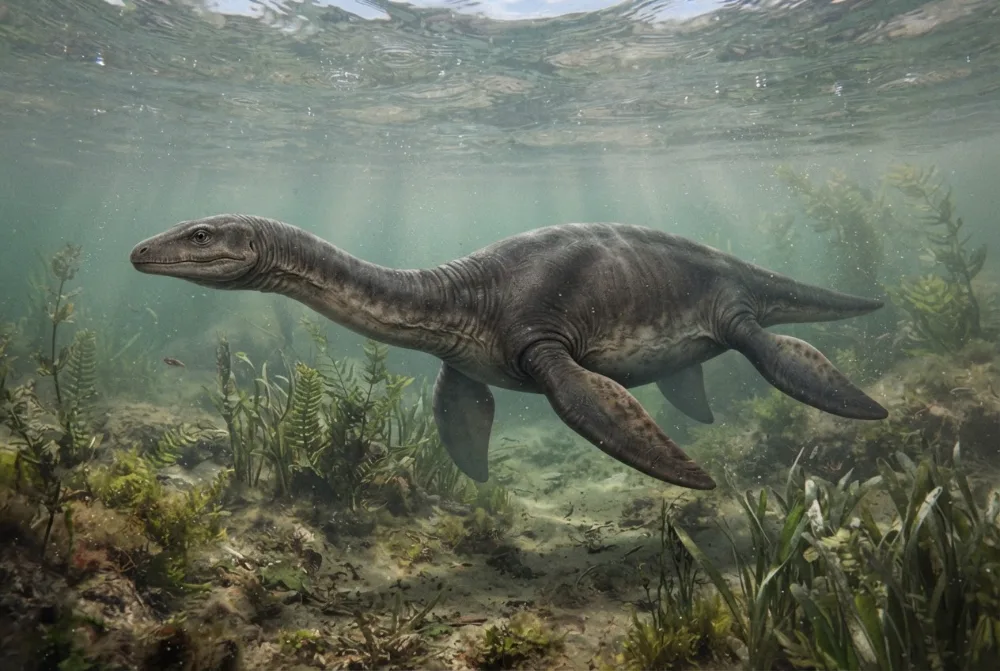
Leptocleidus was a small plesiosaur that swam in shallow seas and rivers during the Early Cretaceous. It had a long neck, a short body, and four flippers to paddle through the water. Unlike many other plesiosaurs, it lived in lagoons and even brackish or fresh water.1
Cando viviu?
Como era de grande?
Canto medía de longo?
 tan longo coma 3 cans do fociño á cola🍌tan longo coma 17 plátanos postos un tras outro🏊podería nadar o longo dunha piscina grande (50 m) en 6,4 segundos
Como era de grande Leptocleidus comparado CONTIGO?
Só son contas no teu navegador. Non se garda nin se envía nada.
Que velocidade alcanzaba?


Datos curiosos
Leptocleidus had about 21 teeth on each side of its upper jaw and around 35 teeth on each side of its lower jaw.1
Its skull was triangle-shaped with a crest running from the tip of the nose to the nasal region.1
Unlike many plesiosaurs, Leptocleidus lived in shallow lagoons and may have entered brackish or fresh water, like river mouths.1
Scientists think Leptocleidus moved into fresh water to escape larger plesiosaurs and pliosaurs.1
The name Leptocleidus comes from Greek words meaning 'slender clavicle', referring to its thin collarbone.1
Leptocleidus had large clavicles and interclavicle bones but small shoulder blades, similar to the early Jurassic Rhomaleosaurus.1
A specimen from the Isle of Wight, once thought to be Leptocleidus, was later named a separate genus, Vectocleidus, in 2012.1
As preguntas máis frecuentes sobre Leptocleidus
?How big was Leptocleidus?
Leptocleidus was small for a plesiosaur, measuring up to 3 metres (9.8 feet) long. One species, Leptocleidus superstes, was even smaller at about 1.5 metres (5 feet).13
?Was Leptocleidus a dinosaur?
No, Leptocleidus was not a dinosaur. It was a plesiosaur, a type of extinct marine reptile that lived in the sea.13
Para expertos en dinos
- Nome científico
- Leptocleidus
- Bautizado por
- Andrews 19224
- Grupo
- Plesiosauros
- Familia / clado
- Leptocleididae4
- Clasificación
- Plesiosauria > Sauropterygia4
- Idade das rochas
- de 143 a 100 millóns de anos (Berriasian / Albian)4
- Formacións rochosas
- Murderong Shale, Bulldog Shale, Weald Clay4
- Países
- Australia, Reino Unido, Suráfrica4
- Rexistros fósiles
- 7 na Paleobiology Database4
- Tamén coñecido como
- Peyerus (nomes antigos que agora contan como o mesmo animal)4
- Descubrimento
- Leptocleidus was named by Charles William Andrews in 1922 based on a partial skeleton and skull from the Weald Clay of Berwick, Sussex, England.41
- Aínda en debate
- Scientists debate whether Leptocleidus belongs within the group Rhomaleosauridae or in its own separate clade called Leptocleididae.2
De onde veñen os datos
- Leptocleidus (en.wikipedia.org)
- Reassessment of the Lower Cretaceous (Barremian) pliosauroid Leptocleidus superstes Andrews, 1922 and other plesiosaur remains from the nonmarine Wealden succession of southern England | Zoological Journal of the Linnean Society | Oxford Academic (academic.oup.com)
- Leptocleidus Facts for Kids (kids.kiddle.co)
- Leptocleidus in The Paleobiology Database (CC BY 4.0): idade, lugares, formacións rochosas, clasificación.
Cada dato desta páxina ten un número que leva á súa fonte. Se nos equivocamos nalgo, sentímolo, somos fans dos dinos, non unha revista científica. Escríbenos a [email protected] e arranxámolo.
 Rex ten fame! Dino Wiki é o proxecto dun pai para o seu fillo, que adora os dinosauros, gratis, sen anuncios e sen rastrexadores. Os adultos poden darlle un petisco a Rex para mantelo en liña.Dálle de comer a Rex
 Elasmosaurus
 Pliosaurus
 Plesiosaurus
 Cimoliasaurus
 Colymbosaurus
 Trinacromerum
 Stegosaurus
 Iguanodon
 Archaeopteryx
 Giganotosaurus
 Microraptor
 Deinonychus