 Que dino es ti? O test
 Batalla de dinos
 Carreira de dinos
 Minixogos de dinos
 Álbum de cromos
 Listas TOP de dinos
 Sorpréndeme!
Libonectes
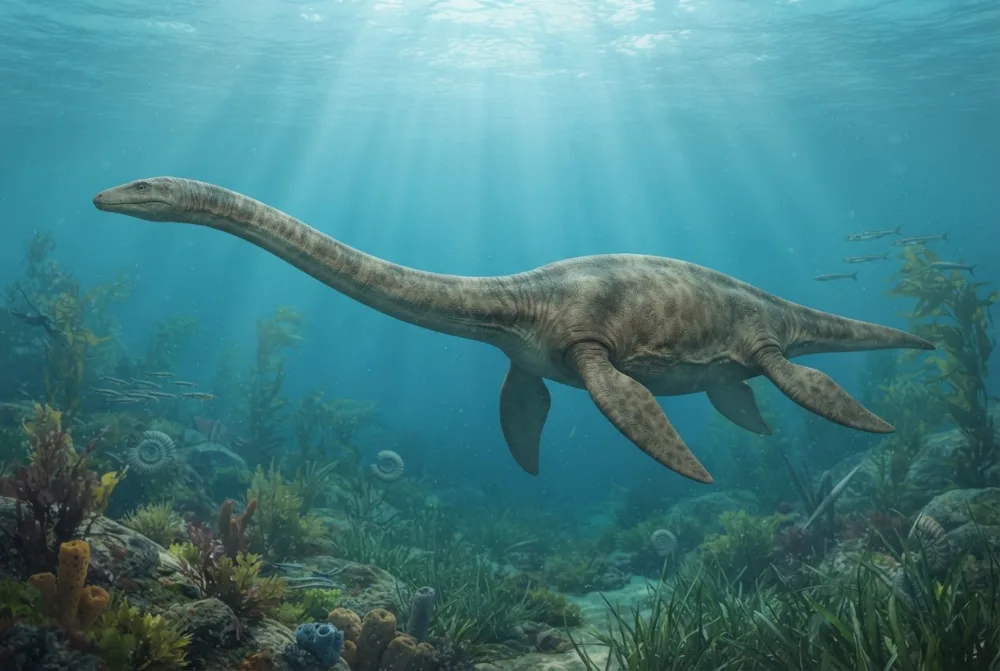
Libonectes was a long-necked marine reptile that swam in warm seas during the time of the dinosaurs. It used its strong flippers to paddle through the water and may have swallowed fish and ammonites whole. Fossils show it had a skull that is one of the best preserved of any elasmosaurid plesiosaur.1
Cando viviu?
Como era de grande?
Canto medía de longo?
 tan longo coma 7 cans do fociño á cola🍌tan longo coma 40 plátanos postos un tras outro🏊podería nadar o longo dunha piscina grande (50 m) en 7,2 segundos
Como era de grande Libonectes comparado CONTIGO?
Só son contas no teu navegador. Non se garda nin se envía nada.
Que velocidade alcanzaba?


Datos curiosos
Libonectes had a neck that was 5.06 metres (16.6 feet) long, more than two-thirds of its total body length.1
The first fossils were found by a farmer named T.W. Tidwell in the late 1930s in Texas.1
Its skull is the best preserved skull of any elasmosaurid plesiosaur ever found.1
Libonectes lived about 93 million years ago, during the Late Cretaceous period.3
It was originally named Elasmosaurus morgani in 1949, but was given its own genus, Libonectes, in 1997.1
Gastroliths (stomach stones) have been found inside Libonectes fossils, which may have helped it digest food or control its buoyancy in the water.1
Libonectes probably swam slowly and used its large size to trap prey.1
As preguntas máis frecuentes sobre Libonectes
?How big was Libonectes?
Libonectes was a medium-sized plesiosaur, about 7.2 metres (24 feet) long. Its neck alone was 5.06 metres (16.6 feet) long.1
?What did Libonectes eat?
Libonectes probably ate small fish and ammonites. It may have swallowed prey whole and used stomach stones to help digest food.1
Cazamitos
Mito: Some people think plesiosaurs like Libonectes could lift their heads and necks high out of the water like a swan.
Verdade: Scientists now believe their necks were not flexible enough to lift high above the water. They probably held their necks more horizontally while swimming.1
Para expertos en dinos
- Nome científico
- Libonectes
- Bautizado por
- Carpenter 19973
- Grupo
- Plesiosauros
- Familia / clado
- Elasmosauridae3
- Clasificación
- Plesiosauria > Elasmosauridae > Sauropterygia3
- Idade das rochas
- de 100 a 90 millóns de anos (Cenomanian / Turonian)3
- Formacións rochosas
- Britton, Akrabou3
- Países
- EUA, Marrocos3
- Rexistros fósiles
- 2 na Paleobiology Database3
- Descubrimento
- The first Libonectes fossils were found by tenant farmer T.W. Tidwell in the late 1930s in Texas. Charles Gill Morgan prepared the fossils, and the species was named Elasmosaurus morgani by Welles in 1949. It was reclassified as its own genus Libonectes by Carpenter in 1997.1
- Aínda en debate
- Scientists are not sure whether Libonectes was a pure carnivore or an omnivore, because gastroliths could indicate plant eating or just buoyancy control.1
De onde veñen os datos
- Libonectes (en.wikipedia.org)
- Libonectes morgani, an elasmosaur with transatlantic dispersal (sachspal.de)
- Libonectes in The Paleobiology Database (CC BY 4.0): idade, lugares, formacións rochosas, clasificación.
Cada dato desta páxina ten un número que leva á súa fonte. Se nos equivocamos nalgo, sentímolo, somos fans dos dinos, non unha revista científica. Escríbenos a [email protected] e arranxámolo.
 Rex ten fame! Dino Wiki é o proxecto dun pai para o seu fillo, que adora os dinosauros, gratis, sen anuncios e sen rastrexadores. Os adultos poden darlle un petisco a Rex para mantelo en liña.Dálle de comer a Rex
 Elasmosaurus
 Pliosaurus
 Plesiosaurus
 Cimoliasaurus
 Colymbosaurus
 Trinacromerum
 Tyrannosaurus
 Triceratops
 Velociraptor
 Spinosaurus
 Ankylosaurus
 Parasaurolophus