 Que dino es ti? O test
 Batalla de dinos
 Carreira de dinos
 Minixogos de dinos
 Álbum de cromos
 Listas TOP de dinos
 Sorpréndeme!
Cando viviu?

Como era de grande?
Canto medía de longo?
Canto medía de alto?
estimación
Canto pesaba?
 tan longo coma 5 cans do fociño á cola🍌tan longo coma 28 plátanos postos un tras outro🍉tan pesado coma 190 sandías🧸tan pesado coma 51 nenos de infantil🎒tan pesado coma 30 nenos de primaria🐻❄️tan pesado coma 2 osos polares🏃podería correr 100 metros en 12 segundos (o humano máis rápido necesita 9,6)
Como era de grande Magyarosaurus comparado CONTIGO?
Só son contas no teu navegador. Non se garda nin se envía nada.
Que velocidade alcanzaba?


Datos curiosos
Magyarosaurus is a famous example of island dwarfism, where animals become smaller when living on islands with limited resources.2
It lived during the Late Cretaceous period, about 71 to 66 million years ago.1
The first fossils were described by Baron Franz Nopcsa in 1915, who named it Titanosaurus dacus.2
Magyarosaurus was a titanosaur, a group of sauropods that includes some of the largest dinosaurs ever.1
Scientists have found bones from many individuals, including skull pieces, which is rare for sauropods.2
In 2024, a study suggested that there were actually four different titanosaur species living in the same area, including the giant Uriash kadici.2
As preguntas máis frecuentes sobre Magyarosaurus
?How big was Magyarosaurus?
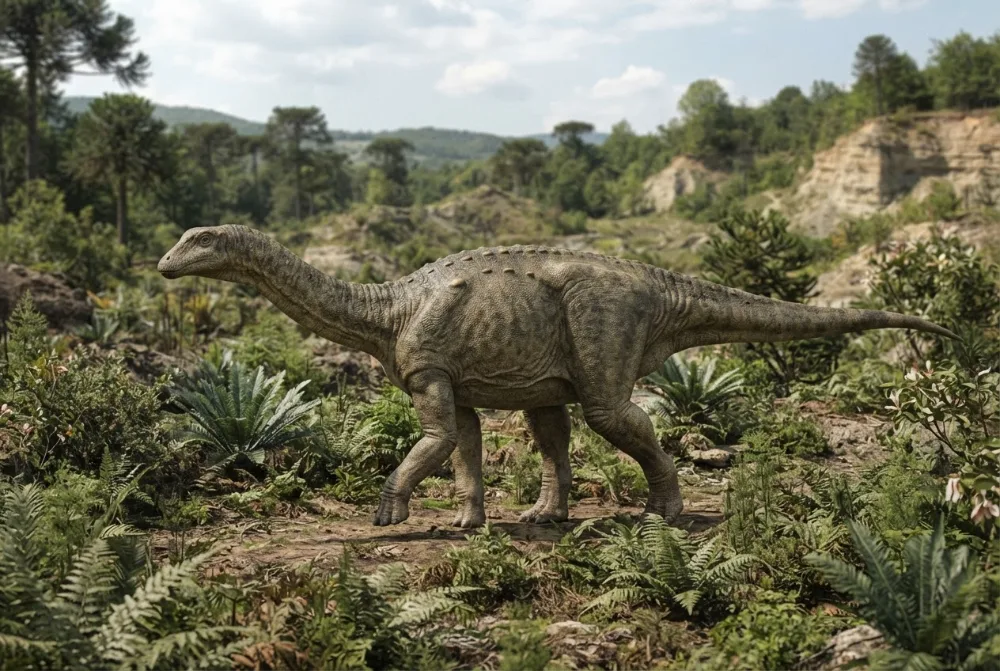
Magyarosaurus was one of the smallest adult sauropods, measuring about 6 metres (20 feet) long and weighing up to 972 kilograms (2,143 pounds).3
?Why was Magyarosaurus so small?
It was a dwarf dinosaur because it lived on an island with limited food, a process called island dwarfism. Scientists confirmed this by studying its bone growth.34
?Did Magyarosaurus have feathers?
No, Magyarosaurus was a sauropod and did not have feathers. It had scaly skin and some bony armour plates called osteoderms.3
?What did Magyarosaurus eat?
Magyarosaurus was a plant-eater, like all sauropods. It ate ferns, cycads and other vegetation that grew on its island home.3
?When did Magyarosaurus live?
Magyarosaurus lived during the Late Cretaceous Period, about 71 to 66 million years ago.3
?Was Magyarosaurus a dinosaur?
Yes, Magyarosaurus was a dinosaur. It was a sauropod, a long-necked plant-eating dinosaur.3
?Could Magyarosaurus swim?
Nobody knows for sure, but like most sauropods it probably lived on land and was not a strong swimmer. It lived on an island, so it may have waded in shallow water.3
?How fast could Magyarosaurus run?
Scientists do not know its exact speed, but as a small sauropod it was likely slower than a modern horse. Its leg bones suggest it was not built for fast running.3
Cazamitos
Mito: Magyarosaurus was a baby or juvenile of a larger sauropod.
Verdade: Studies of its bones show that Magyarosaurus was a fully grown adult, not a baby. It was a true dwarf species.2
Para expertos en dinos
- Nome científico
- Magyarosaurus
- Bautizado por
- Huene 19325
- Grupo
- Pescozos longos
- Familia / clado
- Eutitanosauria5
- Clasificación
- Sauropodomorpha > Sauropoda > Titanosauria > Macronaria5
- Idade das rochas
- de 72 a 66 millóns de anos (Maastrichtian)5
- Formacións rochosas
- Sebeş, Densuș-Ciula, Pui Beds5
- Países
- Romanía5
- Rexistros fósiles
- 11 na Paleobiology Database5
- Descubrimento
- Baron Franz Nopcsa first described the fossils in 1915, calling it Titanosaurus dacus. In 1932, Friedrich von Huene gave it its own genus, Magyarosaurus.2
- Aínda en debate
- Scientists still debate whether all the small titanosaur fossils from Romania belong to Magyarosaurus or to several different species.2
De onde veñen os datos
- Magyarosaurus (nhm.ac.uk)
- Full article: Revision of Romanian sauropod dinosaurs reveals high titanosaur diversity and body-size disparity on the latest Cretaceous Haţeg Island, with implications for titanosaurian biogeography (tandfonline.com)
- Magyarosaurus (en.wikipedia.org)
- Small body size and extreme cortical bone remodeling indicate phyletic dwarfism in Magyarosaurus dacus (Sauropoda: Titanosauria) (pubmed.ncbi.nlm.nih.gov)
- Magyarosaurus in The Paleobiology Database (CC BY 4.0): idade, lugares, formacións rochosas, clasificación.
Cada dato desta páxina ten un número que leva á súa fonte. Se nos equivocamos nalgo, sentímolo, somos fans dos dinos, non unha revista científica. Escríbenos a [email protected] e arranxámolo.
 Rex ten fame! Dino Wiki é o proxecto dun pai para o seu fillo, que adora os dinosauros, gratis, sen anuncios e sen rastrexadores. Os adultos poden darlle un petisco a Rex para mantelo en liña.Dálle de comer a Rex
 Brachiosaurus
 Diplodocus
 Brontosaurus
 Argentinosaurus
 Camarasaurus
 Morosaurus
 Tyrannosaurus
 Triceratops
 Velociraptor
 Spinosaurus
 Ankylosaurus
 Parasaurolophus