 Que dino es ti? O test
 Batalla de dinos
 Carreira de dinos
 Minixogos de dinos
 Álbum de cromos
 Listas TOP de dinos
 Sorpréndeme!
Maiaspondylus
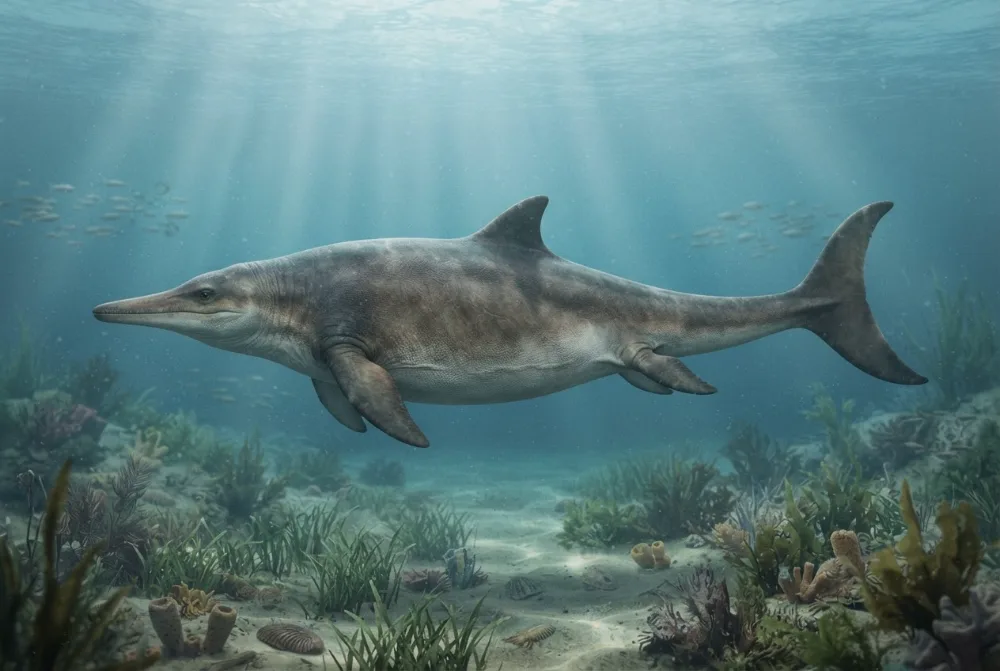
Maiaspondylus was a marine reptile that lived in the sea, not a dinosaur. It was an ichthyosaur, a fast-swimming predator with a long snout and sharp teeth. Fossils show that it gave birth to live babies, just like whales and dolphins do today.1
Cando viviu?
Como era de grande?
Canto medía de longo?
 tan longo coma 4 cans do fociño á cola🍌tan longo coma 22 plátanos postos un tras outro🏊podería nadar o longo dunha piscina grande (50 m) en 3,8 segundos
Como era de grande Maiaspondylus comparado CONTIGO?
Só son contas no teu navegador. Non se garda nin se envía nada.
Que velocidade alcanzaba?


Datos curiosos
Maiaspondylus means 'caring mother vertebra' because a fossil was found with two embryos inside an adult, showing it gave live birth.1
The embryos found inside the adult are the smallest and youngest ichthyosaur embryos ever discovered.1
Maiaspondylus lived about 110 million years ago during the Early Cretaceous period.1
Its fossils were first found in the Loon River Formation in Canada's Northwest Territories.1
Maiaspondylus had a special skull bone arrangement: the jugal and maxilla overlapped a lot, which helped scientists tell it apart from other ichthyosaurs.2
Its teeth had smooth crowns and fluted cementum (the root covering), and they curved inward toward the tongue.2
The arm bone (humerus) of Maiaspondylus had three knobs at the end for muscles, with the middle knob smaller than the outer ones.2
As preguntas máis frecuentes sobre Maiaspondylus
?How big was Maiaspondylus?
No one knows for sure because no complete skeleton has been found. The known fossils include a nearly complete skeleton and vertebrae from adults, but scientists have not estimated its total length.1
?Did Maiaspondylus give live birth?
Yes. A fossil of an adult Maiaspondylus was found with two embryos inside, proving it gave birth to live babies, just like whales and dolphins.13
?Where was Maiaspondylus found?
Its fossils were first found in the Loon River Formation in Canada's Northwest Territories. Later, fossils were also found in England and Russia.1
Para expertos en dinos
- Nome científico
- Maiaspondylus
- Bautizado por
- Maxwell and Caldwell 20064
- Grupo
- Ictiosauros
- Familia / clado
- Ophthalmosauridae4
- Clasificación
- Ichthyosauria > Ichthyosauromorpha4
- Idade das rochas
- de 110 a 106 millóns de anos (Albian)4
- Formacións rochosas
- Loon River4
- Países
- Canadá4
- Rexistros fósiles
- 1 na Paleobiology Database4
- Descubrimento
- Maiaspondylus was named by scientists Erin Maxwell and Michael Caldwell in 2006. The fossils were found by technician Allan Lindoe, who collected and prepared them.1
- Aínda en debate
- Scientists are still debating exactly how Maiaspondylus is related to other ichthyosaurs, especially the genus Platypterygius.1
De onde veñen os datos
- Maiaspondylus (en.wikipedia.org)
- A NEW GENUS OF ICHTHYOSAUR FROM THE LOWER CRETACEOUS OF WESTERN CANADA (onlinelibrary.wiley.com)
- Pregnant prehistoric fossil offers clues to past | EurekAlert! (eurekalert.org)
- Maiaspondylus in The Paleobiology Database (CC BY 4.0): idade, lugares, formacións rochosas, clasificación.
Cada dato desta páxina ten un número que leva á súa fonte. Se nos equivocamos nalgo, sentímolo, somos fans dos dinos, non unha revista científica. Escríbenos a [email protected] e arranxámolo.
 Rex ten fame! Dino Wiki é o proxecto dun pai para o seu fillo, que adora os dinosauros, gratis, sen anuncios e sen rastrexadores. Os adultos poden darlle un petisco a Rex para mantelo en liña.Dálle de comer a Rex
 Ichthyosaurus
 Platypterygius
 Stenopterygius
 Khudiakovia
 Ophthalmosaurus
 Chonespondylus
 Stegosaurus
 Iguanodon
 Archaeopteryx
 Giganotosaurus
 Microraptor
 Deinonychus