 Que dino es ti? O test
 Batalla de dinos
 Carreira de dinos
 Minixogos de dinos
 Álbum de cromos
 Listas TOP de dinos
 Sorpréndeme!
Miragaia
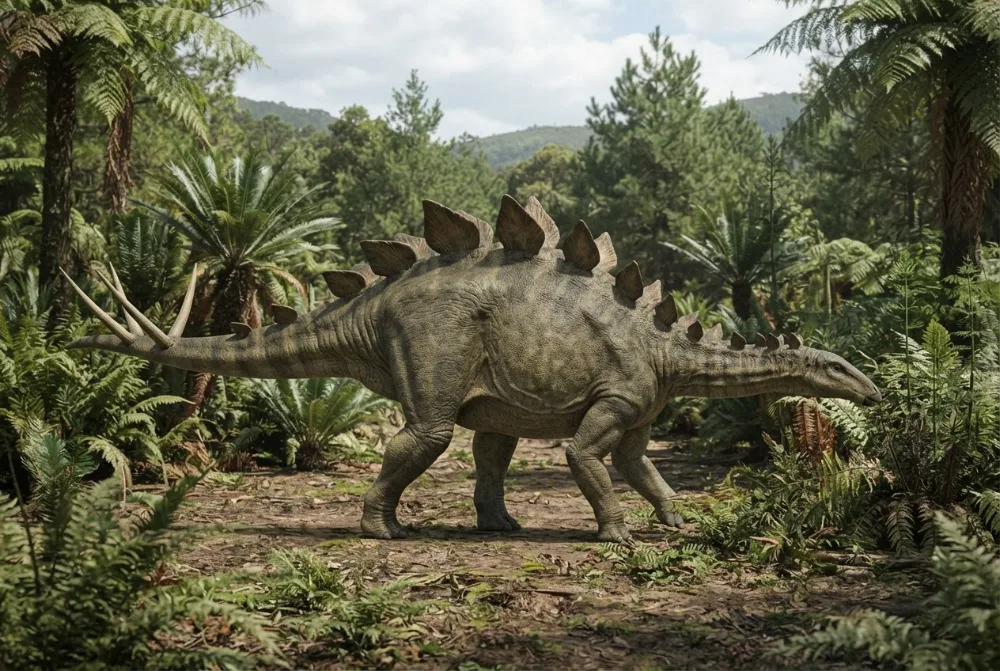
Miragaia was a stegosaur, a plant-eating dinosaur with plates and spines on its back. It had an unusually long neck, much longer than most other stegosaurs. This gentle giant lived in what is now Portugal and the United States during the Late Jurassic period.12
Cando viviu?
Como era de grande?
Canto medía de longo?
Canto medía de alto?
estimación
 tan longo coma 6 cans do fociño á cola🍌tan longo coma 36 plátanos postos un tras outro🏃podería correr 100 metros en 24 segundos (o humano máis rápido necesita 9,6)
Como era de grande Miragaia comparado CONTIGO?
Só son contas no teu navegador. Non se garda nin se envía nada.
Que velocidade alcanzaba?


Datos curiosos
Miragaia had at least 17 neck vertebrae, giving it a very long neck for a stegosaur. Most stegosaurs had fewer than 13.1
The name Miragaia comes from the village where it was found, Miragaia in Portugal, and also means 'wonderful goddess of the Earth'.1
Miragaia belonged to a group called Dacentrurinae, which includes its close relative Dacentrurus. Scientists used to think many stegosaur fossils from Portugal and Spain were Dacentrurus, but now they know some are Miragaia.1
A nearly complete skeleton of Miragaia was discovered in 1959 in Atouguia da Baleia, Peniche, Portugal, but it was not described until many years later.1
Miragaia shared features with a stegosaur from Wyoming called Alcovasaurus longispinus, suggesting that a land bridge once connected North America and Iberia (Portugal and Spain).1
The plates on Miragaia's back were probably used for display, and the spines on its tail (called a thagomizer) could have been a weapon against predators.1
Cazamitos
Mito: Miragaia is sometimes thought to be a species of Dacentrurus.
Verdade: Scientists now agree that Miragaia is a separate, valid genus, different from Dacentrurus in many ways, such as its longer neck and different vertebrae.1
Para expertos en dinos
- Nome científico
- Miragaia
- Bautizado por
- Mateus et al. 20093
- Grupo
- Dinos con placas
- Familia / clado
- Stegosauridae3
- Clasificación
- Ornithischia > Stegosauria > Thyreophora3
- Idade das rochas
- de 155 a 121 millóns de anos (Kimmeridgian / Barremian)3
- Formacións rochosas
- Morrison3
- Países
- EUA3
- Rexistros fósiles
- 31 na Paleobiology Database3
- Descubrimento
- Miragaia was named in 2009 by Octávio Mateus and colleagues, based on a partial skeleton found near the village of Miragaia in the Lourinhã Formation of Portugal. The holotype specimen includes much of the front half of the skeleton.1
- Aínda en debate
- Scientists still debate exactly how many species of Miragaia existed, and whether some fossils from North America belong to this genus or to its close relative Dacentrurus.2
De onde veñen os datos
- Dacentrurine stegosaurs (Dinosauria): A new specimen of Miragaia longicollum from the Late Jurassic of Portugal resolves taxonomical validity and shows the occurrence of the clade in North America (pmc.ncbi.nlm.nih.gov)
- Dacentrurine Stegosaurs in North America: New Occurrences from the Upper Jurassic of USA (Morrison Formation) (dinodata.de)
- Miragaia in The Paleobiology Database (CC BY 4.0): idade, lugares, formacións rochosas, clasificación.
Cada dato desta páxina ten un número que leva á súa fonte. Se nos equivocamos nalgo, sentímolo, somos fans dos dinos, non unha revista científica. Escríbenos a [email protected] e arranxámolo.
 Rex ten fame! Dino Wiki é o proxecto dun pai para o seu fillo, que adora os dinosauros, gratis, sen anuncios e sen rastrexadores. Os adultos poden darlle un petisco a Rex para mantelo en liña.Dálle de comer a Rex
 Stegosaurus
 Diracodon
 Hypsirophus
 Dacentrurus
 Kentrosaurus
 Hesperosaurus
 Iguanodon
 Archaeopteryx
 Giganotosaurus
 Microraptor
 Deinonychus
 Baryonyx