 Que dino es ti? O test
 Batalla de dinos
 Carreira de dinos
 Minixogos de dinos
 Álbum de cromos
 Listas TOP de dinos
 Sorpréndeme!
Monoclonius
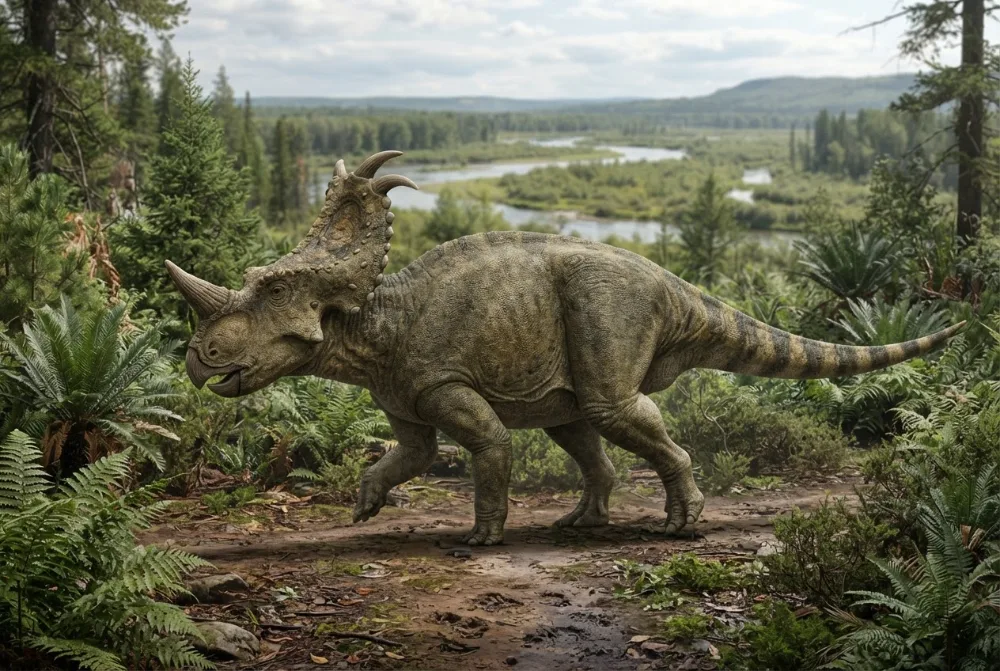
Monoclonius was a plant-eating dinosaur with a big frill on its head and a horn on its nose. It lived about 75 million years ago in what is now Montana and Alberta. Scientists are not sure if Monoclonius is really its own dinosaur or just a young version of another dinosaur called Centrosaurus.12
Cando viviu?
Como era de grande?
Canto medía de longo?
Canto medía de alto?
estimación
Canto pesaba?

 tan longo coma 6 cans do fociño á cola🍌tan longo coma 31 plátanos postos un tras outrotan pesado coma 110 cans🍉tan pesado coma 430 sandías🎒tan pesado coma 2,5 clases enteiras de nenos🐻❄️tan pesado coma 5 osos polares🏃podería correr 100 metros en 11 segundos (o humano máis rápido necesita 9,6)
Como era de grande Monoclonius comparado CONTIGO?
Só son contas no teu navegador. Non se garda nin se envía nada.
Que velocidade alcanzaba?


Datos curiosos
Monoclonius was named in 1876 by the famous fossil hunter Edward Drinker Cope, just months after the Battle of the Little Bighorn.1
The name Monoclonius means 'single sprout' and refers to how its teeth grew, not to a horn. Cope thought only one set of teeth was used at a time.1
Many fossils once called Monoclonius are now thought to belong to other dinosaurs, like Centrosaurus or Styracosaurus.1
The type species is Monoclonius crassus, which means 'the fat one' in Latin.1
Monoclonius fossils have been found in the Judith River Formation in Montana and the Dinosaur Park Formation in Alberta.12
When Cope first described Monoclonius, he did not realize it was a horned dinosaur. He thought the skull frill was part of the breastbone.1
As preguntas máis frecuentes sobre Monoclonius
?How big was Monoclonius?
Monoclonius was up to 5 metres (16.5 feet) long and may have weighed about 2,170 kilograms (4,780 pounds).4
?What did Monoclonius eat?
Monoclonius was an herbivore, a plant eater. It probably ate cycads, palms, and other prehistoric plants with its tough, hook-like beak.4
?When did Monoclonius live?
Monoclonius lived in the Late Cretaceous period, about 76 to 73 million years ago, toward the end of the age of dinosaurs.4
?Why is Monoclonius called a nomen dubium?
Monoclonius is often considered a nomen dubium, or doubtful name, because the fossils are too incomplete or immature to be confidently matched with adult specimens. Many are thought to be young Centrosaurus.1
?Did Monoclonius have a horn on its nose?
Yes, Monoclonius had a single nose horn that pointed upwards and two smaller horns over its eyes, plus a small frill on its head.4
?Where were Monoclonius fossils found?
Monoclonius fossils have been found in Montana, USA, and Alberta, Canada.4
Cazamitos
Mito: Monoclonius means 'single horn'.
Verdade: Monoclonius actually means 'single sprout', referring to its teeth, not a horn. Cope named it before he knew it was a horned dinosaur.1
Para expertos en dinos
- Nome científico
- Monoclonius
- Bautizado por
- Cope 18765
- Grupo
- Dinos con cornos
- Familia / clado
- Ceratopsidae5
- Clasificación
- Ornithischia > Ceratopsia > Ceratopsidae5
- Idade das rochas
- de 84 a 72 millóns de anos (Campanian)5
- Formacións rochosas
- Oldman, Judith River, Kirtland5
- Países
- EUA, Canadá5
- Rexistros fósiles
- 13 na Paleobiology Database5
- Descubrimento
- Edward Drinker Cope named Monoclonius in 1876 based on fossils found near the Judith River in Montana by himself and a young Charles Sternberg.1
- Aínda en debate
- Scientists debate whether Monoclonius is a valid genus or just a mix of juvenile Centrosaurus and other ceratopsids. Many consider it a nomen dubium (doubtful name).12
De onde veñen os datos
- Monoclonius (en.wikipedia.org)
- PBDB Taxon (paleobiodb.org)
- Monoclonius Cope 1876 - Encyclopedia of Life (eol.org)
- enchantedlearning.com (enchantedlearning.com)
- Monoclonius in The Paleobiology Database (CC BY 4.0): idade, lugares, formacións rochosas, clasificación.
Cada dato desta páxina ten un número que leva á súa fonte. Se nos equivocamos nalgo, sentímolo, somos fans dos dinos, non unha revista científica. Escríbenos a [email protected] e arranxámolo.
 Rex ten fame! Dino Wiki é o proxecto dun pai para o seu fillo, que adora os dinosauros, gratis, sen anuncios e sen rastrexadores. Os adultos poden darlle un petisco a Rex para mantelo en liña.Dálle de comer a Rex
 Triceratops
 Protoceratops
 Ojoceratops
 Tatankaceratops
 Psittacosaurus
 Centrosaurus
 Tyrannosaurus
 Velociraptor
 Spinosaurus
 Ankylosaurus
 Parasaurolophus
 Pteranodon