 Que dino es ti? O test
 Batalla de dinos
 Carreira de dinos
 Minixogos de dinos
 Álbum de cromos
 Listas TOP de dinos
 Sorpréndeme!
Nichollsia
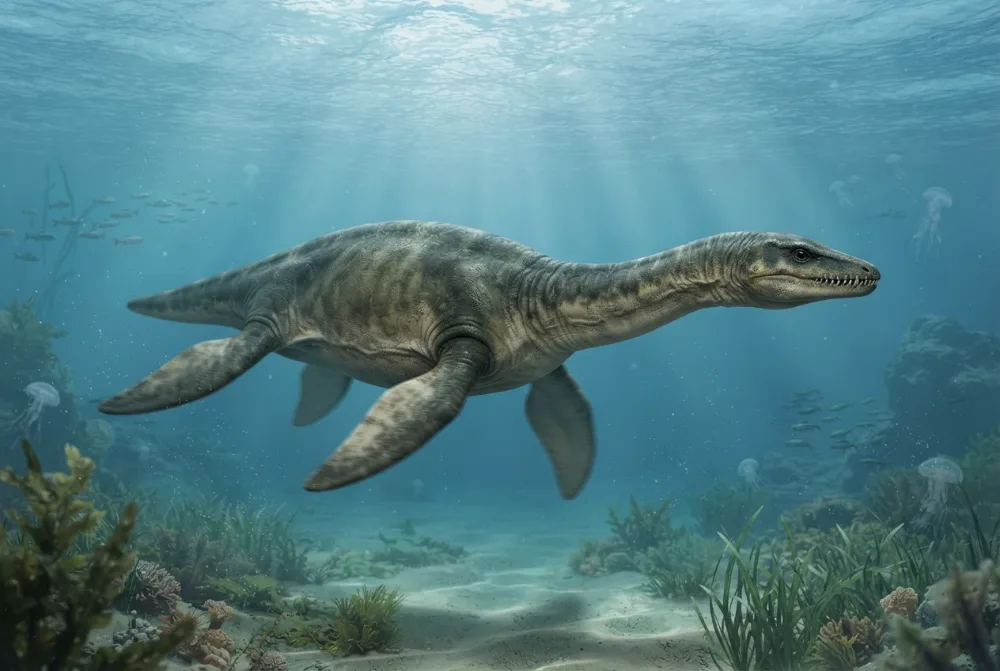
Nichollssaura was a small, fast-swimming marine reptile that lived in the sea that once covered Alberta, Canada. It was a plesiosaur, not a dinosaur, and had a long neck and four flippers for paddling through the water. This creature helps scientists fill in a big 40-million-year gap in the plesiosaur fossil record of North America.1
Cando viviu?
Como era de grande?
Canto medía de longo?
Canto pesaba?
 tan longo coma 3 cans do fociño á cola🍌tan longo coma 16 plátanos postos un tras outro🍉tan pesado coma 27 sandías🧸tan pesado coma 7 nenos de infantil🎒tan pesado coma 4 nenos de primaria🏊podería nadar o longo dunha piscina grande (50 m) en 6,4 segundos
Como era de grande Nichollsia comparado CONTIGO?
Só son contas no teu navegador. Non se garda nin se envía nada.
Que velocidade alcanzaba?


Datos curiosos
The fossil was discovered accidentally by giant electric shovel operators in an oilsand mine. The shovel cut off some bones, but the rest of the skeleton was almost complete.1
This plesiosaur was named after Dr. Betsy Nicholls, a famous paleontologist. The first name Nichollsia was already used for a type of isopod, so scientists changed it to Nichollssaura.1
Nichollssaura had 165 gastroliths (stomach stones) inside it. The stones were smooth and round, probably swallowed to help grind food.1
The stomach stones came from rocks that were 8 to 10 million years older than the plesiosaur itself. This suggests Nichollssaura may have swum west to collect pebbles from ancient beaches.1
It lived about 110 million years ago in the Boreal Sea, a warm shallow sea that covered parts of North America.1
The holotype specimen is on display at the Royal Tyrrell Museum in Alberta, Canada.1
Para expertos en dinos
- Nome científico
- Nichollsia
- Bautizado por
- Druckenmiller and Russell 20082
- Grupo
- Plesiosauros
- Familia / clado
- Leptocleididae2
- Clasificación
- Plesiosauria > Sauropterygia2
- Idade das rochas
- de 113 a 100 millóns de anos (Albian)2
- Rexistros fósiles
- 1 na Paleobiology Database2
- Descubrimento
- The specimen was found in 1994 by shovel operators Greg Fisher and Lorne Cundal at a Syncrude oilsand mine in Alberta. It was named Nichollsia borealis by Druckenmiller and Russell in 2008, but the name was changed to Nichollssaura in 2009 because Nichollsia was already taken.12
De onde veñen os datos
- Nichollssaura (en.wikipedia.org)
- Nichollsia in The Paleobiology Database (CC BY 4.0): idade, lugares, formacións rochosas, clasificación.
Cada dato desta páxina ten un número que leva á súa fonte. Se nos equivocamos nalgo, sentímolo, somos fans dos dinos, non unha revista científica. Escríbenos a [email protected] e arranxámolo.
 Rex ten fame! Dino Wiki é o proxecto dun pai para o seu fillo, que adora os dinosauros, gratis, sen anuncios e sen rastrexadores. Os adultos poden darlle un petisco a Rex para mantelo en liña.Dálle de comer a Rex
 Elasmosaurus
 Pliosaurus
 Plesiosaurus
 Cimoliasaurus
 Colymbosaurus
 Trinacromerum
 Stegosaurus
 Iguanodon
 Archaeopteryx
 Giganotosaurus
 Microraptor
 Deinonychus