 Que dino es ti? O test
 Batalla de dinos
 Carreira de dinos
 Minixogos de dinos
 Álbum de cromos
 Listas TOP de dinos
 Sorpréndeme!
Ornithopsis
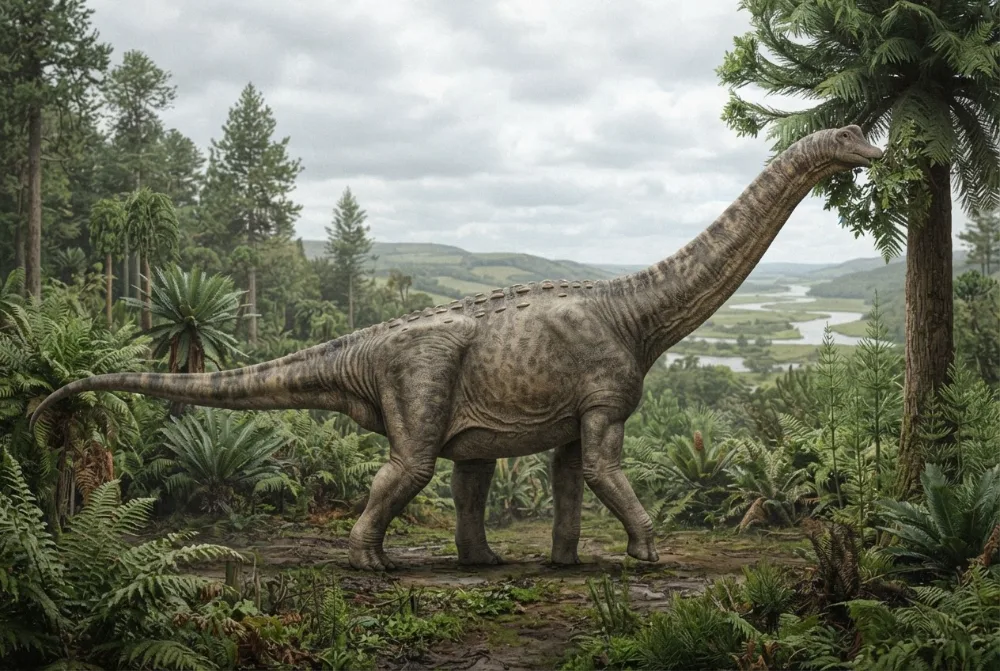
Ornithopsis was a huge, long-necked plant-eater that stomped through England and Germany during the Early Cretaceous. Its name means 'bird-likeness' because its back bones were hollow and filled with air sacs, just like birds have today.1
Cando viviu?
Como era de grande?
Canto medía de longo?
Canto medía de alto?
estimación
 tan longo coma 4 coches aparcados en fila🍌tan longo coma 100 plátanos postos un tras outro🏃podería correr 100 metros en 28 segundos (o humano máis rápido necesita 9,6)
Como era de grande Ornithopsis comparado CONTIGO?
Só son contas no teu navegador. Non se garda nin se envía nada.
Que velocidade alcanzaba?


Datos curiosos
Ornithopsis was one of the first dinosaurs whose bones were recognized as having air sacs, like modern birds and pterosaurs.1
The only known species is Ornithopsis hulkei, named after the scientist John Whitaker Hulke.1
Its back bones were very light because they were filled with big cavities called camellae.1
Scientists think Ornithopsis was about 16 to 18 metres long, as long as two school buses.1
A possible German fossil of Ornithopsis came from a slightly smaller individual.1
Ornithopsis belongs to a group of sauropods called Titanosauriformes, which includes some of the biggest land animals ever.1
As preguntas máis frecuentes sobre Ornithopsis
?What does the name Ornithopsis mean?
Ornithopsis means 'bird-likeness' in Greek, named for its bird-like hollow bones. The name comes from 'ornis' (bird) and 'opsis' (likeness).12
?How big was Ornithopsis?
Ornithopsis was about 16 to 18 metres long. A possible German fossil came from a slightly smaller individual.13
?What did Ornithopsis eat?
Ornithopsis was a herbivore, eating tough vegetation with its chisel-like teeth. It was a long-necked browser.3
Cazamitos
Mito: Ornithopsis was a flying animal like a pterosaur.
Verdade: Ornithopsis was a sauropod dinosaur that walked on land. Its name 'bird-likeness' refers to its air-filled bones, not to flying.1
Para expertos en dinos
- Nome científico
- Ornithopsis
- Bautizado por
- Seeley 18704
- Grupo
- Pescozos longos
- Familia / clado
- Titanosauriformes4
- Clasificación
- Sauropodomorpha > Sauropoda > Macronaria4
- Idade das rochas
- de 145 a 120 millóns de anos (Tithonian / Aptian)4
- Formacións rochosas
- Wessex, Portland Stone4
- Países
- Reino Unido, Alemaña4
- Rexistros fósiles
- 6 na Paleobiology Database4
- Descubrimento
- Harry Govier Seeley named Ornithopsis in 1870 based on two vertebrae from the Isle of Wight, England. He thought it was a creature between pterosaurs and birds, but later scientists showed it was a sauropod dinosaur.1
- Aínda en debate
- Scientists are not sure if the German fossil really belongs to Ornithopsis because it is poorly preserved.1
De onde veñen os datos
- Ornithopsis (en.wikipedia.org)
- ORNITHOPSIS - DinoChecker dinosaur archive (dinochecker.com)
- Ornithopsis, an Isle of Wight Brachiosaur - DinoWight (dinowight.org.uk)
- Ornithopsis in The Paleobiology Database (CC BY 4.0): idade, lugares, formacións rochosas, clasificación.
Cada dato desta páxina ten un número que leva á súa fonte. Se nos equivocamos nalgo, sentímolo, somos fans dos dinos, non unha revista científica. Escríbenos a [email protected] e arranxámolo.
 Rex ten fame! Dino Wiki é o proxecto dun pai para o seu fillo, que adora os dinosauros, gratis, sen anuncios e sen rastrexadores. Os adultos poden darlle un petisco a Rex para mantelo en liña.Dálle de comer a Rex
 Brachiosaurus
 Diplodocus
 Brontosaurus
 Argentinosaurus
 Camarasaurus
 Morosaurus
 Stegosaurus
 Iguanodon
 Archaeopteryx
 Giganotosaurus
 Microraptor
 Deinonychus