 Que dino es ti? O test
 Batalla de dinos
 Carreira de dinos
 Minixogos de dinos
 Álbum de cromos
 Listas TOP de dinos
 Sorpréndeme!
Paralitherizinosaurus
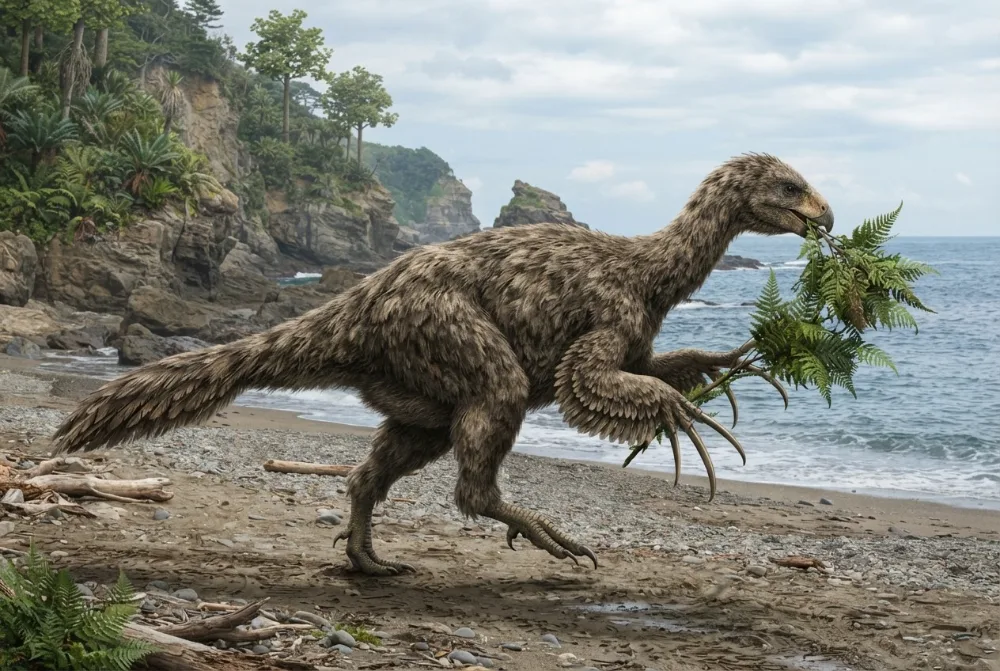
Paralitherizinosaurus was a strange, plant-eating dinosaur with long, curved claws on its hands. It lived near the coast of ancient Japan and used its claws to pull leaves and branches toward its mouth. This dinosaur was covered in feathers and looked a bit like a giant, slow-moving bird.14
Cando viviu?
Como era de grande?
Canto medía de longo?
Canto medía de alto?
estimación
Canto pesaba?
 tan longo coma 4 cans do fociño á cola🍌tan longo coma 20 plátanos postos un tras outro🍉tan pesado coma 56 sandías🧸tan pesado coma 15 nenos de infantil🎒tan pesado coma 9 nenos de primaria🏃podería correr 100 metros en 13 segundos (o humano máis rápido necesita 9,6)
Como era de grande Paralitherizinosaurus comparado CONTIGO?
Só son contas no teu navegador. Non se garda nin se envía nada.
Que velocidade alcanzaba?


Datos curiosos
Paralitherizinosaurus is the youngest therizinosaur ever found in Japan, living about 83 to 72 million years ago.1
Its fossils were discovered in a marine rock layer, meaning it lived near the coast and its body washed out to sea after death.1
Only a partial hand and a single vertebra have been found, but those bones show it had very slender, curved claws like its relative Therizinosaurus.1
The first bone of its thumb (metacarpal I) was flattened from top to bottom, a unique feature that helps scientists tell it apart from other dinosaurs.1
Its claws had weak flexor tubercles (the bump where a muscle attaches), which means it used a hook-and-pull motion to bring branches to its mouth, not to slash or stab.1
Paralitherizinosaurus is one of the few therizinosaurs found in marine sediments anywhere in the world, along with Nothronychus from North America.1
As preguntas máis frecuentes sobre Paralitherizinosaurus
?What did Paralitherizinosaurus eat?
It was a plant-eater. It used its long, curved claws to hook and pull leaves and branches toward its mouth.1
?How big was Paralitherizinosaurus?
Nobody knows for sure because only a partial hand and a neck bone have been found. It was probably medium-sized, but its exact size is unknown.3
?Did Paralitherizinosaurus have feathers?
Yes, it was a feathered theropod dinosaur, related to other feathered dinosaurs like Therizinosaurus. It probably looked like a big, slow-moving bird.3
Para expertos en dinos
- Nome científico
- Paralitherizinosaurus
- Bautizado por
- Kobayashi et al. 20224
- Grupo
- Dinos emplumados curiosos
- Familia / clado
- Therizinosauridae4
- Clasificación
- Theropoda > Therizinosauria4
- Idade das rochas
- de 84 a 72 millóns de anos (Campanian)4
- Formacións rochosas
- Osoushinai4
- Países
- Xapón4
- Rexistros fósiles
- 1 na Paleobiology Database4
- Descubrimento
- The first fossils of Paralitherizinosaurus were found in a concretion (a hard rock nodule) near a river in Hokkaido, Japan. Scientists Murakami and colleagues first described the bones in 2008, but it was not until 2022 that Kobayashi and his team named it as a new species.1
- Aínda en debate
- Scientists are not sure exactly where Paralitherizinosaurus fits on the therizinosaur family tree. It might be closely related to Therizinosaurus, Suzhousaurus, and another unnamed form from the Bissekty Formation, but the relationships are still debated.1
De onde veñen os datos
- New therizinosaurid dinosaur from the marine Osoushinai Formation (Upper Cretaceous, Japan) provides insight for function and evolution of therizinosaur claws (pmc.ncbi.nlm.nih.gov)
- Paralitherizinosaurus japonicus | Dinosaur Database by DinoAnimals.com (dinoanimals.com)
- Paralitherizinosaurus (en.wikipedia.org)
- Paralitherizinosaurus in The Paleobiology Database (CC BY 4.0): idade, lugares, formacións rochosas, clasificación.
Cada dato desta páxina ten un número que leva á súa fonte. Se nos equivocamos nalgo, sentímolo, somos fans dos dinos, non unha revista científica. Escríbenos a [email protected] e arranxámolo.
 Rex ten fame! Dino Wiki é o proxecto dun pai para o seu fillo, que adora os dinosauros, gratis, sen anuncios e sen rastrexadores. Os adultos poden darlle un petisco a Rex para mantelo en liña.Dálle de comer a Rex
 Therizinosaurus
 Oviraptor
 Chirostenotes
 Citipes
 Leptorhynchos
 Avimimus
 Tyrannosaurus
 Triceratops
 Velociraptor
 Spinosaurus
 Ankylosaurus
 Parasaurolophus