 Que dino es ti? O test
 Batalla de dinos
 Carreira de dinos
 Minixogos de dinos
 Álbum de cromos
 Listas TOP de dinos
 Sorpréndeme!
Peloneustes
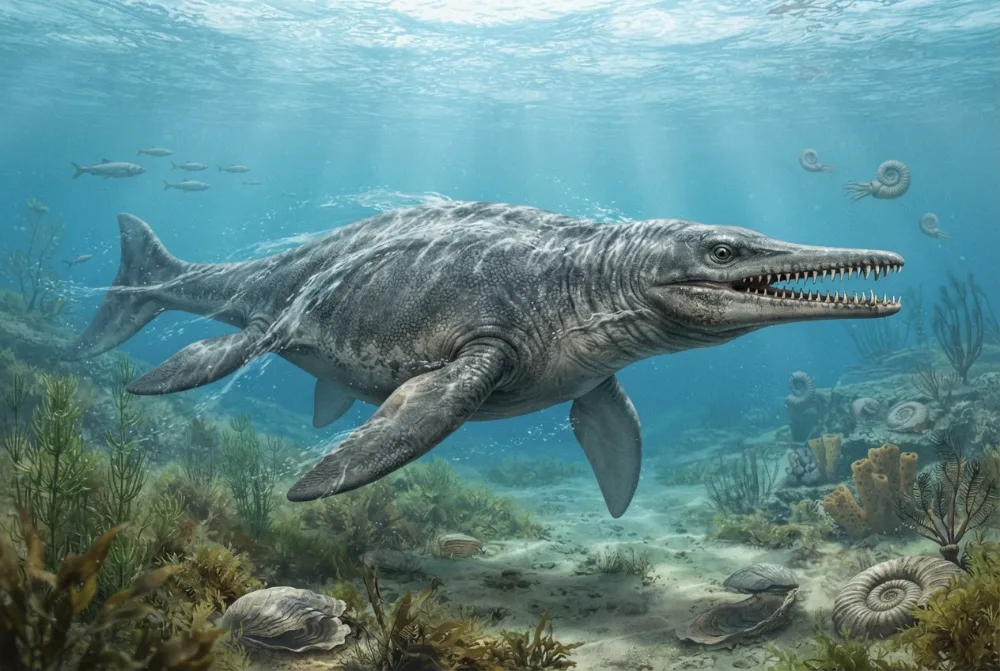
Peloneustes was a pliosaur, a kind of short-necked plesiosaur that lived in a shallow sea. It had a long, narrow snout like a dolphin and many sharp teeth for catching fish. This marine reptile was a fast and fierce hunter in the water.1
Cando viviu?
Como era de grande?
Canto medía de longo?
Canto pesaba?
 tan longo coma 4 cans do fociño á cola🍌tan longo coma 24 plátanos postos un tras outro🍉tan pesado coma 200 sandías🧸tan pesado coma 53 nenos de infantil🎒tan pesado coma 31 nenos de primaria🐻❄️tan pesado coma 2 osos polares🏊podería nadar o longo dunha piscina grande (50 m) en 6,7 segundos
Como era de grande Peloneustes comparado CONTIGO?
Só son contas no teu navegador. Non se garda nin se envía nada.
Que velocidade alcanzaba?


Datos curiosos
Peloneustes lived about 165 to 161 million years ago during the Middle Jurassic period.3
Its name means 'mud swimmer' because its fossils were found in mud from an ancient sea.1
Peloneustes had a long, narrow snout that was shaped like a dolphin's beak. This helped it move quickly through the water.1
It had 30 to 31 teeth in its upper jaw and 36 to 44 teeth in its lower jaw. The teeth were sharp and slightly curved for piercing fish.2
Peloneustes shared its sea home with other marine reptiles like ichthyosaurs and other plesiosaurs. At least five different pliosaurids lived in the same area.1
The sea where Peloneustes swam was only about 30 to 50 metres (100 to 160 feet) deep. It was a shallow inland sea.1
As preguntas máis frecuentes sobre Peloneustes
?How big was Peloneustes?
Peloneustes was about 3.5 to 4 metres (11 to 13 feet) long. This is small for a pliosaurid.1
?What did Peloneustes eat?
Peloneustes ate fish. It had a long, narrow snout and many sharp teeth for piercing fish, and it would swing its head quickly to catch them.1
?When did Peloneustes live?
Peloneustes lived during the Middle Jurassic period, about 165 to 161 million years ago. Its fossils are from the Oxford Clay Formation in England.1
?Was Peloneustes a dinosaur?
No, Peloneustes was a plesiosaur, a marine reptile, not a dinosaur. It lived in the sea and used its flippers to swim.1
Para expertos en dinos
- Nome científico
- Peloneustes
- Bautizado por
- Lydekker 18893
- Grupo
- Plesiosauros
- Familia / clado
- Pliosauridae3
- Clasificación
- Plesiosauria > Pliosauridae > Sauropterygia3
- Idade das rochas
- de 165 a 162 millóns de anos (Callovian)3
- Formacións rochosas
- Oxford Clay, Ornatenton, Argiles de Montaubert3
- Países
- Reino Unido, Francia, Alemaña3
- Rexistros fósiles
- 12 na Paleobiology Database3
- Descubrimento
- Peloneustes was first described as a species of Plesiosaurus by Harry Govier Seeley in 1869. Richard Lydekker gave it its own genus name in 1889.1
- Aínda en debate
- Scientists are not sure if Peloneustes was a close relative of Pliosaurus or a more early-diverging pliosaurid. They are still studying its family tree.1
De onde veñen os datos
- Peloneustes (en.wikipedia.org)
- The cranial anatomy and taxonomy of Peloneustes philarchus (Sauropterygia, Pliosauridae) from the Peterborough Member (Callovian, Middle Jurassic) of the United Kingdom (onlinelibrary.wiley.com)
- Peloneustes in The Paleobiology Database (CC BY 4.0): idade, lugares, formacións rochosas, clasificación.
Cada dato desta páxina ten un número que leva á súa fonte. Se nos equivocamos nalgo, sentímolo, somos fans dos dinos, non unha revista científica. Escríbenos a [email protected] e arranxámolo.
 Rex ten fame! Dino Wiki é o proxecto dun pai para o seu fillo, que adora os dinosauros, gratis, sen anuncios e sen rastrexadores. Os adultos poden darlle un petisco a Rex para mantelo en liña.Dálle de comer a Rex
 Elasmosaurus
 Pliosaurus
 Plesiosaurus
 Cimoliasaurus
 Colymbosaurus
 Trinacromerum
 Ichthyosaurus
 Khudiakovia
 Ophthalmosaurus
 Pterodactylus
 Rhamphocephalus
 Gongbusaurus