 Que dino es ti? O test
 Batalla de dinos
 Carreira de dinos
 Minixogos de dinos
 Álbum de cromos
 Listas TOP de dinos
 Sorpréndeme!
Polycotylus
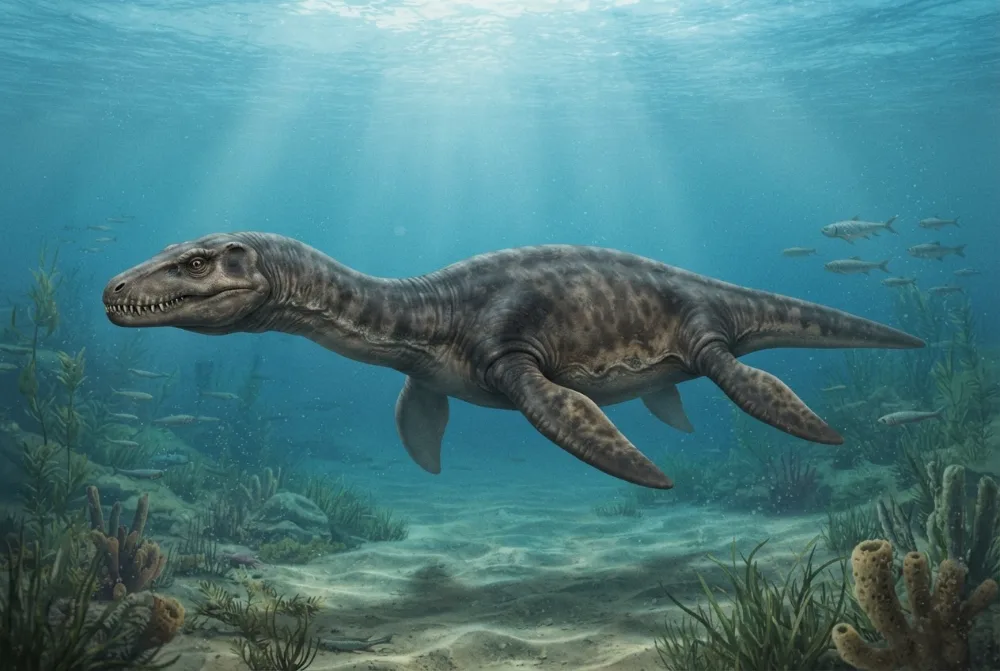
Polycotylus was a short-necked plesiosaur that swam in the warm seas of North America and Europe during the Cretaceous. It had a big head, strong flippers, and gave birth to live babies in the water, just like whales do today.1
Cando viviu?
Como era de grande?
Canto medía de longo?
Canto pesaba?
 tan longo coma 5 cans do fociño á cola🍌tan longo coma 30 plátanos postos un tras outro🍉tan pesado coma 200 sandías🧸tan pesado coma 53 nenos de infantil🎒tan pesado coma 31 nenos de primaria🐻❄️tan pesado coma 2 osos polares🏊podería nadar o longo dunha piscina grande (50 m) en 6,7 segundos
Como era de grande Polycotylus comparado CONTIGO?
Só son contas no teu navegador. Non se garda nin se envía nada.
Que velocidade alcanzaba?


Datos curiosos
Polycotylus was named by famous paleontologist Edward Drinker Cope in 1869 from fossils found in Kansas.1
A fossil of Polycotylus found in Kansas contains a single large fetus inside the mother, proving that these plesiosaurs gave live birth.1
The baby Polycotylus was about 1.5 metres (4.9 feet) long, which is about 32 percent of the mother's length.1
Polycotylus had a short neck and a long head, making it look a bit like a pliosaur, but it is actually a type of plesiosaur called a polycotylid.1
Its name means 'much-cupped vertebrae' because the bones in its spine have deep cup-like hollows.1
Polycotylus lived in the Western Interior Seaway, a shallow sea that split North America in two during the Cretaceous.1
Scientists think Polycotylus gave birth to just one large baby at a time, a strategy called K-selection.1
As preguntas máis frecuentes sobre Polycotylus
?How big was Polycotylus?
Polycotylus was a medium-sized plesiosaur, measuring about 4.7 to 5.4 metres (15 to 18 feet) long and weighing over 1 metric ton (1.1 short tons).1
?Did Polycotylus have a short neck?
Yes, Polycotylus had a short neck and a long head, unlike the long-necked plesiosaurs like Elasmosaurus.1
?What did Polycotylus eat?
Polycotylus had thick teeth with striations on their surfaces, which suggests it ate fish and other marine animals, but the sources do not give a specific diet.1
?When did Polycotylus live?
Polycotylus lived toward the end of the Cretaceous period, about 84 to 66 million years ago.1
Cazamitos
Mito: Many people think all plesiosaurs had long necks like the Loch Ness Monster.
Verdade: Polycotylus had a short neck and a large head, very different from long-necked plesiosaurs like Elasmosaurus.1
Para expertos en dinos
- Nome científico
- Polycotylus
- Bautizado por
- Cope 18693
- Grupo
- Plesiosauros
- Familia / clado
- Polycotylidae3
- Clasificación
- Plesiosauria > Sauropterygia3
- Idade das rochas
- de 152 a 72 millóns de anos (Kimmeridgian / Campanian)3
- Formacións rochosas
- Niobrara, Frontier, Mooreville Chalk3
- Países
- EUA, Francia, Rusia3
- Rexistros fósiles
- 10 na Paleobiology Database3
- Descubrimento
- Edward Drinker Cope named Polycotylus in 1869 from fragmentary bones found in the Niobrara Formation of Kansas. A nearly complete skeleton was later found in Alabama in 1949 but not described until 2002.1
- Aínda en debate
- Scientists are not sure exactly how many species of Polycotylus existed, and some species may be the same as others.1
De onde veñen os datos
- Polycotylus (en.wikipedia.org)
- PBDB Taxon (paleobiodb.org)
- Polycotylus in The Paleobiology Database (CC BY 4.0): idade, lugares, formacións rochosas, clasificación.
Cada dato desta páxina ten un número que leva á súa fonte. Se nos equivocamos nalgo, sentímolo, somos fans dos dinos, non unha revista científica. Escríbenos a [email protected] e arranxámolo.
 Rex ten fame! Dino Wiki é o proxecto dun pai para o seu fillo, que adora os dinosauros, gratis, sen anuncios e sen rastrexadores. Os adultos poden darlle un petisco a Rex para mantelo en liña.Dálle de comer a Rex
 Elasmosaurus
 Pliosaurus
 Plesiosaurus
 Cimoliasaurus
 Colymbosaurus
 Trinacromerum
 Stegosaurus
 Iguanodon
 Archaeopteryx
 Giganotosaurus
 Microraptor
 Deinonychus