 Que dino es ti? O test
 Batalla de dinos
 Carreira de dinos
 Minixogos de dinos
 Álbum de cromos
 Listas TOP de dinos
 Sorpréndeme!
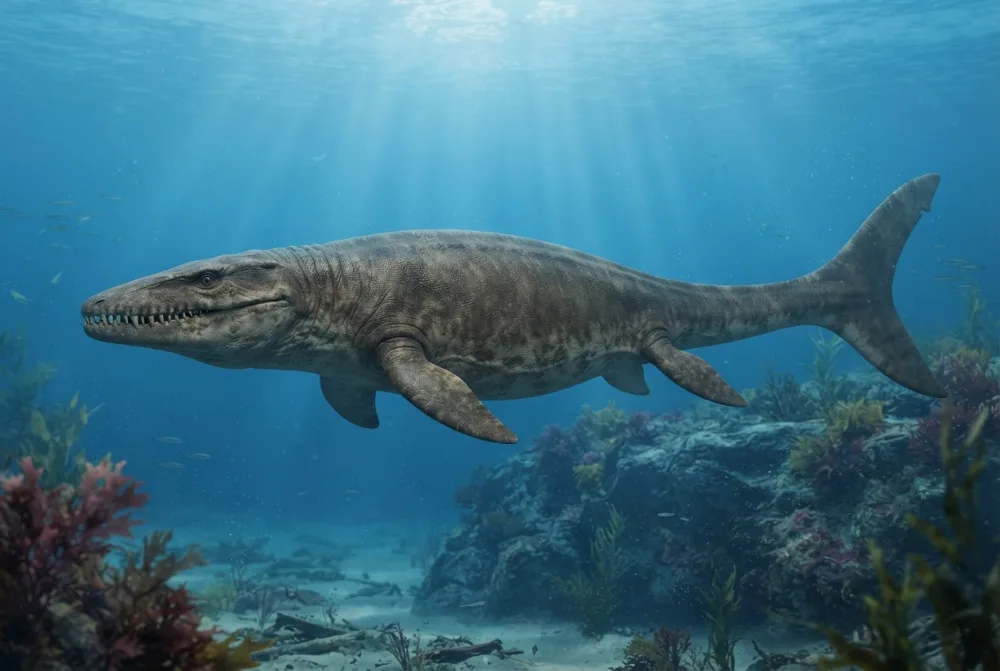
Prognathodon
Prognathodon was a giant marine lizard that lived in the oceans at the same time as the dinosaurs. It had a huge, powerful skull and strong teeth that could crush the shells of sea turtles. This mosasaur was an apex predator, meaning it was at the top of the food chain.1
Cando viviu?
Como era de grande?
Canto medía de longo?
 tan longo coma 2,5 coches aparcados en fila🍌tan longo coma 67 plátanos postos un tras outro🏊podería nadar o longo dunha piscina grande (50 m) en 5,8 segundos
Como era de grande Prognathodon comparado CONTIGO?
Só son contas no teu navegador. Non se garda nin se envía nada.
Que velocidade alcanzaba?


Datos curiosos
The name Prognathodon means 'forejaw tooth' because its front teeth were especially big and strong.1
One fossil of Prognathodon saturator, nicknamed 'Bèr', was found in a limestone quarry in the Netherlands and is about 12 metres long.1
Prognathodon had teeth with fine, wavy ridges near the tip that helped strengthen them for crushing hard prey like sea turtles.1
Gut contents from a Canadian specimen show that Prognathodon ate a very large fish (1.6 metres long), a smaller fish, a sea turtle, and possibly a squid-like cephalopod.1
Unlike many other mosasaurs, Prognathodon had blunt, rounded tooth tips instead of sharp cutting edges, suggesting it was a crusher of hard-shelled animals.1
The pterygoid teeth on the roof of its mouth were unusually large and showed no wear, so scientists think they were used to grip prey before swallowing it whole.1
Prognathodon fossils have been found on every continent except Antarctica, showing it lived in warm seas worldwide.2
Scientists still argue about which species belong in Prognathodon, because many fossils are incomplete and look different from each other.1
As preguntas máis frecuentes sobre Prognathodon
?Was Prognathodon a dinosaur?
No, Prognathodon was a marine lizard, not a dinosaur. It belonged to the mosasaur family, which lived in the oceans at the same time as the dinosaurs.1
?How big was Prognathodon?
Prognathodon was one of the largest mosasaurs. Different species reached different sizes: P. giganteus was about 10 metres (33 feet) long, P. currii about 11 metres (36 feet), and P. saturator about 12 metres (39 feet).1
?What did Prognathodon eat?
Prognathodon was an apex predator that ate hard-shelled prey like sea turtles, as well as large fish and possibly squid. Gut contents from one fossil included a 1.6 metre long fish, a smaller fish, a sea turtle, and a possible cephalopod.1
?Could Prognathodon crush shells?
Yes, Prognathodon had massively built jaws and blunt, rounded teeth with wavy ridges that helped it crush hard prey like sea turtle shells. Its bite was stronger than any other mosasaur.1
?Where was Prognathodon found?
Prognathodon fossils have been found in North America, Europe, Africa, the Middle East, and New Zealand. One famous specimen nicknamed 'Bèr' was discovered in a limestone quarry in the Netherlands.1
?When did Prognathodon live?
Prognathodon lived during the Late Cretaceous period, from about 84 to 66 million years ago. It went extinct at the same time as the non-avian dinosaurs.1
Cazamitos
Mito: Some people think Prognathodon was a dinosaur.
Verdade: Prognathodon was not a dinosaur. It was a mosasaur, a type of marine lizard that lived in the sea.1
Para expertos en dinos
- Nome científico
- Prognathodon
- Bautizado por
- Dollo 18892
- Grupo
- Mosasauros
- Familia / clado
- Mosasauridae2
- Clasificación
- Mosasauroidea2
- Idade das rochas
- de 100 a 62 millóns de anos (Cenomanian / Danian)2
- Formacións rochosas
- Bearpaw Shale, Torme, Gulpen2
- Países
- EUA, Marrocos, España, Suecia, Francia, Bélxica2
- Rexistros fósiles
- 94 na Paleobiology Database2
- Descubrimento
- Prognathodon was first named by Belgian paleontologist Louis Dollo in 1889, based on fossils found in Belgium. There was some confusion because Dollo first called it 'Prognathodon' but later used the name 'Prognathosaurus' in his papers.1
- Aínda en debate
- Scientists are still debating which species truly belong to Prognathodon, because many fossils are incomplete and show different features.1
De onde veñen os datos
- Prognathodon (en.wikipedia.org)
- Prognathodon in The Paleobiology Database (CC BY 4.0): idade, lugares, formacións rochosas, clasificación.
Cada dato desta páxina ten un número que leva á súa fonte. Se nos equivocamos nalgo, sentímolo, somos fans dos dinos, non unha revista científica. Escríbenos a [email protected] e arranxámolo.
 Rex ten fame! Dino Wiki é o proxecto dun pai para o seu fillo, que adora os dinosauros, gratis, sen anuncios e sen rastrexadores. Os adultos poden darlle un petisco a Rex para mantelo en liña.Dálle de comer a Rex
 Mosasaurus
 Tylosaurus
 Platecarpus
 Clidastes
 Globidens
 Halisaurus
 Tyrannosaurus
 Triceratops
 Velociraptor
 Spinosaurus
 Ankylosaurus
 Parasaurolophus