 Que dino es ti? O test
 Batalla de dinos
 Carreira de dinos
 Minixogos de dinos
 Álbum de cromos
 Listas TOP de dinos
 Sorpréndeme!
Pycnonemosaurus
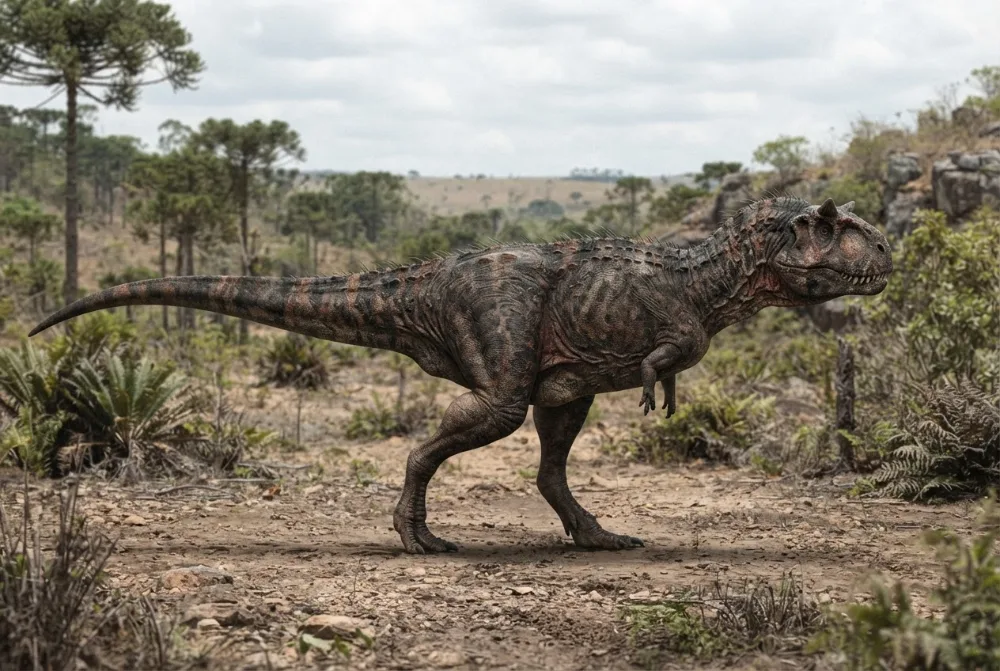
Pycnonemosaurus was a big meat-eating dinosaur with sharp teeth and strong legs. It lived in what is now Brazil, about 72 million years ago. It was one of the largest abelisaurids, a group of short-snouted predators.1
Cando viviu?
Como era de grande?
Canto medía de longo?
Canto medía de alto?
estimación
Canto pesaba?
 tan longo coma 2 coches aparcados en fila🍌tan longo coma 50 plátanos postos un tras outro
 tan pesado coma 180 cans🍉tan pesado coma 720 sandías🎒tan pesado coma 4 clases enteiras de nenos🐻❄️tan pesado coma 8 osos polares🏃podería correr 100 metros en 12 segundos (o humano máis rápido necesita 9,6)
Como era de grande Pycnonemosaurus comparado CONTIGO?
Só son contas no teu navegador. Non se garda nin se envía nada.
Que velocidade alcanzaba?


Datos curiosos
Pycnonemosaurus is the largest formally described abelisaurid, with later estimates reaching about 8.9 metres (29.2 ft) long.1
Its bones were found in red conglomeratic sandstone, and the surface was abraded, meaning the bones were partly exposed before being collected.1
The only known skeleton is incomplete, including five teeth, parts of seven tail vertebrae, a right pubis, a right tibia, and part of a right fibula.12
It had a small pubic foot and a hatchet-shaped cnemial crest on its tibia, which are unique features among abelisaurs.12
The specimen is thought to be from an immature individual, probably a subadult, so adults might have been even larger.1
Its tail vertebrae have fan-shaped transverse processes and forward projections, typical of abelisaurids, but these projections become smaller towards the end of the tail.1
As preguntas máis frecuentes sobre Pycnonemosaurus
?How big was Pycnonemosaurus?
It was about 8.9 metres long and weighed around 3.6 tonnes. That makes it the largest formally described abelisaurid.1
?What did Pycnonemosaurus eat?
It was a predator that probably ate titanosaurs, which were huge long-necked dinosaurs found in the same area. Its small, sharp teeth helped it grip struggling prey.1
?Where was Pycnonemosaurus found?
Its bones were found in Brazil, in the state of Mato Grosso, in red conglomeratic sandstone of the Cachoeira do Bom Jardim Formation.1
?When did Pycnonemosaurus live?
It lived during the Late Cretaceous, about 72 million years ago, in the late Campanian to early Maastrichtian stages.1
?Was Pycnonemosaurus a dinosaur?
Yes, it was a carnivorous theropod dinosaur, part of the group Abelisauridae.1
?Is Pycnonemosaurus bigger than Carnotaurus?
Yes, Pycnonemosaurus was larger. It reached about 8.9 metres long, while Carnotaurus was about 7.8 metres long.3
Cazamitos
Mito: Pycnonemosaurus was a small dinosaur.
Verdade: It was actually one of the largest abelisaurids, with length estimates up to 9 metres (29.5 ft) and weight up to 3.6 tonnes (4.0 short tons).1
Para expertos en dinos
- Nome científico
- Pycnonemosaurus
- Bautizado por
- Kellner and Campos 20024
- Grupo
- Dinos carnívoros
- Familia / clado
- Abelisauridae4
- Clasificación
- Theropoda > Ceratosauria > Abelisauridae4
- Idade das rochas
- de 100 a 66 millóns de anos (Cenomanian / Maastrichtian)4
- Países
- Brasil4
- Rexistros fósiles
- 1 na Paleobiology Database4
- Descubrimento
- The fossils were collected in 1952 to 1953 by Llewellyn Ivor Price at a farm called Roncador in Mato Grosso, Brazil. The species was named by Kellner and Campos in 2002.14
- Aínda en debate
- Scientists are not sure about its exact size because the only skeleton is incomplete and from a young individual, so estimates range from 6 to 9 metres long.1
De onde veñen os datos
- Pycnonemosaurus (en.wikipedia.org)
- On a theropod dinosaur (Abelisauria) from the continental Cretaceous of Brazil (eurekamag.com)
- Allometry and body length of abelisauroid theropods: Pycnonemosaurus nevesi is the new king (sciencedirect.com)
- Pycnonemosaurus in The Paleobiology Database (CC BY 4.0): idade, lugares, formacións rochosas, clasificación.
Cada dato desta páxina ten un número que leva á súa fonte. Se nos equivocamos nalgo, sentímolo, somos fans dos dinos, non unha revista científica. Escríbenos a [email protected] e arranxámolo.
 Rex ten fame! Dino Wiki é o proxecto dun pai para o seu fillo, que adora os dinosauros, gratis, sen anuncios e sen rastrexadores. Os adultos poden darlle un petisco a Rex para mantelo en liña.Dálle de comer a Rex
 Allosaurus
 Carnotaurus
 Dilophosaurus
 Giganotosaurus
 Compsognathus
 Paronychodon
 Tyrannosaurus
 Triceratops
 Velociraptor
 Spinosaurus
 Ankylosaurus
 Parasaurolophus