 Que dino es ti? O test
 Batalla de dinos
 Carreira de dinos
 Minixogos de dinos
 Álbum de cromos
 Listas TOP de dinos
 Sorpréndeme!
Rhabdodon
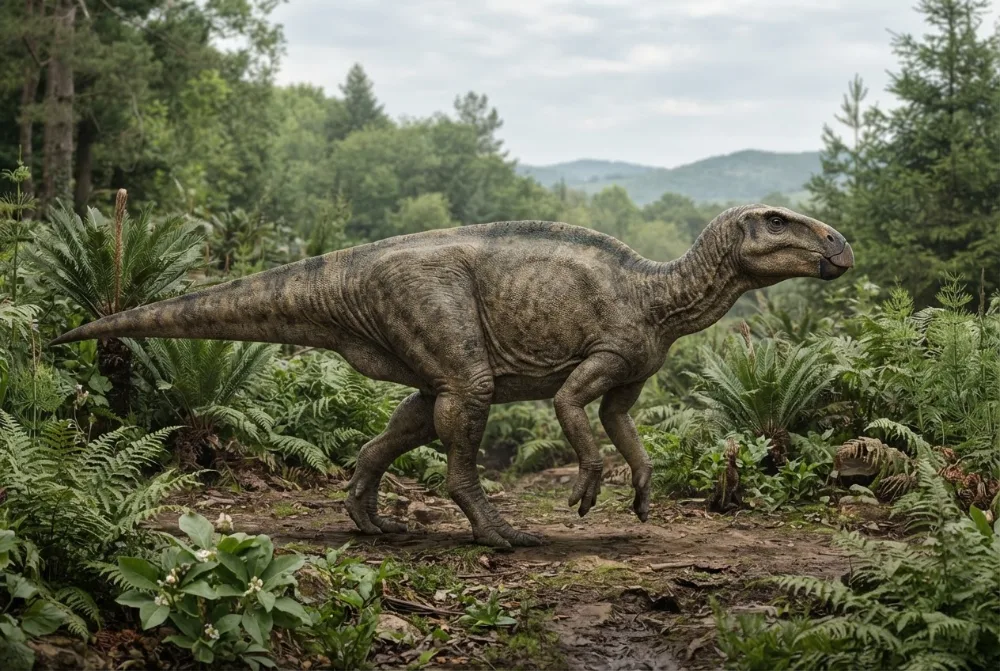
Rhabdodon was a plant-eating dinosaur that lived in Europe near the end of the Age of Dinosaurs. It had a strong beak for snipping leaves and walked on two legs, but could also drop to all fours. It was one of the biggest members of its family, the rhabdodontids.21
Cando viviu?
Como era de grande?
Canto medía de longo?
Canto medía de alto?
Canto pesaba?
 tan longo coma 6 cans do fociño á cola🍌tan longo coma 33 plátanos postos un tras outro🍉tan pesado coma 50 sandías🧸tan pesado coma 13 nenos de infantil🎒tan pesado coma 8 nenos de primaria🏃podería correr 100 metros en 8,4 segundos (o humano máis rápido necesita 9,6)
Como era de grande Rhabdodon comparado CONTIGO?
Só son contas no teu navegador. Non se garda nin se envía nada.
Que velocidade alcanzaba?


Datos curiosos
Rhabdodon lived about 72 to 69 million years ago, during the Late Cretaceous period.2
Its name means 'rod tooth' because its teeth were shaped like little rods.1
Rhabdodon was big for a rhabdodontid, measuring about 4 metres (13 feet) long and weighing 250 kilograms (550 pounds). Some fossils suggest it could grow up to 6 metres (20 feet) long.2
Scientists once thought Rhabdodon was a dwarf dinosaur because it lived on islands, but new research shows it was actually a giant compared to its closest relatives.2
Rhabdodon shared its home with other dinosaurs like the sauropod Ampelosaurus and the carnivorous theropods Arcovenator and Pyroraptor.2
As preguntas máis frecuentes sobre Rhabdodon
?What did Rhabdodon eat?
Rhabdodon was a plant-eater, or herbivore. It ate C3 plants, which are the most common type of plants, like trees and shrubs.2
?How big was Rhabdodon?
Rhabdodon was about 4 metres (13 feet) long and weighed 250 kilograms (550 pounds). Some fossils suggest it could grow up to 6 metres (20 feet) long.21
?When did Rhabdodon live?
Rhabdodon lived during the Late Cretaceous period, about 72 to 69 million years ago. Other estimates suggest it lived between 76 and 70 million years ago.21
?Where was Rhabdodon found?
Rhabdodon fossils have been found in southern France, and also in Spain, Romania, and Austria. It lived across much of southern Europe.21
Cazamitos
Mito: Rhabdodon was a small, weak dinosaur because it lived on islands.
Verdade: Rhabdodon was actually one of the largest rhabdodontids, and scientists now think it grew big on the mainland, not as a dwarf on islands.2
Para expertos en dinos
- Nome científico
- Rhabdodon
- Bautizado por
- Matheron 18694
- Grupo
- Herbívoros con bico
- Familia / clado
- Rhabdodontidae4
- Clasificación
- Ornithischia > Ornithopoda > Iguanodontia4
- Idade das rochas
- de 84 a 66 millóns de anos (Campanian / Maastrichtian)4
- Formacións rochosas
- Marnes Rouges Inférieures, Grès à Reptiles, Grünbach4
- Países
- Francia, España, Romanía, Austria4
- Rexistros fósiles
- 37 na Paleobiology Database4
- Tamén coñecido como
- Oligosaurus, Ornithomerus (nomes antigos que agora contan como o mesmo animal)4
- Descubrimento
- Rhabdodon was named by French paleontologist Philippe Matheron in 1869 based on fossils from the Fuveau Basin in southern France. The name was originally spelled two ways, but the ICZN officially fixed it as Rhabdodon priscus in 1988.24
- Aínda en debate
- Scientists are not sure whether Rhabdodon was a dwarf or a giant, because some fossils are much larger than others, and it lived on both islands and the mainland.2
De onde veñen os datos
- Rhabdodon (nhm.ac.uk)
- Rhabdodon (en.wikipedia.org)
- RHABDODON : DinoChecker dinosaur archive (dinochecker.com)
- Rhabdodon in The Paleobiology Database (CC BY 4.0): idade, lugares, formacións rochosas, clasificación.
Cada dato desta páxina ten un número que leva á súa fonte. Se nos equivocamos nalgo, sentímolo, somos fans dos dinos, non unha revista científica. Escríbenos a [email protected] e arranxámolo.
 Rex ten fame! Dino Wiki é o proxecto dun pai para o seu fillo, que adora os dinosauros, gratis, sen anuncios e sen rastrexadores. Os adultos poden darlle un petisco a Rex para mantelo en liña.Dálle de comer a Rex
 Iguanodon
 Tenontosaurus
 Thescelosaurus
 Zalmoxes
 Camptosaurus
 Nanosaurus
 Tyrannosaurus
 Triceratops
 Velociraptor
 Spinosaurus
 Ankylosaurus
 Parasaurolophus