 Que dino es ti? O test
 Batalla de dinos
 Carreira de dinos
 Minixogos de dinos
 Álbum de cromos
 Listas TOP de dinos
 Sorpréndeme!
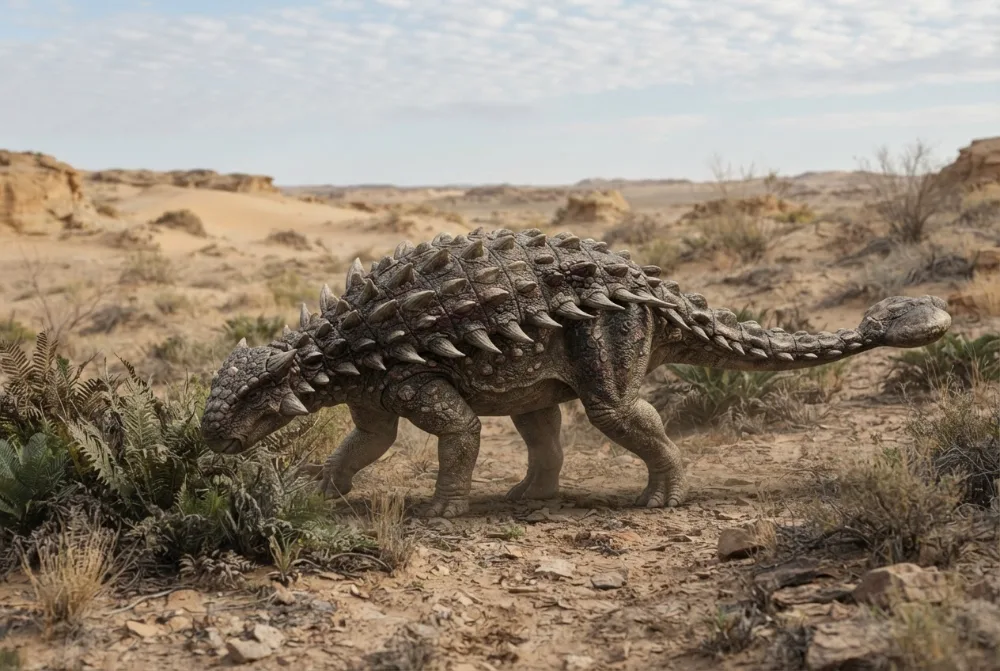
Saichania
Saichania was a tank-like dinosaur covered in bony armour and armed with a heavy tail club. It lived in the deserts of Mongolia and China during the Late Cretaceous period. Even big predators like Tarbosaurus probably thought twice before attacking this walking fortress!1
Cando viviu?
Como era de grande?
Canto medía de longo?
Canto medía de alto?
estimación
Canto pesaba?

 tan longo coma 7 cans do fociño á cola🍌tan longo coma 39 plátanos postos un tras outrotan pesado coma 100 cans🍉tan pesado coma 400 sandías🎒tan pesado coma 2,5 clases enteiras de nenos🐻❄️tan pesado coma 4 osos polares🏃podería correr 100 metros en 22 segundos (o humano máis rápido necesita 9,6)
Como era de grande Saichania comparado CONTIGO?
Só son contas no teu navegador. Non se garda nin se envía nada.
Que velocidade alcanzaba?


Datos curiosos
Saichania means 'beautiful one' in Mongolian, because the first fossil found was so well preserved.1
Its neck bones, shoulder bones and ribs were fused together, making its body extra strong and sturdy.1
Saichania had a special cooling system in its nose: bony curls inside the nasal cavity helped moisten the dry desert air.2
It shared its desert home with other dinosaurs like Bagaceratops and Tylocephale, but large meat-eaters were rare in that area.1
Some scientists think that two Chinese dinosaurs, Tianzhenosaurus and Shanxia, are actually the same as Saichania.14
Saichania's tail club could deliver a powerful blow to defend itself against predators like Tarbosaurus.1
The first Saichania fossil was found by a Polish-Mongolian expedition in the Gobi Desert in 1970 and 1971.1
As preguntas máis frecuentes sobre Saichania
?What did Saichania eat?
Saichania was an herbivore (plant-eater). It used its horny beak to bite off plants in its desert habitat and then processed the food in its wide hindgut.1
?How big was Saichania?
Saichania was about 5 to 7 metres long and weighed around 1.4 to 2.0 metric tons.1
?Did Saichania have a tail club?
Yes, Saichania had a heavy tail club. It could use it to defend itself against predators like Tarbosaurus, and biomechanical analysis shows the club could generate a force of about 13631 Newtons.13
?When did Saichania live?
Saichania lived during the Late Cretaceous period, about 73 million years ago, in what is now Mongolia and China.1
?Could Saichania run fast?
Saichania was a slow, heavy dinosaur that walked on four short legs. It wasn't built for speed, but its armour and tail club made it a tough target for predators.1
?Is Saichania a dinosaur?
Yes, Saichania is a dinosaur. More specifically, it is an ankylosaurid, a type of armoured herbivorous dinosaur from the Late Cretaceous.1
Para expertos en dinos
- Nome científico
- Saichania
- Bautizado por
- Maryanska 19774
- Grupo
- Dinos acoirazados
- Familia / clado
- Ankylosauridae4
- Clasificación
- Ornithischia > Ankylosauria > Ankylosauridae > Thyreophora4
- Idade das rochas
- de 100 a 72 millóns de anos (Cenomanian / Campanian)4
- Formacións rochosas
- Baruungoyot, Huiquanpu4
- Países
- Mongolia, China4
- Rexistros fósiles
- 5 na Paleobiology Database4
- Tamén coñecido como
- Shanxia, Tianzhenosaurus (nomes antigos que agora contan como o mesmo animal)4
- Descubrimento
- Saichania was named by Polish palaeontologist Teresa Maryańska in 1977, based on a beautifully preserved skull and front part of the body found in the Gobi Desert, Mongolia.1
- Aínda en debate
- Scientists debate whether some fossils belong to Saichania or to its close relatives Tarchia and Zaraapelta, since they lived in the same area.1
De onde veñen os datos
- Saichania (en.wikipedia.org)
- ANKYLOSAURIDAE (DINOSAURIA) FROM MONGOLIA (palaeontologia.pan.pl)
- Saichania chulsanensis (Ornithischia, Ankylosauridae) from the Upper Cretaceous of Mongolia - Palaeontographica Abteilung A Band 294 Lieferung 1-3 — Schweizerbart science publishers (schweizerbart.de)
- Saichania in The Paleobiology Database (CC BY 4.0): idade, lugares, formacións rochosas, clasificación.
Cada dato desta páxina ten un número que leva á súa fonte. Se nos equivocamos nalgo, sentímolo, somos fans dos dinos, non unha revista científica. Escríbenos a [email protected] e arranxámolo.
 Rex ten fame! Dino Wiki é o proxecto dun pai para o seu fillo, que adora os dinosauros, gratis, sen anuncios e sen rastrexadores. Os adultos poden darlle un petisco a Rex para mantelo en liña.Dálle de comer a Rex
 Ankylosaurus
 Sauropelta
 Pinacosaurus
 Scutellosaurus
 Struthiosaurus
 Euoplocephalus
 Tyrannosaurus
 Triceratops
 Velociraptor
 Spinosaurus
 Parasaurolophus
 Pteranodon