 Que dino es ti? O test
 Batalla de dinos
 Carreira de dinos
 Minixogos de dinos
 Álbum de cromos
 Listas TOP de dinos
 Sorpréndeme!
Sarmientosaurus
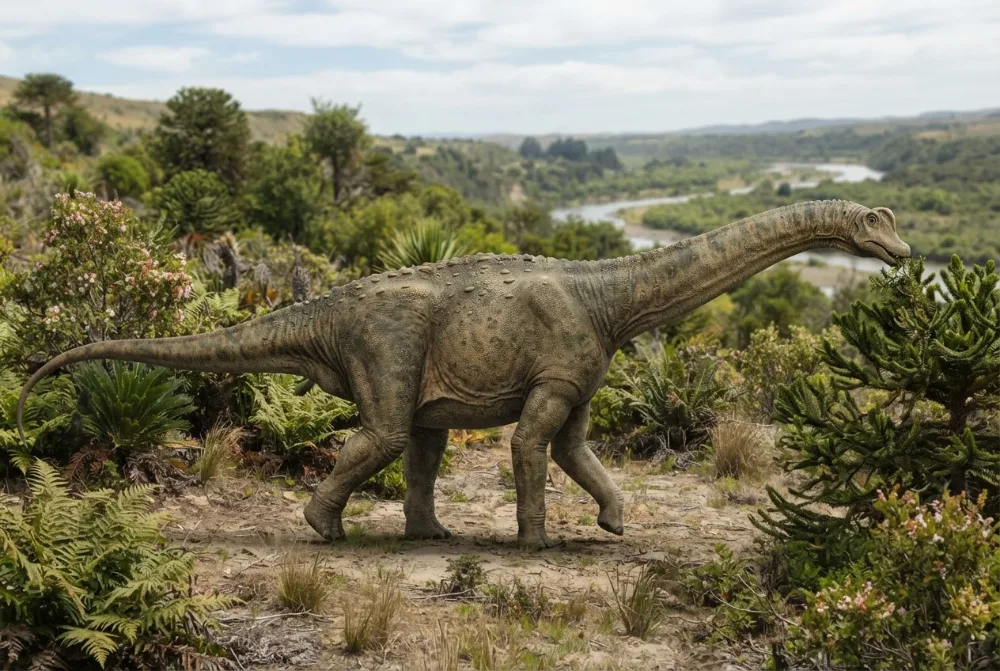
Sarmientosaurus was a long-necked plant-eater that lived in what is now Argentina. It had a complete skull with huge eye sockets, which might have given it excellent vision. Its skull and neck bones show it may have held its head low to eat ferns and other low-growing plants.1
Cando viviu?
Que velocidade alcanzaba?


Datos curiosos
Sarmientosaurus is one of the few sauropods known from a complete skull, which is in fantastic condition with all its teeth still in place.1
Its eye sockets were huge, about 40 percent of the length of its skull. This may have given it better vision than many other titanosaurs.12
The dinosaur had a strange, long ossified tendon along its neck, which may have helped support its head or control its posture.1
Sarmientosaurus is a basal lithostrotian titanosaur, meaning it was an early relative of the huge, armored titanosaurs like Ankylosaurus.1
Based on the inner ear and neck structure, scientists think Sarmientosaurus often kept its head and neck hanging downward, much like a sad donkey.2
It lived during the Cenomanian to Turonian ages of the Late Cretaceous, about 100 to 90 million years ago.4
As preguntas máis frecuentes sobre Sarmientosaurus
?How big was Sarmientosaurus?
Scientists do not know its exact size because only the skull and neck bones have been found. The skull is about 43 centimetres (17 inches) long.2
?What did Sarmientosaurus eat?
It was a plant-eater. It probably ate low-growing plants like ferns, because its skull and neck suggest it held its head and neck downward.23
?Why did Sarmientosaurus have huge eyes?
Its eye sockets were huge, about 40 percent of the skull's length. This may have given it better vision than many other titanosaurs.23
?When did Sarmientosaurus live?
It lived during the Late Cretaceous Period, about 95 million years ago, in what is now Argentina.2
Para expertos en dinos
- Nome científico
- Sarmientosaurus
- Bautizado por
- Martínez et al. 20164
- Grupo
- Pescozos longos
- Familia / clado
- Diamantinasauria4
- Clasificación
- Sauropodomorpha > Sauropoda > Macronaria4
- Idade das rochas
- de 100 a 90 millóns de anos (Cenomanian / Turonian)4
- Formacións rochosas
- Bajo Barreal4
- Países
- Arxentina4
- Rexistros fósiles
- 1 na Paleobiology Database4
- Descubrimento
- The only known specimen of Sarmientosaurus was discovered in the Bajo Barreal Formation in Chubut Province, central Patagonia, Argentina. It was named in 2016 by Martínez and colleagues from a skull and part of the neck.41
- Aínda en debate
- Scientists are still unsure exactly how Sarmientosaurus held its neck. Some think it kept it low for eating low plants, but others debate its precise posture.1
De onde veñen os datos
- A Basal Lithostrotian Titanosaur (Dinosauria: Sauropoda) with a Complete Skull: Implications for the Evolution and Paleobiology of Titanosauria - PMC (pmc.ncbi.nlm.nih.gov)
- Sarmientosaurus (en.wikipedia.org)
- A Basal Lithostrotian Titanosaur (Dinosauria: Sauropoda) with a Complete Skull: Implications for the Evolution and Paleobiology of Titanosauria (journals.plos.org)
- Sarmientosaurus in The Paleobiology Database (CC BY 4.0): idade, lugares, formacións rochosas, clasificación.
Cada dato desta páxina ten un número que leva á súa fonte. Se nos equivocamos nalgo, sentímolo, somos fans dos dinos, non unha revista científica. Escríbenos a [email protected] e arranxámolo.
 Rex ten fame! Dino Wiki é o proxecto dun pai para o seu fillo, que adora os dinosauros, gratis, sen anuncios e sen rastrexadores. Os adultos poden darlle un petisco a Rex para mantelo en liña.Dálle de comer a Rex
 Brachiosaurus
 Diplodocus
 Brontosaurus
 Argentinosaurus
 Camarasaurus
 Morosaurus
 Tyrannosaurus
 Triceratops
 Velociraptor
 Spinosaurus
 Ankylosaurus
 Parasaurolophus