 Que dino es ti? O test
 Batalla de dinos
 Carreira de dinos
 Minixogos de dinos
 Álbum de cromos
 Listas TOP de dinos
 Sorpréndeme!
Cando viviu?

Como era de grande?
Canto medía de longo?
Canto medía de alto?
estimación
Canto pesaba?
 tan longo coma 3 cans do fociño á cola🍌tan longo coma 18 plátanos postos un tras outro🍉tan pesado coma 70 sandías🧸tan pesado coma 18 nenos de infantil🎒tan pesado coma 11 nenos de primaria🏃podería correr 100 metros en 11 segundos (o humano máis rápido necesita 9,6)
Como era de grande Serendipaceratops comparado CONTIGO?
Só son contas no teu navegador. Non se garda nin se envía nada.
Que velocidade alcanzaba?


Datos curiosos
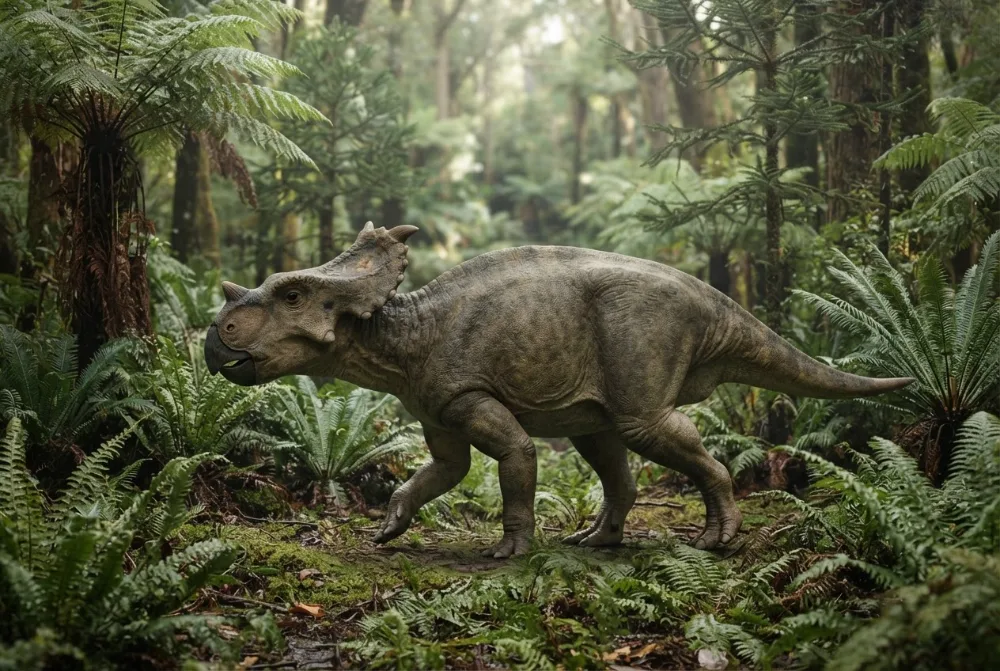
Serendipaceratops is known from just one bone, a left ulna (lower arm bone) that is about 16 centimetres long.1
The bone was discovered in 1993 during the Dinosaur Cove project, in a small area of sea-floor protected by a dam.1
Scientists first thought the bone might be from a theropod, but later noticed it looked like the arm bone of a horned dinosaur called Leptoceratops.1
The species name, arthurcclarkei, honors science fiction writer Arthur C. Clarke, who was a friend of the scientists that named it.1
Some scientists think Serendipaceratops might actually be an ankylosaur, not a horned dinosaur, because the arm bone is robust.1
The fossil was found in the Wonthaggi Formation, which is about 115 million years old.1
As preguntas máis frecuentes sobre Serendipaceratops
?What did Serendipaceratops eat?
Serendipaceratops was a herbivore, meaning it ate plants.1
?How big was Serendipaceratops?
Nobody knows for sure, because only one arm bone has been found. That bone is about 16 centimetres (6 inches) long.1
?When did Serendipaceratops live?
It lived during the Early Cretaceous Period, about 115 million years ago.1
?Was Serendipaceratops a dinosaur?
It is a type of ornithischian dinosaur, possibly an ankylosaur.1
?Why is it called Serendipaceratops?
The name means 'serendipitous horned face', because scientists were surprised to find a horned dinosaur bone in Australia. It was named by luck or serendipity.1
?Was Serendipaceratops a ceratopsian?
Scientists disagree. Some think it was a ceratopsian, but others think it was an ankylosaur because the arm bone is robust.1
Cazamitos
Mito: Some people think Serendipaceratops was definitely a horned dinosaur like Triceratops.
Verdade: Scientists are not sure. Some studies say it is a ceratopsian, but others say it might be an ankylosaur because the arm bone is robust.1
Para expertos en dinos
- Nome científico
- Serendipaceratops
- Bautizado por
- Rich and Vickers-Rich 20033
- Grupo
- Dinos con cornos
- Familia / clado
- Ceratopsia3
- Clasificación
- Ornithischia > Ceratopsia3
- Idade das rochas
- de 121 a 120 millóns de anos (Aptian)3
- Formacións rochosas
- Wonthaggi3
- Países
- Australia3
- Rexistros fósiles
- 1 na Paleobiology Database3
- Descubrimento
- The bone was found in 1993 near Kilcunda, Australia, and the dinosaur was named by Tom Rich and Patricia Vickers-Rich in 2003. The name came after a colleague pointed out the bone looked like a horned dinosaur's arm bone.1
- Aínda en debate
- Scientists still debate whether Serendipaceratops is a ceratopsian or an ankylosaur, because only one bone is known and it may be deformed.1
De onde veñen os datos
- Serendipaceratops (en.wikipedia.org)
- Serendipaceratops arthurcclarkei | Dinosaur Database by DinoAnimals.com (dinoanimals.com)
- Serendipaceratops in The Paleobiology Database (CC BY 4.0): idade, lugares, formacións rochosas, clasificación.
Cada dato desta páxina ten un número que leva á súa fonte. Se nos equivocamos nalgo, sentímolo, somos fans dos dinos, non unha revista científica. Escríbenos a [email protected] e arranxámolo.
 Rex ten fame! Dino Wiki é o proxecto dun pai para o seu fillo, que adora os dinosauros, gratis, sen anuncios e sen rastrexadores. Os adultos poden darlle un petisco a Rex para mantelo en liña.Dálle de comer a Rex
 Triceratops
 Protoceratops
 Ojoceratops
 Tatankaceratops
 Psittacosaurus
 Centrosaurus
 Stegosaurus
 Iguanodon
 Archaeopteryx
 Giganotosaurus
 Microraptor
 Deinonychus