 Que dino es ti? O test
 Batalla de dinos
 Carreira de dinos
 Minixogos de dinos
 Álbum de cromos
 Listas TOP de dinos
 Sorpréndeme!
Cando viviu?

Como era de grande?
Canto medía de longo?
Canto pesaba?

 tan longo coma 4 gatos domésticos do fociño á cola🍌tan longo coma 11 plátanos postos un tras outrotan pesado coma 10 gatos domésticos🍉tan pesado coma 8 sandías🧸tan pesado coma 2 nenos de infantil🎒tan pesado coma 1 nenos de primaria🏃podería correr 100 metros en 8,2 segundos (o humano máis rápido necesita 9,6)
Como era de grande Sphaerotholus comparado CONTIGO?
Só son contas no teu navegador. Non se garda nin se envía nada.
Que velocidade alcanzaba?


Datos curiosos
Sphaerotholus lived for a long time, about 7 to 8 million years, and spread across a wide area from New Mexico to Montana.1
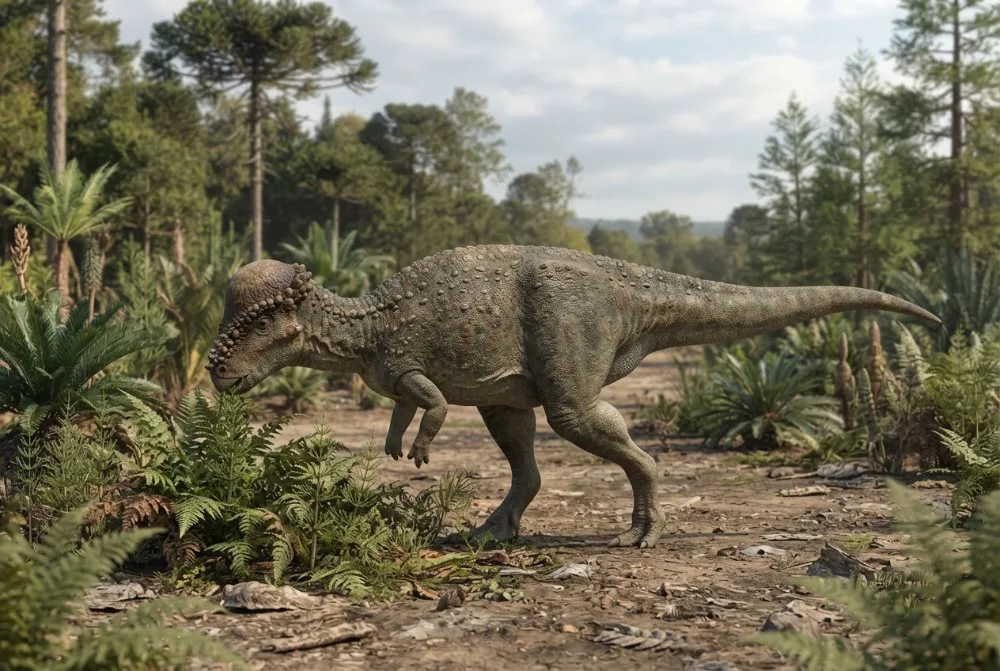
There are five known species of Sphaerotholus, each with slightly different bumps and nodes on the back of their skulls.1
One species, S. triregnum, had a triple row of small bony nodes on its skull, making it look like it wore a triple crown.1
Another species, S. lyonsi, had a double row of small nodes, while others had a single row of large nodes.1
The name Sphaerotholus means 'ball dome', which describes its round, dome-shaped skull.1
Sphaerotholus is considered a highly evolved, or derived, pachycephalosaur.1
As preguntas máis frecuentes sobre Sphaerotholus
?How big was Sphaerotholus?
Sphaerotholus edmontonensis reached about 2 metres (6.6 feet) in length and weighed around 40 kilograms (88 pounds). Other species were probably a similar size.1
?What did Sphaerotholus eat?
Sphaerotholus was a plant-eater. Like other pachycephalosaurs, it had teeth suited for eating tough plants.1
?When did Sphaerotholus live?
Sphaerotholus lived during the Late Cretaceous, from about 76 to 66 million years ago.1
?Where did Sphaerotholus live?
Sphaerotholus lived in what is now the western United States and Canada, from New Mexico to Montana and Alberta.1
?How many species of Sphaerotholus are there?
There are five known species: S. goodwini, S. buchholtzae, S. edmontonensis, S. lyonsi, and S. triregnum.1
?Why did Sphaerotholus have a dome?
Sphaerotholus had a thick, bony dome on its skull that it probably used for head-butting contests, like other dome-headed dinosaurs.1
Cazamitos
Mito: Some people think Sphaerotholus used its dome for ramming like a battering ram.
Verdade: Scientists are not sure. The dome might have been for head-butting, but it could also have been for showing off to mates or recognizing each other.1
Para expertos en dinos
- Nome científico
- Sphaerotholus
- Bautizado por
- Williamson and Carr 20032
- Grupo
- Cabezas de cúpula
- Familia / clado
- Pachycephalosauridae2
- Clasificación
- Ornithischia > Pachycephalosauria2
- Idade das rochas
- de 84 a 66 millóns de anos (Campanian / Maastrichtian)2
- Formacións rochosas
- Hell Creek, Kirtland, Frenchman2
- Países
- EUA, Canadá2
- Rexistros fósiles
- 6 na Paleobiology Database2
- Descubrimento
- The first species, Sphaerotholus goodwini, was named by Thomas Williamson and Thomas Carr in 2002 from a partial skull found in New Mexico. The species name honors paleontologist Mark Goodwin.1
- Aínda en debate
- Scientists still debate whether some species, like S. edmontonensis, are really separate or just the same as others, because their skulls look very similar.1
De onde veñen os datos
- Sphaerotholus (en.wikipedia.org)
- Sphaerotholus in The Paleobiology Database (CC BY 4.0): idade, lugares, formacións rochosas, clasificación.
Cada dato desta páxina ten un número que leva á súa fonte. Se nos equivocamos nalgo, sentímolo, somos fans dos dinos, non unha revista científica. Escríbenos a [email protected] e arranxámolo.
 Rex ten fame! Dino Wiki é o proxecto dun pai para o seu fillo, que adora os dinosauros, gratis, sen anuncios e sen rastrexadores. Os adultos poden darlle un petisco a Rex para mantelo en liña.Dálle de comer a Rex
 Pachycephalosaurus
 Stegoceras
 Prenocephale
 Foraminacephale
 Brontotholus
 Colepiocephale
 Tyrannosaurus
 Triceratops
 Velociraptor
 Spinosaurus
 Ankylosaurus
 Parasaurolophus