 Que dino es ti? O test
 Batalla de dinos
 Carreira de dinos
 Minixogos de dinos
 Álbum de cromos
 Listas TOP de dinos
 Sorpréndeme!
Ugrunaaluk
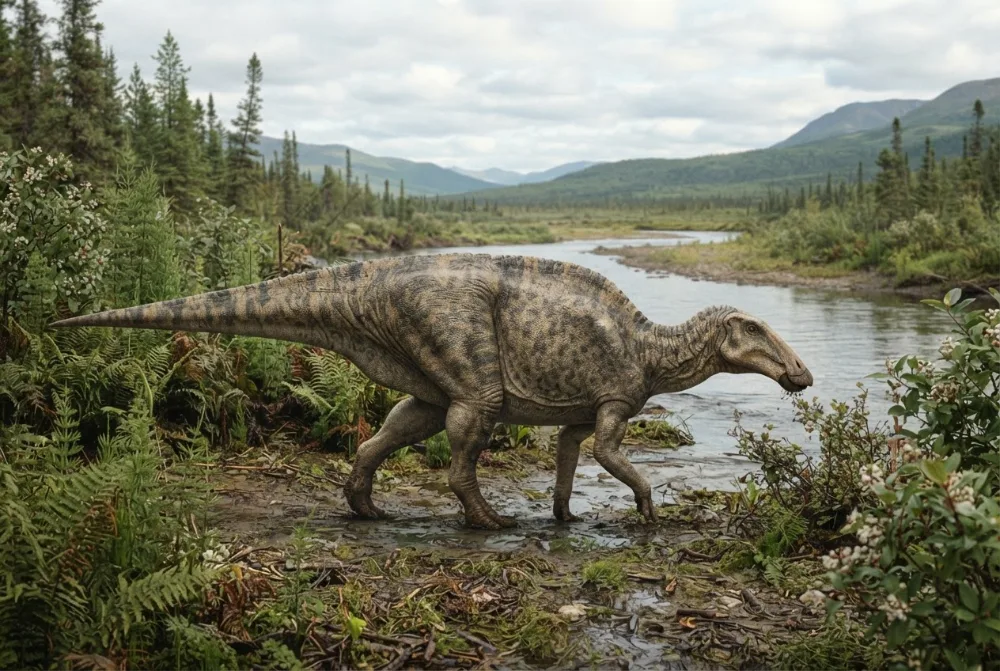
Ugrunaaluk was a duck-billed dinosaur that lived in the ancient Arctic, where it was cold and dark for part of the year. It had a long, flat beak and hundreds of teeth for chewing tough plants. This dinosaur is special because it shows that some dinosaurs could survive in polar regions.51
Cando viviu?
Como era de grande?
Canto medía de longo?
Canto medía de alto?
estimación
Canto pesaba?
 tan longo coma 2,5 coches aparcados en fila🍌tan longo coma 67 plátanos postos un tras outro
 máis ou menos tan pesado coma un elefante🍉tan pesado coma 1100 sandías🎒tan pesado coma 7 clases enteiras de nenos🐻❄️tan pesado coma 12 osos polares🏃podería correr 100 metros en 17 segundos (o humano máis rápido necesita 9,6)
Como era de grande Ugrunaaluk comparado CONTIGO?
Só son contas no teu navegador. Non se garda nin se envía nada.
Que velocidade alcanzaba?


Datos curiosos
Ugrunaaluk lived in the Arctic about 69 million years ago, when the climate was much cooler than today, with average temperatures around 5 to 6°C.1
Most of the Ugrunaaluk fossils found are from young animals, not fully grown adults. Scientists think a whole herd of juveniles may have died together in a flood.1
Its name comes from the Iñupiaq language of Alaska. Ugruŋnaq means a grazing animal with grinding teeth, and -aluk means old, so Ugrunaaluk is 'ancient grazer'.1
Ugrunaaluk was a close relative of Edmontosaurus, but scientists found enough differences in its skull bones to give it its own name.1
The Liscomb bonebed where Ugrunaaluk was found has thousands of bones, mostly from this dinosaur, along with a few teeth from tyrannosaurs and other small dinosaurs.1
During the time of Ugrunaaluk, the Arctic had polar woodlands with flowering plants in the understory, and the days were dark for months in winter.1
As preguntas máis frecuentes sobre Ugrunaaluk
?How big was Ugrunaaluk?
Ugrunaaluk was about 7.6 to 9.1 meters (25 to 30 feet) long and stood about 1.8 to 2.1 meters (6 to 7 feet) tall at the hip.4
?What did Ugrunaaluk eat?
It was a plant-eater, with a flat beak and hundreds of teeth for chewing tough plants. Its jaw had at least 1,000 teeth with coarse surfaces perfect for pulverizing plants.4
?Did Ugrunaaluk live in the Arctic?
Yes, Ugrunaaluk lived in the ancient Arctic, above the Arctic Circle, about 69 million years ago. It endured cold and dark winters, with average temperatures around 5 to 6°C.41
?Was Ugrunaaluk a duck-billed dinosaur?
Yes, Ugrunaaluk belonged to the hadrosaur group of duck-billed dinosaurs. It had a long, flat beak and hundreds of teeth for chewing plants.4
?Why is Ugrunaaluk special?
Ugrunaaluk is special because it shows that some dinosaurs could survive in polar regions. It lived above the Arctic Circle, enduring months of darkness and cold.4
?How many teeth did Ugrunaaluk have?
Ugrunaaluk had at least 1,000 teeth in its jaw, with coarse surfaces perfect for pulverizing plants.4
?When did Ugrunaaluk live?
Ugrunaaluk lived about 69 million years ago, during the Late Cretaceous period, in the ancient Arctic.4
?Is Ugrunaaluk related to Edmontosaurus?
Yes, Ugrunaaluk is closely related to Edmontosaurus, but scientists found enough differences in its skull bones to give it its own name.1
?Where was Ugrunaaluk found?
Ugrunaaluk fossils were found in the Liscomb bonebed in the Prince Creek Formation of northern Alaska, along the Colville River.1
Cazamitos
Mito: Ugrunaaluk is just a young Edmontosaurus and not a real separate dinosaur.
Verdade: Scientists showed that Ugrunaaluk has unique skull features that make it a distinct species, even when accounting for age differences.1
Para expertos en dinos
- Nome científico
- Ugrunaaluk
- Bautizado por
- Mori et al. 20165
- Grupo
- Bicos de pato
- Familia / clado
- Hadrosauridae5
- Clasificación
- Ornithischia > Ornithopoda > Iguanodontia > Hadrosauridae5
- Idade das rochas
- de 72 a 66 millóns de anos (Maastrichtian)5
- Formacións rochosas
- Prince Creek5
- Países
- EUA5
- Rexistros fósiles
- 1 na Paleobiology Database5
- Descubrimento
- Ugrunaaluk was named in 2016 by Hirotsugu Mori, Patrick Druckenmiller, and Gregory Erickson. The fossils were found in the Liscomb bonebed along the Colville River in northern Alaska.51
- Aínda en debate
- Scientists are not sure exactly how big adult Ugrunaaluk grew, because almost all the fossils are from juveniles.1
De onde veñen os datos
- Formation (lower Maastrichtian) of northern Alaska (app.pan.pl)
- Edmontosaurus (en.wikipedia.org)
- Edmontosaurus regalis (en.wikipedia.org)
- New Dinosaur Species Probably Endured Snow and Darkness for Months on End | NOVA | PBS (pbs.org)
- Ugrunaaluk in The Paleobiology Database (CC BY 4.0): idade, lugares, formacións rochosas, clasificación.
Cada dato desta páxina ten un número que leva á súa fonte. Se nos equivocamos nalgo, sentímolo, somos fans dos dinos, non unha revista científica. Escríbenos a [email protected] e arranxámolo.
 Rex ten fame! Dino Wiki é o proxecto dun pai para o seu fillo, que adora os dinosauros, gratis, sen anuncios e sen rastrexadores. Os adultos poden darlle un petisco a Rex para mantelo en liña.Dálle de comer a Rex
 Parasaurolophus
 Edmontosaurus
 Saurolophus
 Hypacrosaurus
 Corythosaurus
 Kritosaurus
 Tyrannosaurus
 Triceratops
 Velociraptor
 Spinosaurus
 Ankylosaurus
 Pteranodon