 Que dino es ti? O test
 Batalla de dinos
 Carreira de dinos
 Minixogos de dinos
 Álbum de cromos
 Listas TOP de dinos
 Sorpréndeme!
Cando viviu?

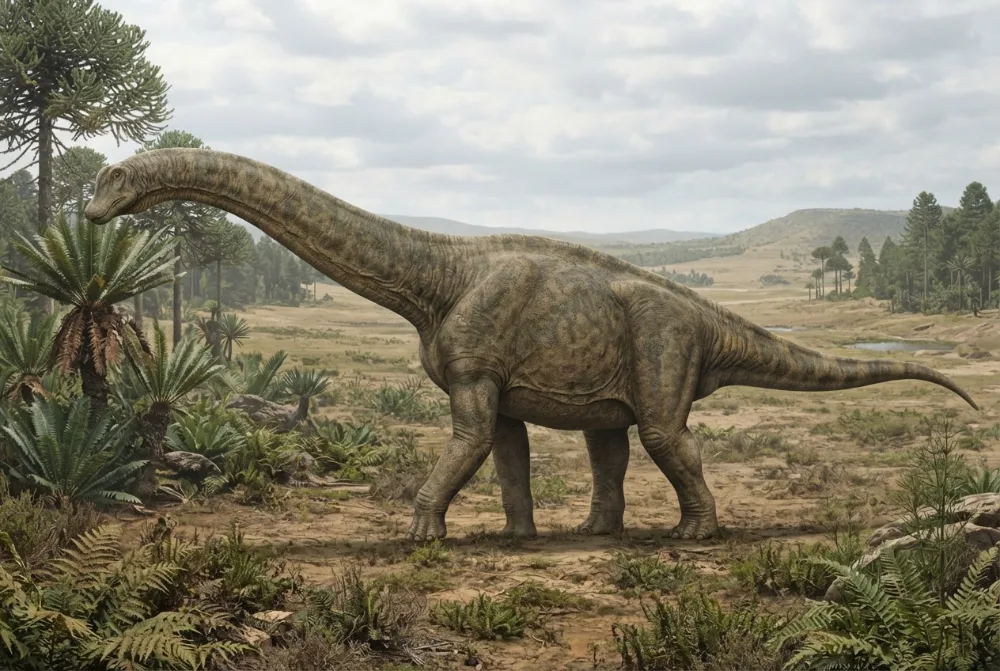
Como era de grande?
Canto medía de longo?
Canto pesaba?
 tan longo coma 22 coches aparcados en fila🍌tan longo coma 560 plátanos postos un tras outro
 máis ou menos tan pesado coma un elefante🍉tan pesado coma 1400 sandías🎒tan pesado coma 9 clases enteiras de nenos🐻❄️tan pesado coma 16 osos polares🏃podería correr 100 metros en 21 segundos (o humano máis rápido necesita 9,6)
Como era de grande Wamweracaudia comparado CONTIGO?
Só son contas no teu navegador. Non se garda nin se envía nada.
Que velocidade alcanzaba?


Datos curiosos
Wamweracaudia is known from a nearly complete series of thirty tail vertebrae, plus two chevrons and two neural spines.1
Its tail bones were procoelous, meaning they had a hollow at the front and a ball at the back, which made the tail flexible and strong.1
It was a close relative of Mamenchisaurus, a famous long-necked dinosaur from Asia, and scientists think it may be the first mamenchisaurid found outside Asia.1
The fossils were first dug up between 1909 and 1912 by German expeditions, but they were not given their own name until 2019.1
The name honors the Wamwera people who live near the find site, and the specific name keranjei honors Mohammadi Keranje, the foreman who led the excavation team.1
Wamweracaudia lived during the Late Jurassic, about 155 to 145 million years ago.1
As preguntas máis frecuentes sobre Wamweracaudia
?What did Wamweracaudia eat?
Wamweracaudia was a herbivore, meaning it ate plants. As a sauropod, it was a large quadrupedal herbivore.1
?When did Wamweracaudia live?
Wamweracaudia lived during the Late Jurassic, about 155 to 145 million years ago.1
?How big was Wamweracaudia?
Scientists don't know exactly, but it was a large sauropod. It is known from a nearly complete series of thirty tail vertebrae, which suggests a long tail.1
?Is Wamweracaudia related to Mamenchisaurus?
Yes, Wamweracaudia is a close relative of Mamenchisaurus. Scientists think it may be the first mamenchisaurid found outside Asia.1
Cazamitos
Mito: Some people think Wamweracaudia was a titanosaur, a type of giant sauropod.
Verdade: Scientists now think it was a mamenchisaurid, more closely related to Mamenchisaurus, because of its tail bone features.1
Para expertos en dinos
- Nome científico
- Wamweracaudia
- Bautizado por
- Mannion et al. 20194
- Grupo
- Pescozos longos
- Familia / clado
- Mamenchisauridae4
- Clasificación
- Sauropodomorpha > Sauropoda4
- Idade das rochas
- de 149 a 143 millóns de anos (Tithonian)4
- Formacións rochosas
- Tendaguru4
- Países
- Tanzania4
- Rexistros fósiles
- 2 na Paleobiology Database4
- Descubrimento
- The tail was found during German expeditions to Tendaguru in Tanzania between 1909 and 1912, supervised by paleontologist Werner Janensch. It was named Wamweracaudia keranjei in 2019 by Philip Mannion and colleagues.1
- Aínda en debate
- Scientists are still unsure about the exact size of Wamweracaudia because only tail bones have been found, and the PBDB gives a very broad length estimate.2
De onde veñen os datos
- Wamweracaudia (en.wikipedia.org)
- PBDB Taxon (paleobiodb.org)
- Wamweracaudia keranjei | Dinosaur Database by DinoAnimals.com (dinoanimals.com)
- Wamweracaudia in The Paleobiology Database (CC BY 4.0): idade, lugares, formacións rochosas, clasificación.
Cada dato desta páxina ten un número que leva á súa fonte. Se nos equivocamos nalgo, sentímolo, somos fans dos dinos, non unha revista científica. Escríbenos a [email protected] e arranxámolo.
 Rex ten fame! Dino Wiki é o proxecto dun pai para o seu fillo, que adora os dinosauros, gratis, sen anuncios e sen rastrexadores. Os adultos poden darlle un petisco a Rex para mantelo en liña.Dálle de comer a Rex
 Brachiosaurus
 Diplodocus
 Brontosaurus
 Argentinosaurus
 Camarasaurus
 Morosaurus
 Allosaurus
 Compsognathus
 Camptosaurus
 Nanosaurus
 Rhamphorhynchus
 Ceratosaurus