 Que dino es ti? O test
 Batalla de dinos
 Carreira de dinos
 Minixogos de dinos
 Álbum de cromos
 Listas TOP de dinos
 Sorpréndeme!
Wendiceratops
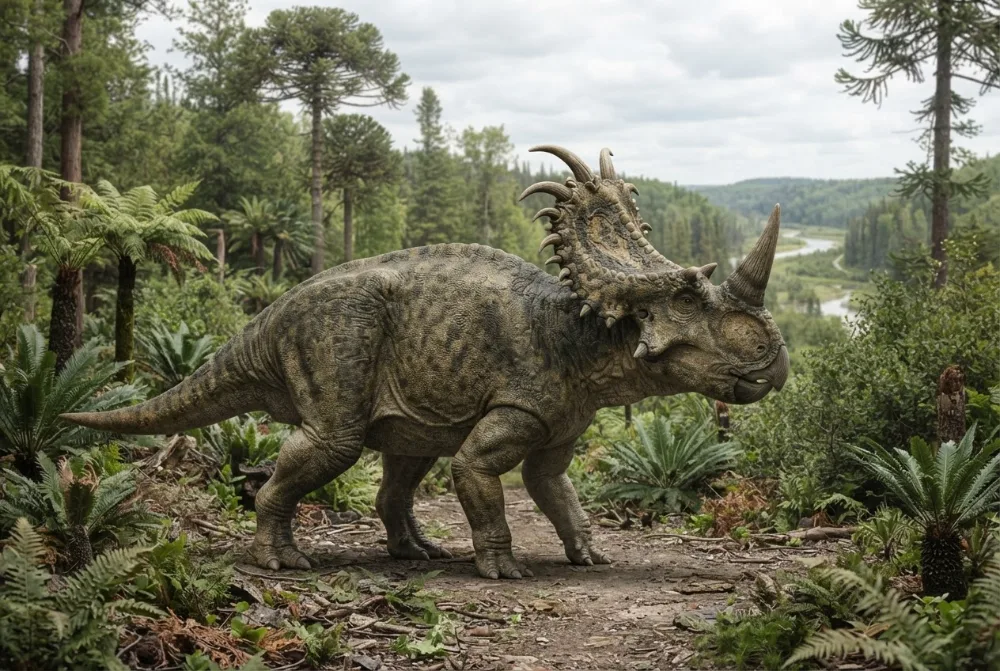
Wendiceratops was a plant-eating dinosaur with a huge bony frill on its head and a big upright horn above its nose. It lived about 78 to 79 million years ago in what is now Alberta, Canada. This dinosaur is one of the oldest horned dinosaurs with a tall nose horn ever found.1
Cando viviu?
Como era de grande?
Canto medía de longo?
Canto medía de alto?
Canto pesaba?

 tan longo coma 6 cans do fociño á cola🍌tan longo coma 33 plátanos postos un tras outrotan pesado coma 75 cans🍉tan pesado coma 300 sandías🧸tan pesado coma 79 nenos de infantil🎒tan pesado coma 47 nenos de primaria🐻❄️tan pesado coma 3 osos polares🏃podería correr 100 metros en 9,5 segundos (o humano máis rápido necesita 9,6)
Como era de grande Wendiceratops comparado CONTIGO?
Só son contas no teu navegador. Non se garda nin se envía nada.
Que velocidade alcanzaba?


Datos curiosos
Wendiceratops had a frill decorated with many curved, forward-pointing spikes that made it look very fancy.1
Its name honors Canadian fossil hunter Wendy Sloboda, who discovered the bonebed where this dinosaur was found.1
Over 200 bones from many different Wendiceratops individuals were found together in one bonebed, making it one of the best-known early horned dinosaurs.1
Wendiceratops lived about 78 to 79 million years ago, during the Campanian stage of the Late Cretaceous.1
Scientists think the tall nose horn of Wendiceratops evolved separately from the nose horns of later horned dinosaurs like Triceratops.1
The ischium, a hip bone, of Wendiceratops had a wide, rectangular end, which is a unique feature not seen in other horned dinosaurs.1
As preguntas máis frecuentes sobre Wendiceratops
?How big was Wendiceratops?
Wendiceratops reached about 6 metres (20 feet) in length and weighed about 1.5 metric tons (1.7 short tons).2
?What did Wendiceratops eat?
Wendiceratops was a herbivore, eating low-lying plants. It cropped them with a parrot-like beak and sliced them with leaf-shaped teeth.3
?Why did Wendiceratops have a nose horn?
The tall nose horn was likely used for display or defense, but scientists aren't sure exactly. It evolved separately from the nose horns of later horned dinosaurs like Triceratops.3
?When did Wendiceratops live?
Wendiceratops lived about 78 to 79 million years ago, during the Campanian stage of the Late Cretaceous.3
Cazamitos
Mito: Wendiceratops had a long nose horn like a rhino.
Verdade: Wendiceratops had an upright nasal horn, but its exact shape is unknown because the nasal bone is incomplete.1
Para expertos en dinos
- Nome científico
- Wendiceratops
- Bautizado por
- Evans and Ryan 20154
- Grupo
- Dinos con cornos
- Familia / clado
- Ceratopsidae4
- Clasificación
- Ornithischia > Ceratopsia > Ceratopsidae4
- Idade das rochas
- de 84 a 72 millóns de anos (Campanian)4
- Formacións rochosas
- Oldman4
- Países
- Canadá4
- Rexistros fósiles
- 1 na Paleobiology Database4
- Descubrimento
- Wendiceratops was named by paleontologists David Evans and Michael Ryan in 2015 based on fossils from a bonebed in Alberta, Canada. The bonebed was discovered by fossil hunter Wendy Sloboda, and the dinosaur was named in her honor.1
- Aínda en debate
- Scientists are not sure exactly how tall or curved the nose horn of Wendiceratops was, because the nasal bone is not completely preserved.1
De onde veñen os datos
- Cranial Anatomy of Wendiceratops pinhornensis gen. et sp ... (journals.plos.org)
- Wendiceratops (Wikipedia) (Wikipedia)
- Introducing Wendiceratops: A remarkable new horned dinosaur | Royal Ontario Museum (rom.on.ca)
- Wendiceratops in The Paleobiology Database (CC BY 4.0): idade, lugares, formacións rochosas, clasificación.
Cada dato desta páxina ten un número que leva á súa fonte. Se nos equivocamos nalgo, sentímolo, somos fans dos dinos, non unha revista científica. Escríbenos a [email protected] e arranxámolo.
 Rex ten fame! Dino Wiki é o proxecto dun pai para o seu fillo, que adora os dinosauros, gratis, sen anuncios e sen rastrexadores. Os adultos poden darlle un petisco a Rex para mantelo en liña.Dálle de comer a Rex
 Triceratops
 Protoceratops
 Ojoceratops
 Tatankaceratops
 Psittacosaurus
 Centrosaurus
 Tyrannosaurus
 Velociraptor
 Spinosaurus
 Ankylosaurus
 Parasaurolophus
 Pteranodon