 Que dino es ti? O test
 Batalla de dinos
 Carreira de dinos
 Minixogos de dinos
 Álbum de cromos
 Listas TOP de dinos
 Sorpréndeme!
Wintonotitan
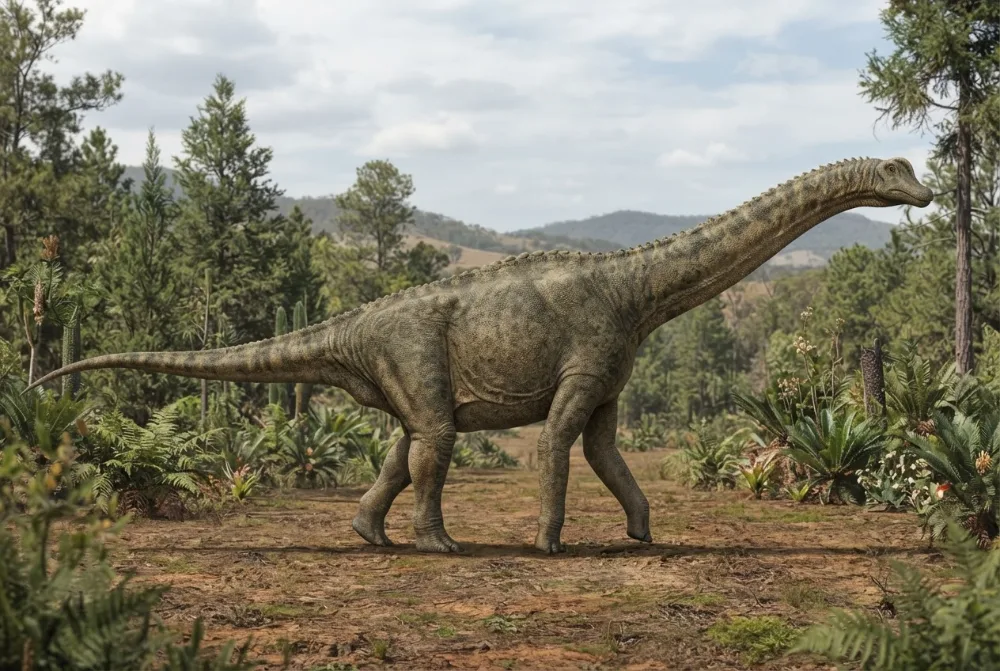
Wintonotitan was a long-necked sauropod that lived in Australia about 100 million years ago. It was a plant-eater with a relatively slender body and front legs longer than its back legs. Scientists call it 'Clancy' after a poem by Banjo Patterson.2
Cando viviu?
Como era de grande?
Canto medía de longo?
Canto medía de alto?
Canto pesaba?

 tan longo coma 4 coches aparcados en fila🍌tan longo coma 89 plátanos postos un tras outrotan pesado coma 10 coches🍉tan pesado coma 3000 sandías🎒tan pesado coma 19 clases enteiras de nenos🐻❄️tan pesado coma 33 osos polares🏃podería correr 100 metros en 26 segundos (o humano máis rápido necesita 9,6)
Como era de grande Wintonotitan comparado CONTIGO?
Só son contas no teu navegador. Non se garda nin se envía nada.
Que velocidade alcanzaba?


Datos curiosos
Wintonotitan was one of three new dinosaurs named from the Winton Formation in 2009, along with Diamantinasaurus and Australovenator.1
Its fossils were first discovered in the 1970s by Keith Watts, who donated them to the Queensland Museum. The species name wattsi honors him.2
Wintonotitan had unique tail bones that were biconvex (rounded on both ends) near the tip, which is different from most other sauropods.2
It lived in a river plain environment with large rivers, swamps, and lakes, after the Eromanga Sea had retreated. The climate was subtropical with abundant rainfall.2
Wintonotitan was a relatively small titanosaur, reaching about 15 to 16 metres long, while some other titanosaurs could grow to 35 metres.2
The fossils found include most of the front limb and shoulder girdle, tail vertebrae, ribs, and hip bones, but no skull or teeth have been discovered yet.2
As preguntas máis frecuentes sobre Wintonotitan
?How much did Wintonotitan weigh?
About 10 to 15 tonnes (22,000 to 33,000 pounds). That is roughly as heavy as a large truck.2
?What plants did Wintonotitan eat?
It ate ferns, ginkgoes, conifers, cycads, and early flowering plants that grew in its river-plain home.2
?How did Wintonotitan get its name?
Its name means 'Winton titan', after the town of Winton in Queensland, Australia, where its fossils were found.3
?When did Wintonotitan live?
It lived during the Cretaceous Period, about 100 million years ago.2
Para expertos en dinos
- Nome científico
- Wintonotitan
- Bautizado por
- Hocknull et al. 20094
- Grupo
- Pescozos longos
- Familia / clado
- Diamantinasauria4
- Clasificación
- Sauropodomorpha > Sauropoda > Macronaria4
- Idade das rochas
- de 100 a 90 millóns de anos (Cenomanian / Turonian)4
- Formacións rochosas
- Winton4
- Países
- Australia4
- Rexistros fósiles
- 7 na Paleobiology Database4
- Descubrimento
- Wintonotitan was named by Scott Hocknull and colleagues in 2009 based on fossils found near Winton, Queensland. The bones were first collected in the 1970s by Keith Watts and later excavated by the Queensland Museum in the 1980s.12
- Aínda en debate
- Scientists are not sure what Wintonotitan's skull looked like because no skull bones have been found. They also debate whether it was a basal titanosauriform or a more derived titanosaur.21
De onde veñen os datos
- New Mid-Cretaceous (Latest Albian) Dinosaurs from Winton, Queensland, Australia | PLOS One (journals.plos.org)
- Dinosaurs - Wintonotitan wattsi - The Australian Museum (australian.museum)
- Wintonotitan (Wikipedia) (Wikipedia)
- Wintonotitan in The Paleobiology Database (CC BY 4.0): idade, lugares, formacións rochosas, clasificación.
Cada dato desta páxina ten un número que leva á súa fonte. Se nos equivocamos nalgo, sentímolo, somos fans dos dinos, non unha revista científica. Escríbenos a [email protected] e arranxámolo.
 Rex ten fame! Dino Wiki é o proxecto dun pai para o seu fillo, que adora os dinosauros, gratis, sen anuncios e sen rastrexadores. Os adultos poden darlle un petisco a Rex para mantelo en liña.Dálle de comer a Rex
 Brachiosaurus
 Diplodocus
 Brontosaurus
 Argentinosaurus
 Camarasaurus
 Morosaurus
 Tyrannosaurus
 Triceratops
 Velociraptor
 Spinosaurus
 Ankylosaurus
 Parasaurolophus