 Kwizi: Oli dayinoso ki?
 Olutalo lwa dayinoso
 Empaka z'emisinde gya dayinoso
 Emizannyo emitono egya dayinoso
 Alubaamu ya sitika
 Enkalala za dayinoso eza TOP
 Mpa ekyewuunyisa!
Megalodon
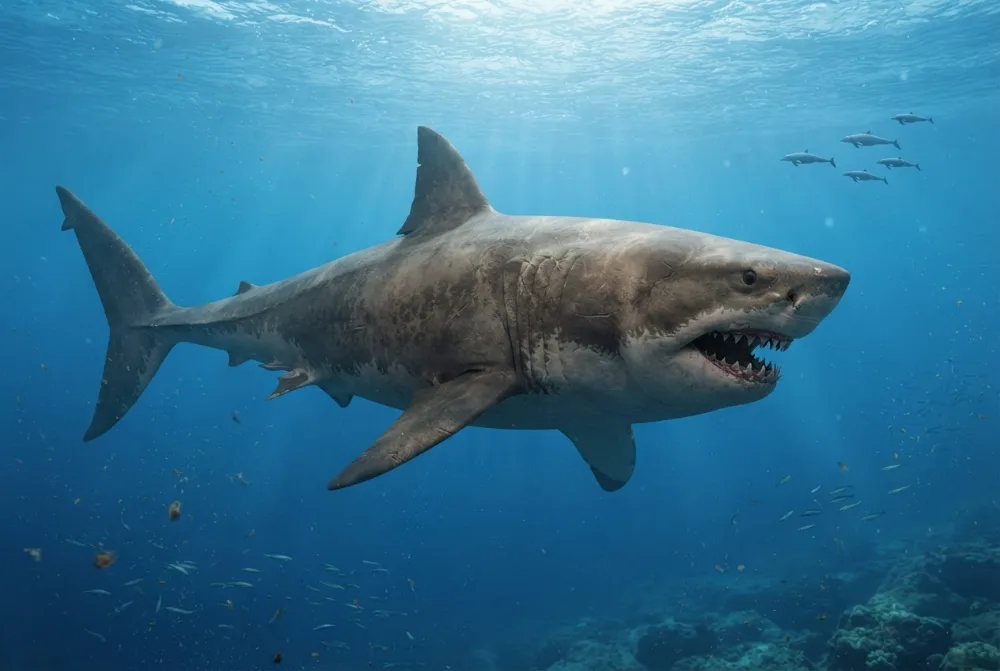
Megalodon was a giant shark that lived millions of years ago. It had teeth as big as a human hand and could eat whales! It was one of the biggest and scariest ocean hunters ever.1
Yabeerawo ddi?
Yali munene atya?
Yali muwanvu kwenkana wa?
Yali muzito kwenkana wa?

 obuwanvu ng'emmotoka 5 ezisimbiddwa mu lunyiriri🍌obuwanvu ng'amenvu 140 nga gaddiriŋŋana🍉obuzito ng'obwa wotamerooni 19000🎒obuzito ng'obw'ebibiina 120 ebijjuvu eby'abaana b'essomero🏊yandiwuze obuwanvu bw'ekidiba ekinene (50 m) mu sikonda 10
Megalodon yali munene atya bw'ogeraageranya ku GGWE?
Kubala kwokka mu browser yo. Tewali kiterekebwa wadde okusindikibwa wonna.
Yali wa mbiro kwenkana wa?


Ebyewuunyisa
Megalodon teeth can be up to 16 centimetres tall, and some might have been even 20 centimetres. That is bigger than a human hand!2
Megalodon probably gave birth to live young, and baby megalodons were already about 3.6 to 3.9 metres long at birth.2
Megalodon had a huge appetite. It ate dolphins, small whales, seals, sea turtles, and even other sharks.1
Megalodon used nursery areas in warm, shallow coastal waters to raise its young, where there was lots of food and fewer predators.1
Megalodon was once thought to be a close relative of the great white shark, but scientists now think it belonged to a different, extinct family called Otodontidae.1
Megalodon probably swam at a cruising speed of about 2.1 to 3.5 kilometres per hour, which is a slow, steady pace for such a big shark.2
Ebibuuzo ebisinga okubuuzibwa ku Megalodon
?How big was megalodon?
Scientists estimate megalodon grew up to 15 to 18 metres (49 to 59 feet) long, which is about three times longer than the largest great white shark.31
?When did megalodon go extinct?
Megalodon went extinct about 3.6 million years ago, at the end of the Pliocene epoch. The planet cooled, which reduced its habitat and food supply.31
?What did megalodon eat?
Megalodon ate meat, mostly whales, dolphins, seals, sea turtles, and other sharks. It was an apex predator that could bite through the chest of a whale.34
?Could megalodon still be alive today?
No, megalodon is extinct and has been for millions of years. The ocean is too cold now, and there is no evidence of a living megalodon.31
?How big were megalodon teeth?
Megalodon teeth can be up to 18 centimetres (7 inches) tall, which is bigger than a human hand. The word megalodon means 'big tooth'.35
?Was megalodon bigger than a blue whale?
No, the largest blue whale is about 30 metres long, while megalodon was up to 24.3 metres. So blue whales are bigger.3
?Is megalodon a dinosaur?
No, megalodon is not a dinosaur. It was a giant prehistoric shark that lived in the ocean, long after the dinosaurs died out.1
?How fast could megalodon swim?
Up to about 18 km/h (11 mph) by one study, about as fast as a grown-up riding a bike. Most of the time it cruised much slower, about 2 to 5 km/h (1 to 3 mph), to save energy. It may have sped up in short bursts to catch prey.3
Omumenyi w'enfumo
Enfumo: Some people think megalodon is still alive today in the deep ocean.
Amazima: Megalodon went extinct about 3.58 million years ago. Scientists have found no evidence that it lives today.1
Eri abakugu mu dayinoso
- Erinnya lya ssaayansi
- Otodus megalodon
- Yatuumibwa
- (Agassiz 1835)6
- Ekibinja
- Ebisolo bya ttutumu eby'edda
- Ekika / ekibinja
- Otodontidae6
- Engabanya
- Chondrichthyes > Lamniformes > Otodontidae6
- Emyaka gy'enjazi
- emyaka obukadde 66 okutuuka ku 0.3 (Danian / Chibanian)6
- Ensengeka z'enjazi
- Pisco, Temblor, Calvert6
- Ensi
- Amerika, Japaani, Panama, Venezuwela, Peru, Bufalansa6
- Ebisigalira ebyazuulibwa
- 350 mu The Paleobiology Database6
- Okuzuulibwa
- Swiss naturalist Louis Agassiz named megalodon in 1835. He studied fossil teeth and gave it the scientific name Carcharias megalodon, which means 'big tooth'.1
- Kikyakubaganyizibwako ebirowoozo
- Scientists still debate the exact size and body shape of megalodon. Some think it was long and slender, while others think it was bulkier like a great white shark.2
Ebituufu gye biva
- Megalodon (en.wikipedia.org)
- Reassessment of the possible size, form, weight, cruising speed, and growth parameters of the extinct megatooth shark, Otodus megalodon (Lamniformes: Otodontidae), and new evolutionary insights into its gigantism, life history strategies, ecology, and extinction (pmc.ncbi.nlm.nih.gov)
- Megalodon: The truth about the largest shark that ever lived | Natural History Museum (nhm.ac.uk)
- Megalodon, Otodus megalodon - The Australian Museum (australian.museum)
- The Megalodon | Smithsonian Ocean (ocean.si.edu)
- Megalodon in The Paleobiology Database (CC BY 4.0): emyaka, ebifo, ensengeka z'enjazi, engabanya.
Buli kituufu ku lupapula luno kirina ennamba eraga ensibuko yaakyo. Bwe tuba nga tukoze ensobi, tusonyiwe, ffe tuli bawagizi ba dayinoso, so si magazini ya ssaayansi. Tubuulire ku [email protected] tujja kugitereeza.
 Rex alumwa enjala! Dino Wiki pulojekiti ya taata eri mutabani we ayagala ennyo dayinoso, ya bwereere, tewali bulango era tewali bikulondoola. Abakulu basobola okuwa Rex akantu ak'okulya okuyamba okugikuuma ku mutimbagano.Liisa Rex
 Sabre-toothed cat
 Dimetrodon
 Woolly mammoth
 Arthropleura
 Helicoprion
 Deinosuchus