 Kwizi: Oli dayinoso ki?
 Olutalo lwa dayinoso
 Empaka z'emisinde gya dayinoso
 Emizannyo emitono egya dayinoso
 Alubaamu ya sitika
 Enkalala za dayinoso eza TOP
 Mpa ekyewuunyisa!
Yabeerawo ddi?

Yali munene atya?
Yali muwanvu kwenkana wa?
Yali mugulumivu kwenkana wa?
Yali muzito kwenkana wa?

 obuwanvu ng'embwa 6, ennyindo ku mukira🍌obuwanvu ng'amenvu 33 nga gaddiriŋŋana
 obuzito ng'obw'enjovu🍉obuzito ng'obwa wotamerooni 900🎒obuzito ng'obw'ebibiina 6 ebijjuvu eby'abaana b'essomero🐻❄️obuzito ng'obwa ddubu enjeru 10🏃yandidduse mita 100 mu sikonda 28 (omuntu asinga embiro yeetaaga 9.6)
Peloroplites yali munene atya bw'ogeraageranya ku GGWE?
Kubala kwokka mu browser yo. Tewali kiterekebwa wadde okusindikibwa wonna.
Yali wa mbiro kwenkana wa?


Ebyewuunyisa
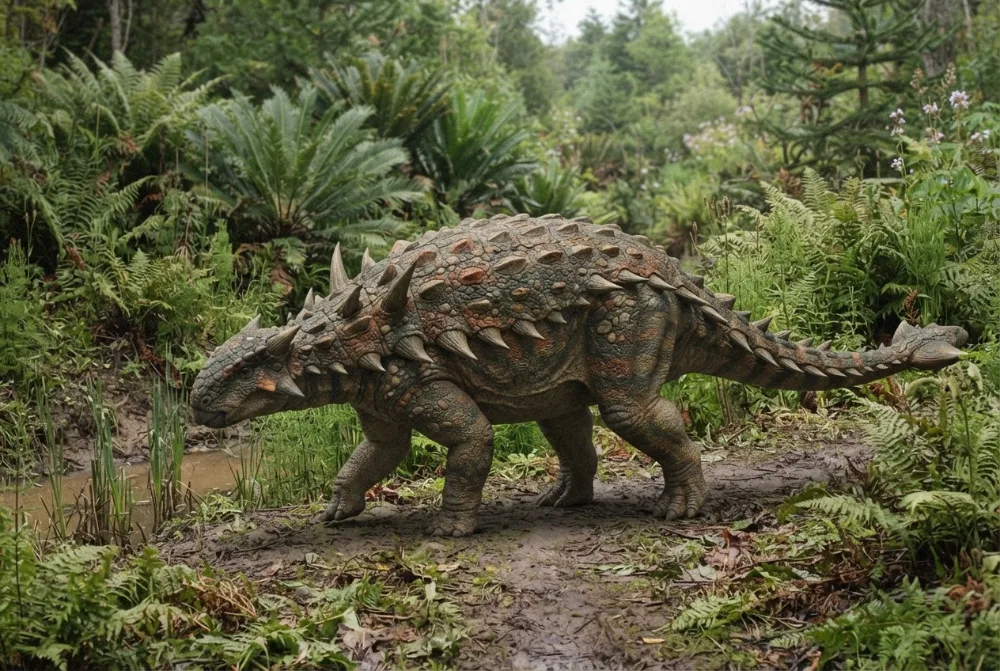
Peloroplites is one of the largest known nodosaurids, a group of armored dinosaurs.1
Its body was covered in bony armor plates and long spikes that protected it from big predators like Acrocanthosaurus.2
The name Peloroplites means 'monstrous heavy one' in Greek, referring to its huge size and heavy armor.1
Only one species is known: Peloroplites cedrimontanus, named after the Cedar Mountain Formation where it was found.1
Its skeleton was put together from bones dug up by staff and volunteers from the USU Prehistoric Museum.2
Utah has more species of armored dinosaurs than any other U.S. state, and Peloroplites is one of them.2
Peloroplites lived in a wet, swampy environment near the edge of the Western Interior Seaway.1
Ebibuuzo ebisinga okubuuzibwa ku Peloroplites
?How big was Peloroplites?
Peloroplites was about 6 metres (20 feet) long and weighed around 2 tonnes (4,410 lbs). That makes it one of the largest known nodosaurids.12
?What did Peloroplites eat?
Peloroplites was a plant-eater. It had small teeth and a wide beak at the front of its mouth to crop low vegetation.23
?When did Peloroplites live?
Peloroplites lived during the Late Cretaceous Period, about 98 to 93 million years ago.1
?Where was Peloroplites found?
Peloroplites was discovered in the Cedar Mountain Formation in Emery County, Utah, USA.12
?Was Peloroplites a dinosaur?
Yes, Peloroplites was a dinosaur. It belongs to a group of armored dinosaurs called nodosaurids.1
Eri abakugu mu dayinoso
- Erinnya lya ssaayansi
- Peloroplites
- Yatuumibwa
- Carpenter et al. 20084
- Ekibinja
- Dayinoso ez'engabo
- Ekika / ekibinja
- Nodosauridae4
- Engabanya
- Ornithischia > Ankylosauria > Nodosauridae > Thyreophora4
- Emyaka gy'enjazi
- emyaka obukadde 121 okutuuka ku 100 (Aptian / Albian)4
- Ensengeka z'enjazi
- Cedar Mountain4
- Ensi
- Amerika4
- Ebisigalira ebyazuulibwa
- 1 mu The Paleobiology Database4
- Okuzuulibwa
- Peloroplites was named in 2008 by Kenneth Carpenter and colleagues from a partial skull and other bones found in the Price River II quarry in Utah.1
- Kikyakubaganyizibwako ebirowoozo
- Scientists are not sure exactly how large Peloroplites grew, because different estimates give lengths from 5 to 6 metres.1
Ebituufu gye biva
- Peloroplites (en.wikipedia.org)
- Armored Monster Invades USU Eastern Prehistoric Museum (usu.edu)
- Peloroplites cedrimontanus (eastern.usu.edu)
- Peloroplites in The Paleobiology Database (CC BY 4.0): emyaka, ebifo, ensengeka z'enjazi, engabanya.
Buli kituufu ku lupapula luno kirina ennamba eraga ensibuko yaakyo. Bwe tuba nga tukoze ensobi, tusonyiwe, ffe tuli bawagizi ba dayinoso, so si magazini ya ssaayansi. Tubuulire ku [email protected] tujja kugitereeza.
 Rex alumwa enjala! Dino Wiki pulojekiti ya taata eri mutabani we ayagala ennyo dayinoso, ya bwereere, tewali bulango era tewali bikulondoola. Abakulu basobola okuwa Rex akantu ak'okulya okuyamba okugikuuma ku mutimbagano.Liisa Rex
 Ankylosaurus
 Sauropelta
 Pinacosaurus
 Scutellosaurus
 Struthiosaurus
 Euoplocephalus
 Stegosaurus
 Iguanodon
 Archaeopteryx
 Giganotosaurus
 Microraptor
 Deinonychus