 Kwizi: Oli dayinoso ki?
 Olutalo lwa dayinoso
 Empaka z'emisinde gya dayinoso
 Emizannyo emitono egya dayinoso
 Alubaamu ya sitika
 Enkalala za dayinoso eza TOP
 Mpa ekyewuunyisa!
Pliosaurus
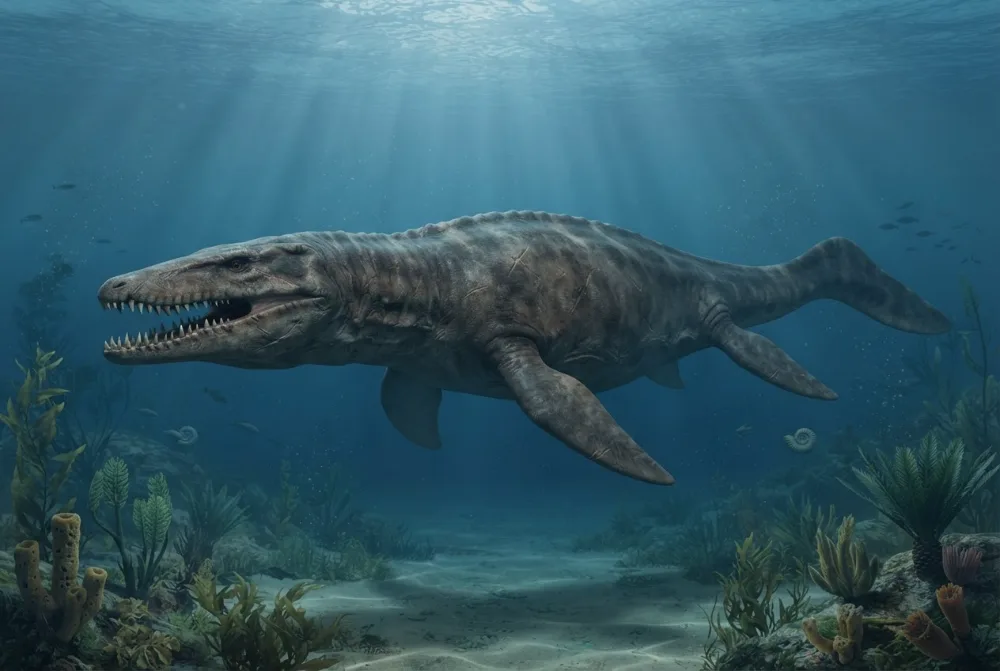
Pliosaurus was a giant marine reptile that ruled the Jurassic oceans. It had a huge head, a short neck, and powerful jaws full of sharp teeth. This predator could grow as long as a school bus and ate big prey like other sea creatures.1
Yabeerawo ddi?
Yali munene atya?
Yali muwanvu kwenkana wa?
Yali muzito kwenkana wa?
 obuwanvu ng'emmotoka 3 ezisimbiddwa mu lunyiriri🍌obuwanvu ng'amenvu 83 nga gaddiriŋŋana
 obuzito ng'obw'enjovu 2🍉obuzito ng'obwa wotamerooni 2200🎒obuzito ng'obw'ebibiina 14 ebijjuvu eby'abaana b'essomero🐻❄️obuzito ng'obwa ddubu enjeru 24🏊yandiwuze obuwanvu bw'ekidiba ekinene (50 m) mu sikonda 9.5
Pliosaurus yali munene atya bw'ogeraageranya ku GGWE?
Kubala kwokka mu browser yo. Tewali kiterekebwa wadde okusindikibwa wonna.
Yali wa mbiro kwenkana wa?


Ebyewuunyisa
Pliosaurus had a skull that could be up to 2.1 metres (about 7 feet) long, making it one of the largest-headed marine reptiles.1
Its teeth were trihedral, meaning they had three flat sides, which helped it grip slippery prey.1
Pliosaurus lived during the Late Jurassic, about 165 to 66 million years ago, and its fossils are often found in the Kimmeridge Clay Formation in England.4
The first Pliosaurus fossil was discovered in 1822 near Weymouth, England, and it was named by the famous scientist Richard Owen in 1841.1
Pliosaurus was a plesiosaur, but unlike the long-necked plesiosaurs, it had a short neck and a huge head.1
Some scientists think Pliosaurus could grow up to 15 metres (about 49 feet) long, but these estimates are debated.2
Ebibuuzo ebisinga okubuuzibwa ku Pliosaurus
?How big was Pliosaurus?
The largest species, P. funkei and P. kevani, are estimated at around 10 metres (33 ft) long and weighed nearly 11 tonnes (12 short tons). Some estimates go up to 15 metres (49 ft), but these are debated.32
?Was Pliosaurus a dinosaur?
No, Pliosaurus was not a dinosaur. It was a marine reptile called a plesiosaur, specifically a pliosaur, that lived in the ocean.3
?What did Pliosaurus eat?
Pliosaurus ate large prey like fish, ichthyosaurs, and other plesiosaurs. Its powerful jaws and trihedral teeth helped it grip slippery animals.3
?How fast could Pliosaurus swim?
Probably up to about 19 km/h (12 mph), about as fast as a grown-up riding a bike. This is an estimate. It 'flew' through the water with its four flippers, like a sea turtle.3
?When did Pliosaurus live?
Pliosaurus lived from the Late Jurassic to the Early Cretaceous, about 154 to 137 million years ago.3
?Where was Pliosaurus found?
Fossils of Pliosaurus have been found in Europe (especially England) and South America. Many come from the Kimmeridge Clay Formation in England.31
?How big was Pliosaurus's skull?
The skull of the largest species could be over 2 metres (6.6 ft) long, making it one of the largest-headed marine reptiles.3
?What does the name Pliosaurus mean?
Pliosaurus means 'more lizard' in Greek. Richard Owen named it that because it looked more like a crocodile than the long-necked Plesiosaurus.3
Omumenyi w'enfumo
Enfumo: Pliosaurus was a dinosaur.
Amazima: Pliosaurus was not a dinosaur. It was a marine reptile called a plesiosaur, which lived in the ocean during the time of dinosaurs.1
Eri abakugu mu dayinoso
- Erinnya lya ssaayansi
- Pliosaurus
- Yatuumibwa
- (Owen 1841)4
- Ekibinja
- Pulesiyosawulu
- Ekika / ekibinja
- Pliosauridae4
- Engabanya
- Plesiosauria > Pliosauridae > Sauropterygia4
- Emyaka gy'enjazi
- emyaka obukadde 165 okutuuka ku 66 (Callovian / Maastrichtian)4
- Ensengeka z'enjazi
- Kimmeridge Clay, Coral Rag, Oxford Clay4
- Ensi
- Bungereza, Bufalansa, Rwasha, Nowe, Arigentina, Polandi4
- Ebisigalira ebyazuulibwa
- 57 mu The Paleobiology Database4
- Era emanyiddwa nga
- Ischyrodon, Spondylosaurus, Stretosaurus (amannya ag'edda kati gabalibwa ng'ekisolo kye kimu)4
- Okuzuulibwa
- The first Pliosaurus fossils were found in the early 1800s in England. Richard Owen named the genus Pliosaurus in 1841, based on a partial skeleton from Market Rasen, Lincolnshire.1
- Kikyakubaganyizibwako ebirowoozo
- Scientists still debate the exact maximum size of Pliosaurus, with estimates ranging from 10 to 15 metres long.2
Ebituufu gye biva
- A Giant Pliosaurid Skull from the Late Jurassic of England | PLOS One (journals.plos.org)
- A taxonomic revision of the genus Pliosaurus (Owen, 1841a) Owen, 1841b (geologi.no)
- Pliosaurus (en.wikipedia.org)
- Pliosaurus in The Paleobiology Database (CC BY 4.0): emyaka, ebifo, ensengeka z'enjazi, engabanya.
Buli kituufu ku lupapula luno kirina ennamba eraga ensibuko yaakyo. Bwe tuba nga tukoze ensobi, tusonyiwe, ffe tuli bawagizi ba dayinoso, so si magazini ya ssaayansi. Tubuulire ku [email protected] tujja kugitereeza.
 Rex alumwa enjala! Dino Wiki pulojekiti ya taata eri mutabani we ayagala ennyo dayinoso, ya bwereere, tewali bulango era tewali bikulondoola. Abakulu basobola okuwa Rex akantu ak'okulya okuyamba okugikuuma ku mutimbagano.Liisa Rex
 Elasmosaurus
 Plesiosaurus
 Cimoliasaurus
 Colymbosaurus
 Trinacromerum
 Cryptoclidus
 Stegosaurus
 Iguanodon
 Archaeopteryx
 Giganotosaurus
 Microraptor
 Deinonychus