 Kwizi: Oli dayinoso ki?
 Olutalo lwa dayinoso
 Empaka z'emisinde gya dayinoso
 Emizannyo emitono egya dayinoso
 Alubaamu ya sitika
 Enkalala za dayinoso eza TOP
 Mpa ekyewuunyisa!
Sauroplites
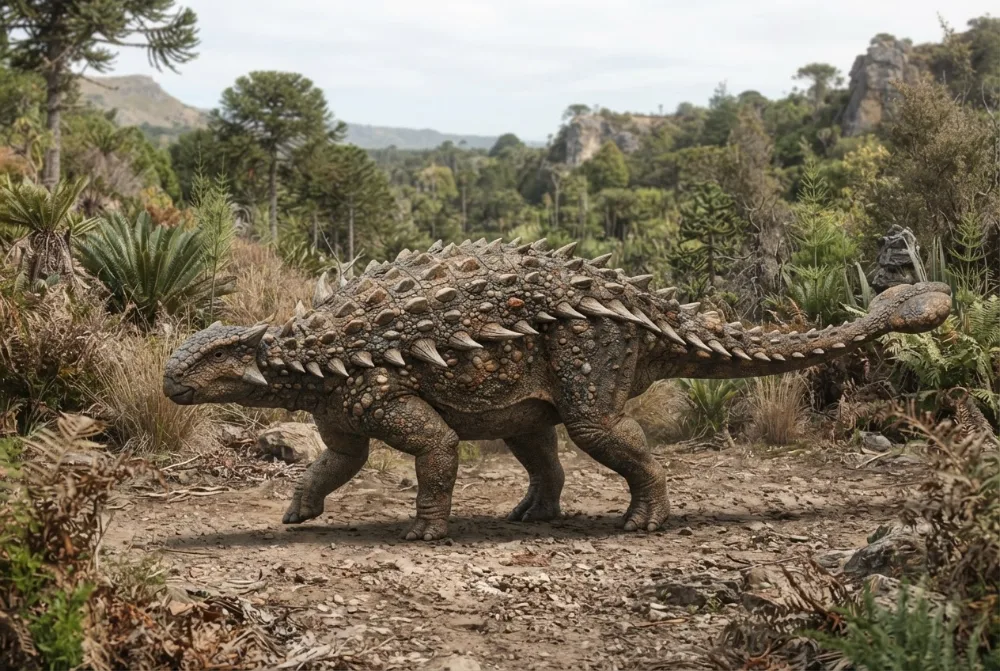
Sauroplites was an armoured dinosaur that walked on four legs and ate plants. Its back and hips were covered with a shield made of bony plates, like a suit of armour. It lived in what is now Inner Mongolia, China, during the Early Cretaceous period.14
Yabeerawo ddi?
Yali munene atya?
Yali muwanvu kwenkana wa?
Yali mugulumivu kwenkana wa?
 obuwanvu ng'embwa 6, ennyindo ku mukira🍌obuwanvu ng'amenvu 31 nga gaddiriŋŋana🏃yandidduse mita 100 mu sikonda 22 (omuntu asinga embiro yeetaaga 9.6)
Sauroplites yali munene atya bw'ogeraageranya ku GGWE?
Kubala kwokka mu browser yo. Tewali kiterekebwa wadde okusindikibwa wonna.
Yali wa mbiro kwenkana wa?


Ebyewuunyisa
Sauroplites had a special shield on its hips made of fused rosettes. Each rosette had one large central bony plate surrounded by a single ring of smaller plates. No other armoured dinosaur had this exact pattern.12
The largest bony plates on its back could be up to 40 centimetres (about 16 inches) long. The plates on its sides were about 30 centimetres (12 inches) across.1
The fossils of Sauroplites were discovered in 1930 by Swedish paleontologist Anders Birger Bohlin during an expedition in Inner Mongolia. The dinosaur was named and described by Bohlin in 1953.1
The original fossil bones of Sauroplites are lost today, but some casts (copies) are kept at the American Museum of Natural History in New York.1
For a long time, scientists thought Sauroplites might be a doubtful name because the fossils were so fragmentary. But in 2014, researcher Victoria Megan Arbour found a unique feature on the hip shield that proved it was a real, valid dinosaur.1
Ebibuuzo ebisinga okubuuzibwa ku Sauroplites
?How big was Sauroplites?
Nobody knows for sure because the fossils are very fragmentary. The largest bony plates on its back could be up to 40 centimetres (about 16 inches) long, but no complete skeleton has been found to estimate its full size.1
?What did Sauroplites eat?
Sauroplites was an herbivore, meaning it ate plants. It had a plant-eating dinosaur's body and teeth suited for chewing vegetation.1
?Is Sauroplites a dinosaur?
Yes, Sauroplites is a dinosaur. It is an ankylosaurian dinosaur from the Early Cretaceous of China.1
Eri abakugu mu dayinoso
- Erinnya lya ssaayansi
- Sauroplites
- Yatuumibwa
- Bohlin 19534
- Ekibinja
- Dayinoso ez'engabo
- Ekika / ekibinja
- Nodosauridae4
- Engabanya
- Ornithischia > Ankylosauria > Nodosauridae > Thyreophora4
- Emyaka gy'enjazi
- emyaka obukadde 121 okutuuka ku 113 (Aptian)4
- Ensi
- Cayina4
- Ebisigalira ebyazuulibwa
- 1 mu The Paleobiology Database4
- Okuzuulibwa
- Swedish paleontologist Anders Birger Bohlin discovered the fossils of Sauroplites in 1930 near Tebch in Inner Mongolia, during the Swedish-Chinese expeditions of Sven Hedin. He named and described the dinosaur in 1953.1
- Kikyakubaganyizibwako ebirowoozo
- Scientists are not sure whether Sauroplites belonged to the Nodosauridae family or the Ankylosauridae family. Some studies place it with nodosaurids because of its hip shield, but nodosaurids are rare in Asia.1
Ebituufu gye biva
- Sauroplites (en.wikipedia.org)
- PBDB Taxon (paleobiodb.org)
- Sauroplites — Facts, Size, Diet & Pronunciation | Types of Dinosaurs (typesofdinosaurs.com)
- Sauroplites in The Paleobiology Database (CC BY 4.0): emyaka, ebifo, ensengeka z'enjazi, engabanya.
Buli kituufu ku lupapula luno kirina ennamba eraga ensibuko yaakyo. Bwe tuba nga tukoze ensobi, tusonyiwe, ffe tuli bawagizi ba dayinoso, so si magazini ya ssaayansi. Tubuulire ku [email protected] tujja kugitereeza.
 Rex alumwa enjala! Dino Wiki pulojekiti ya taata eri mutabani we ayagala ennyo dayinoso, ya bwereere, tewali bulango era tewali bikulondoola. Abakulu basobola okuwa Rex akantu ak'okulya okuyamba okugikuuma ku mutimbagano.Liisa Rex
 Ankylosaurus
 Sauropelta
 Pinacosaurus
 Scutellosaurus
 Struthiosaurus
 Euoplocephalus
 Stegosaurus
 Iguanodon
 Archaeopteryx
 Giganotosaurus
 Microraptor
 Deinonychus