 Kwizi: Oli dayinoso ki?
 Olutalo lwa dayinoso
 Empaka z'emisinde gya dayinoso
 Emizannyo emitono egya dayinoso
 Alubaamu ya sitika
 Enkalala za dayinoso eza TOP
 Mpa ekyewuunyisa!
Yabeerawo ddi?

Yali munene atya?
Yali muwanvu kwenkana wa?
Yali mugulumivu kwenkana wa?
kuteebereza
Yali muzito kwenkana wa?
 obuwanvu nga kkapa 2 ab'awaka, ennyindo ku mukira🍌obuwanvu ng'amenvu 6 nga gaddiriŋŋana🪶obuzito butono okusinga kkapa ow'awaka🍌obuzito ng'obw'amenvu 8🪑mutono nnyo nga asobola okuyita wansi w'entebe🏃yandidduse mita 100 mu sikonda 19 (omuntu asinga embiro yeetaaga 9.6)
Sinosauropteryx yali munene atya bw'ogeraageranya ku GGWE?
Kubala kwokka mu browser yo. Tewali kiterekebwa wadde okusindikibwa wonna.
Yali wa mbiro kwenkana wa?


Ebyewuunyisa
Sinosauropteryx was the first feathered dinosaur discovered that was not directly related to birds.1
Scientists used Sinosauropteryx to figure out a dinosaur's color pattern for the first time ever.1
A fossil of Sinosauropteryx has a tiny lizard preserved in its stomach, showing what it ate for its last meal.1
Sinosauropteryx had over 50 very long tail bones, which made up about 60% of its body length.2
Its feathers were short and simple, like down feathers, not like the flight feathers of modern birds.2
Sinosauropteryx could not fly, but it could run fast on two legs, like an ostrich.2
One of the small mammals Sinosauropteryx ate, called Zhangheotherium, may have been venomous, with spurs on its ankles like a platypus.1
Ebibuuzo ebisinga okubuuzibwa ku Sinosauropteryx
?How big was Sinosauropteryx?
About 1.07 metres (3.5 feet) long and weighed around 0.55 kilograms (1.2 pounds). That is about as long as a skateboard but much lighter.31
?Did Sinosauropteryx have feathers?
Yes, it had a coat of thin, hair-like feathers. It was the first non-avian dinosaur discovered with evidence of feathers.13
?What did Sinosauropteryx eat?
It ate small animals like lizards, mammals, and insects. One fossil even has a tiny lizard preserved in its stomach.13
?When did Sinosauropteryx live?
It lived during the Early Cretaceous period, about 125 to 122 million years ago.13
?Where was Sinosauropteryx found?
Its fossils were found in Liaoning Province in northeastern China.13
?What color was Sinosauropteryx?
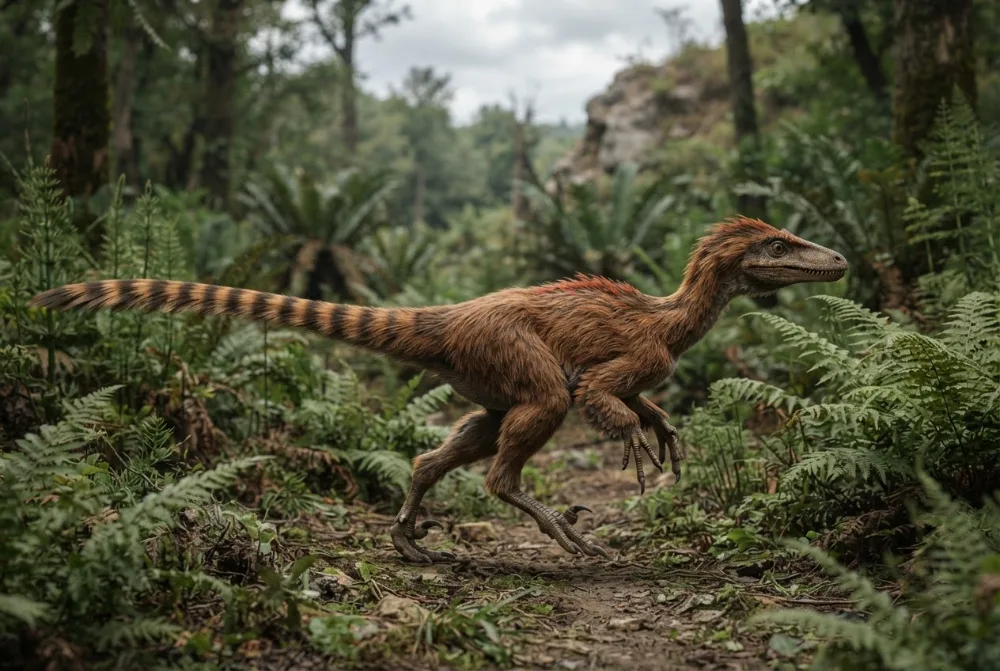
Scientists think it was reddish-brown with a light belly and dark and light bands on its tail, like a camouflage pattern.13
Eri abakugu mu dayinoso
- Erinnya lya ssaayansi
- Sinosauropteryx
- Yatuumibwa
- Ji and Ji 19965
- Ekibinja
- Dayinoso ezirya ennyama
- Ekika / ekibinja
- Sinosauropterygidae5
- Engabanya
- Theropoda5
- Emyaka gy'enjazi
- emyaka obukadde 126 okutuuka ku 120 (Barremian / Aptian)5
- Ensengeka z'enjazi
- Yixian5
- Ensi
- Cayina5
- Ebisigalira ebyazuulibwa
- 4 mu The Paleobiology Database5
- Okuzuulibwa
- A fossil hunter named Li Yumin found the first Sinosauropteryx remains in 1996 in Liaoning, China. He sold the fossils to museums, and scientists Ji and Ji named the dinosaur in the same year.15
Ebituufu gye biva
- Sinosauropteryx | Natural History Museum (nhm.ac.uk)
- On the Discovery of the earliest fossil bird in China (Sinosauropteryx (naturalhistory.si.edu)
- Sinosauropteryx (en.wikipedia.org)
- Dinosaurs - Sinosauropteryx prima - The Australian Museum (australian.museum)
- Sinosauropteryx in The Paleobiology Database (CC BY 4.0): emyaka, ebifo, ensengeka z'enjazi, engabanya.
Buli kituufu ku lupapula luno kirina ennamba eraga ensibuko yaakyo. Bwe tuba nga tukoze ensobi, tusonyiwe, ffe tuli bawagizi ba dayinoso, so si magazini ya ssaayansi. Tubuulire ku [email protected] tujja kugitereeza.
 Rex alumwa enjala! Dino Wiki pulojekiti ya taata eri mutabani we ayagala ennyo dayinoso, ya bwereere, tewali bulango era tewali bikulondoola. Abakulu basobola okuwa Rex akantu ak'okulya okuyamba okugikuuma ku mutimbagano.Liisa Rex
 Allosaurus
 Carnotaurus
 Dilophosaurus
 Giganotosaurus
 Compsognathus
 Paronychodon
 Stegosaurus
 Iguanodon
 Archaeopteryx
 Microraptor
 Deinonychus
 Baryonyx