 Kwizi: Oli dayinoso ki?
 Olutalo lwa dayinoso
 Empaka z'emisinde gya dayinoso
 Emizannyo emitono egya dayinoso
 Alubaamu ya sitika
 Enkalala za dayinoso eza TOP
 Mpa ekyewuunyisa!
Stenopterygius
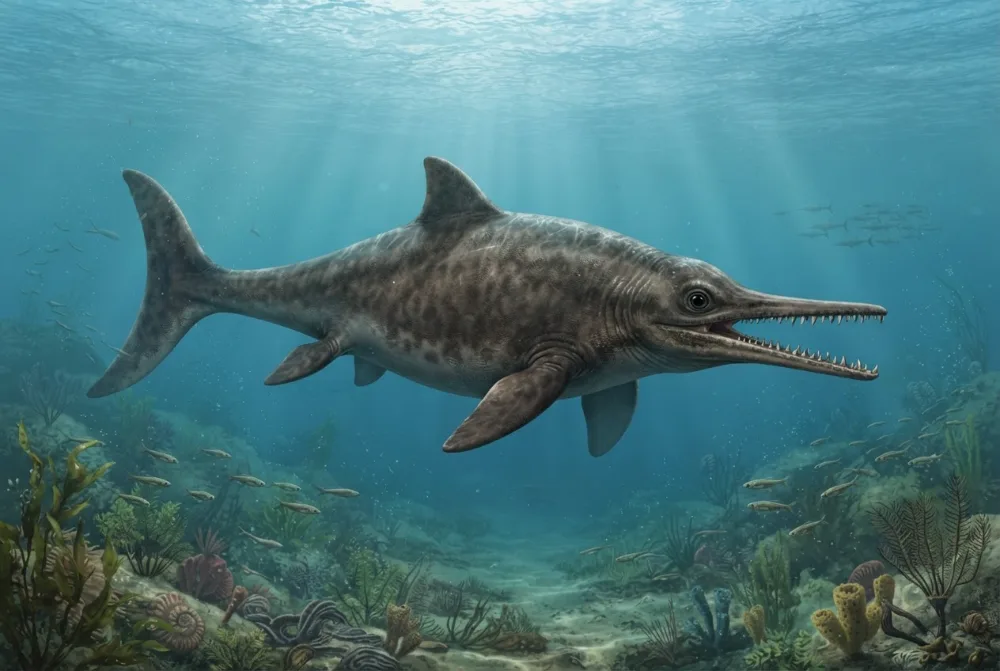
Stenopterygius was a fast-swimming marine reptile that lived in the Jurassic seas. It looked a bit like a dolphin but was actually an ichthyosaur, not a dinosaur. It had a long beak full of teeth and chased after fish and squid.1
Yabeerawo ddi?
Yali munene atya?
Yali muwanvu kwenkana wa?
 obuwanvu ng'embwa 4, ennyindo ku mukira🍌obuwanvu ng'amenvu 22 nga gaddiriŋŋana🏊yandiwuze obuwanvu bw'ekidiba ekinene (50 m) mu sikonda 3.8
Stenopterygius yali munene atya bw'ogeraageranya ku GGWE?
Kubala kwokka mu browser yo. Tewali kiterekebwa wadde okusindikibwa wonna.
Yali wa mbiro kwenkana wa?


Ebyewuunyisa
Stenopterygius had a small skull and narrow flippers compared to its relative Ichthyosaurus.1
One well-preserved fossil shows traces of skin, revealing that Stenopterygius was countershaded: darker on the back and lighter on the belly.1
Fossils of Stenopterygius often contain the remains of its last meal in the stomach area.1
The tail ended in a large, semicircular, leathery vertical fin, and it also had a triangular dorsal fin on its back.1
Stenopterygius lived during the Early and Middle Jurassic, about 183 to 173 million years ago.1
The type specimen of Stenopterygius quadriscissus is a complete skeleton that even preserved a very large embryo inside.1
Ebibuuzo ebisinga okubuuzibwa ku Stenopterygius
?How big was Stenopterygius?
Stenopterygius was a medium sized ichthyosaur, with most species reaching about 3.5 metres long, while the largest, S. uniter, could exceed 4 metres.1
?What did Stenopterygius eat?
Stenopterygius hunted fish, cephalopods, and other animals in the open sea. Fossils often contain the remains of its last meal in the stomach area.1
?Was Stenopterygius a dinosaur?
No, Stenopterygius was an ichthyosaur, a marine reptile, not a dinosaur. It looked a bit like a dolphin but was actually a different group of reptiles.1
?Did Stenopterygius give birth to live young?
Yes, Stenopterygius gave birth to live young, and one famous fossil shows a mother that died in childbirth. It preferred tail-first births, like modern dolphins and whales.1
Eri abakugu mu dayinoso
- Erinnya lya ssaayansi
- Stenopterygius
- Yatuumibwa
- Jaekel 19043
- Ekibinja
- Ikisiyosawulu
- Ekika / ekibinja
- Thunnosauria3
- Engabanya
- Ichthyosauria > Ichthyosauromorpha3
- Emyaka gy'enjazi
- emyaka obukadde 184 okutuuka ku 171 (Toarcian / Aalenian)3
- Ensengeka z'enjazi
- Posidonia Shale, Opalinuston, Beacon Limstone3
- Ensi
- Bugirimaani, Bungereza, Lukusembaagi, Bufalansa3
- Ebisigalira ebyazuulibwa
- 47 mu The Paleobiology Database3
- Okuzuulibwa
- The species was first named as Ichthyosaurus quadriscissus by Quenstedt in 1856. Otto Jaekel gave it its own genus, Stenopterygius, in 1904.1
- Kikyakubaganyizibwako ebirowoozo
- Scientists are still debating exactly how many species of Stenopterygius existed, because the fossils are often incomplete.2
Ebituufu gye biva
- Stenopterygius (en.wikipedia.org)
- First Diagnostic Marine Reptile Remains from the Aalenian (Middle Jurassic): A New Ichthyosaur from Southwestern Germany | PLOS One (journals.plos.org)
- Stenopterygius in The Paleobiology Database (CC BY 4.0): emyaka, ebifo, ensengeka z'enjazi, engabanya.
Buli kituufu ku lupapula luno kirina ennamba eraga ensibuko yaakyo. Bwe tuba nga tukoze ensobi, tusonyiwe, ffe tuli bawagizi ba dayinoso, so si magazini ya ssaayansi. Tubuulire ku [email protected] tujja kugitereeza.
 Rex alumwa enjala! Dino Wiki pulojekiti ya taata eri mutabani we ayagala ennyo dayinoso, ya bwereere, tewali bulango era tewali bikulondoola. Abakulu basobola okuwa Rex akantu ak'okulya okuyamba okugikuuma ku mutimbagano.Liisa Rex
 Ichthyosaurus
 Platypterygius
 Khudiakovia
 Ophthalmosaurus
 Chonespondylus
 Cymbospondylus
 Dilophosaurus
 Dorygnathus
 Lufengosaurus
 Scutellosaurus
 Yunnanosaurus
 Sinosaurus